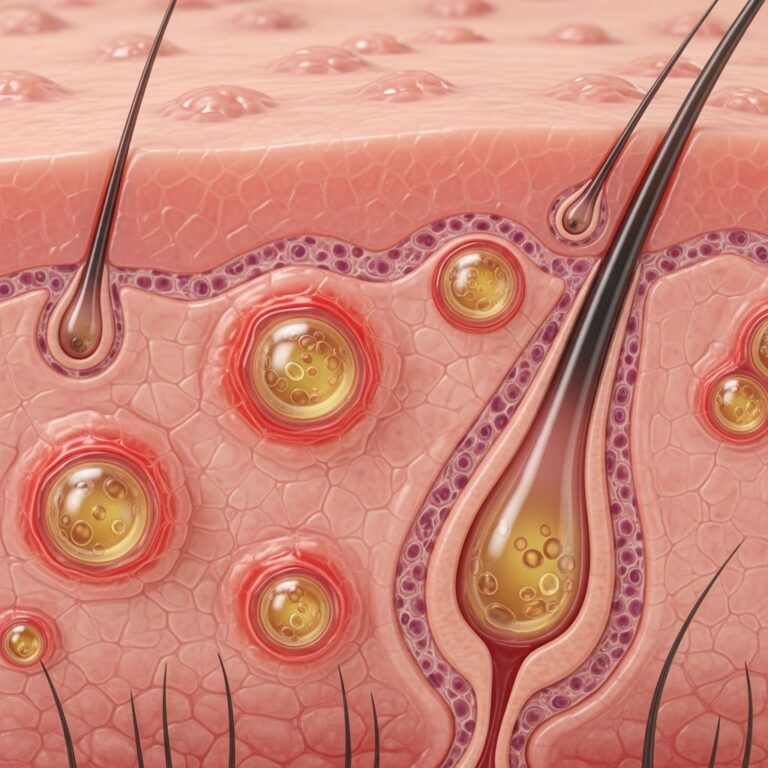
Palmoplantar Keratoderma Nagashima Type: What You Need To Know
Understanding Nagashima-type palmoplantar keratoderma: genetics, symptoms, diagnosis, and management of this rare skin disorder.
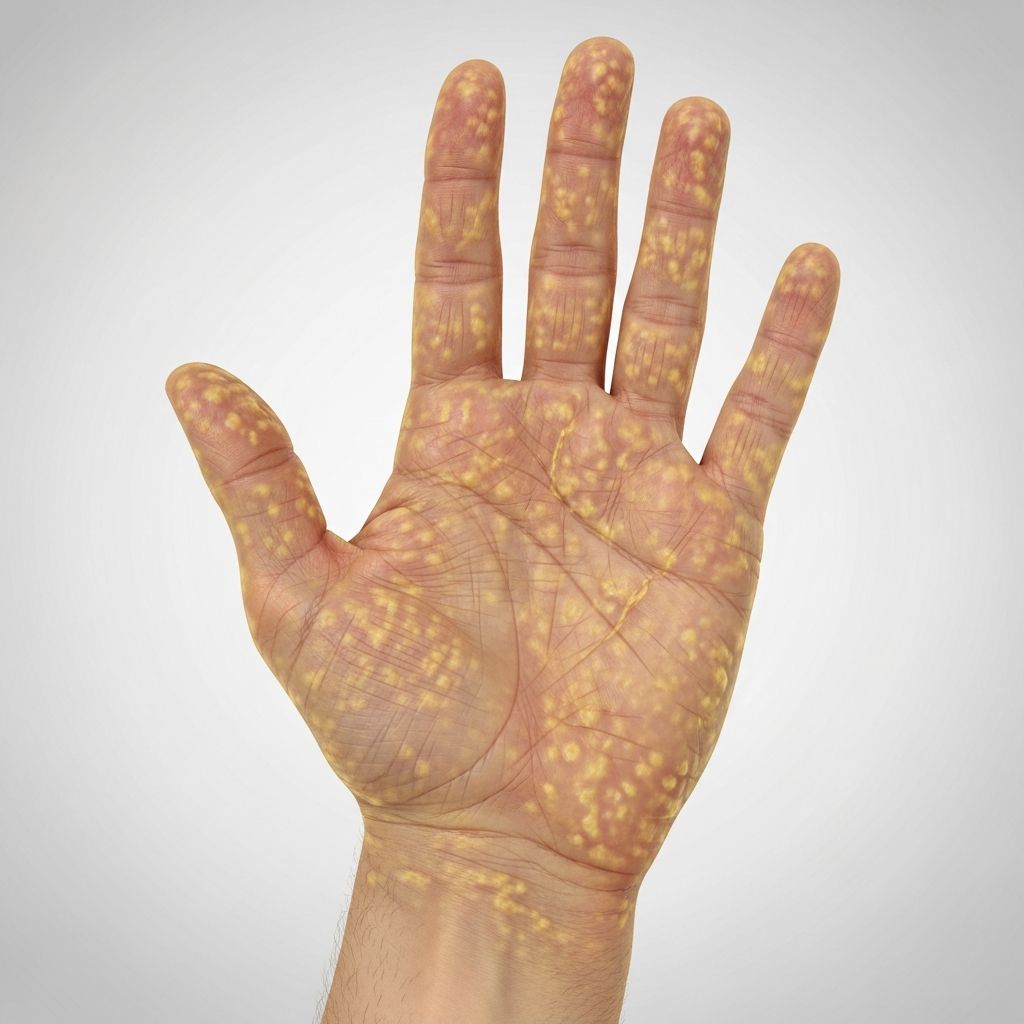
Palmoplantar keratoderma Nagashima type (NPPK) is an autosomal recessive nonsyndromic diffuse palmoplantar keratosis characterised by well-demarcated mild thickening and redness of the palms and soles, often extending to dorsal surfaces in a transgradient pattern. This rare genetic skin disorder primarily affects individuals of East Asian descent and results from mutations in the SERPINB7 gene.
What is palmoplantar keratoderma Nagashima type?
Palmoplantar keratoderma Nagashima type (PPKN or NPPK, MIM 615598) represents a distinct form of hereditary palmoplantar keratoderma (PPK), first described in Japan and prevalent in East Asia. It manifests as diffuse hyperkeratosis with associated redness, expanding onto the dorsal surfaces of hands and feet, wrists, ankles, and Achilles tendon areas. Unlike more severe conditions such as mal de Meleda, NPPK presents milder symptoms but shares similar transgrediens features, where keratosis extends beyond typical palmoplantar boundaries.
The condition arises from biallelic loss-of-function mutations in SERPINB7, a gene on chromosome 18q21 encoding a serine protease inhibitor expressed in the upper epidermis. This protein normally inhibits protease activity to maintain skin barrier integrity; its deficiency leads to unchecked protease action, keratinocyte degradation, and barrier dysfunction, culminating in hyperkeratosis, swelling, and whitening. NPPK does not progress with age and spares mucous membranes, nails, and hair.
Who gets palmoplantar keratoderma Nagashima type?
NPPK follows an autosomal recessive inheritance pattern, requiring two mutated gene copies (homozygous or compound heterozygous). It predominantly affects East Asians, with high carrier frequencies reported in Japanese populations. Symptoms typically emerge in infancy or early childhood, starting as erythema and mild hyperkeratosis on palms and soles. Family history is key, though sporadic cases may occur due to consanguinity or high carrier rates in endemic areas.
- Infants: Initial red, thickened skin on palms/soles.
- Children: Extension to dorsal hands/feet (transgrediens).
- Adults: Stable mild-moderate hyperkeratosis; elbows/knees occasionally involved.
Clinical features
The hallmark of NPPK is well-demarcated erythema with mild to moderate diffuse hyperkeratosis covering the entire palm and sole, extending transgradiently to dorsal hands, feet, inner wrists, ankles, and Achilles tendon. A characteristic white spongy degeneration appears after 10-minute water immersion, reflecting barrier disruption.
Additional features include:
- High prevalence of palmoplantar hyperhidrosis, tinea pedis, and odor.
- Frequent elbow/knee involvement; rare atypical sites like lumbar, ears, nails.
- Painful fissuring and cracking from thickened skin.
- No systemic associations; non-progressive.
Electron microscopy reveals keratinocyte lysis, excessive exocytosis, and lipid inclusions in the granular layer. T-cell infiltration (primarily CD4+) suggests an inflammatory component exacerbating hyperkeratosis.
Diagnosis
Diagnosis relies on clinical history, examination, and confirmatory tests. Suspicion arises from transgradient palmoplantar erythema/hyperkeratosis with white sponginess post-water exposure.
| Method | Findings |
|---|---|
| Clinical Exam | Diffuse red hyperkeratosis; transgrediens; water-induced whitening |
| Skin Biopsy | Non-epidermolytic hyperkeratosis, hypergranulosis, eccrine gland hyperplasia, mild lymphocytic infiltrate |
| Genetic Testing | SERPINB7 loss-of-function mutations (e.g., homozygous p.Ser126Leu) |
Histopathology is nonspecific but shows orthokeratotic hyperkeratosis, thickened spinous/granular layers, and superficial dermal T-cell infiltrate without epidermolysis. Immunohistochemistry confirms reduced SERPINB7 and elevated keratins KRT1/KRT14.
Differential diagnosis
NPPK must be differentiated from other diffuse transgradient PPKs:
| Condition | Key Distinctions |
|---|---|
| Mal de Meleda (SLURP1) | Severer hyperkeratosis, autoamputation risk, systemic features |
| Unna-Thost PPK | No erythema/transgrediens; epidermolytic variants |
| Olmsted Syndrome | Mutilating keratoderma, periorificial lesions |
| Vörner PPK | Epidermolytic hyperkeratosis on biopsy |
| Acquired PPK | Late onset, underlying malignancy/ectodermosis |
Related Stories



Genetic testing resolves ambiguities, as SERPINB7 mutations are pathognomonic for NPPK.
Clinicopathologic characterisation
Biopsies exhibit:
- Epidermal: Hyperkeratosis, incomplete keratosis, hypergranulosis, acanthosis.
- Dermal: Mild mononuclear infiltrate, eccrine hyperplasia.
- EM: Keratinocyte lysis between desmosomes, lipid bodies.
Inflammation correlates with severity; oxidative stress may worsen microenvironment. CD4+ T-cells predominate, hinting at immune-mediated exacerbation.
Pathogenesis
SERPINB7 deficiency unleashes serine proteases, degrading desmosomes and corneodesmosomes, impairing barrier function. This permits water ingress, causing swelling/whitening, and triggers hyperproliferation. T-cell infiltration amplifies inflammation. Keratinocyte stress from proteases leads to hyperkeratosis as a compensatory response.
Treatment
No curative therapy exists; management is symptomatic.
- Topicals: Urea/salicylic acid emollients, adapalene, vitamin D3 analogues (variable efficacy).
- Immunosuppressives: Topical steroids/immunomodulators for inflammation.
- Supportive: Antifungals for tinea, antiperspirants for hyperhidrosis.
- Emerging: Gene therapy potential untested.
Daily moisturizing prevents fissuring; keratolytics soften plaques.
Investigations
- Biopsy for histopathology.
- Genetic sequencing of SERPINB7.
- Patch testing to exclude contact dermatitis.
Possible complications
- Painful fissures/cracks.
- Secondary infections (tinea, bacterial).
- Odor from hyperhidrosis.
- Functional impairment (grip/walking).
Prognosis
Excellent; non-progressive, stable post-childhood. No malignancy risk or extracutaneous spread.
Frequently Asked Questions
Is palmoplantar keratoderma Nagashima type contagious?
No, it is a genetic disorder, not infectious.
Does NPPK affect nails or hair?
Typically no; rare nail involvement reported.
Can NPPK be cured?
No cure; symptomatic management only.
Is genetic testing necessary?
Recommended for confirmation and family counseling.
What causes the white spongy skin after water exposure?
Barrier dysfunction from SERPINB7 loss allows water permeation.
References
- KEGG DISEASE: Palmoplantar keratoderma, Nagashima type — KEGG. 2023. https://www.kegg.jp/entry/H02264
- Nagashima-Type Palmoplantar Keratosis: Clinical Characteristics… — PMC/NCBI. 2021-02-04. https://pmc.ncbi.nlm.nih.gov/articles/PMC7861918/
- Palmoplantar keratoderma Nagashima type — DermNet NZ. 2023. https://dermnetnz.org/topics/palmoplantar-keratoderma-nagashima-type
- Palmoplantar Keratoderma, Nagashima Type — Rare Diseases Health Center. 2023. https://www.rarediseaseshealthcenter.com/condition/Palmoplantar-keratoderma,-Nagashima-type/c/117974
- Palmoplantar Keratodermas — Foundation for Ichthyosis & Related Skin Types. 2023. https://www.firstskinfoundation.org/types-of-ichthyosis/palmoplantar-keratodermas
Similar Articles








Read full bio of medha deb