Palmoplantar Keratoderma: Diagnosis, Causes & Treatment Guide
Comprehensive guide to palmoplantar keratoderma: causes, types, symptoms, diagnosis, and effective management strategies.
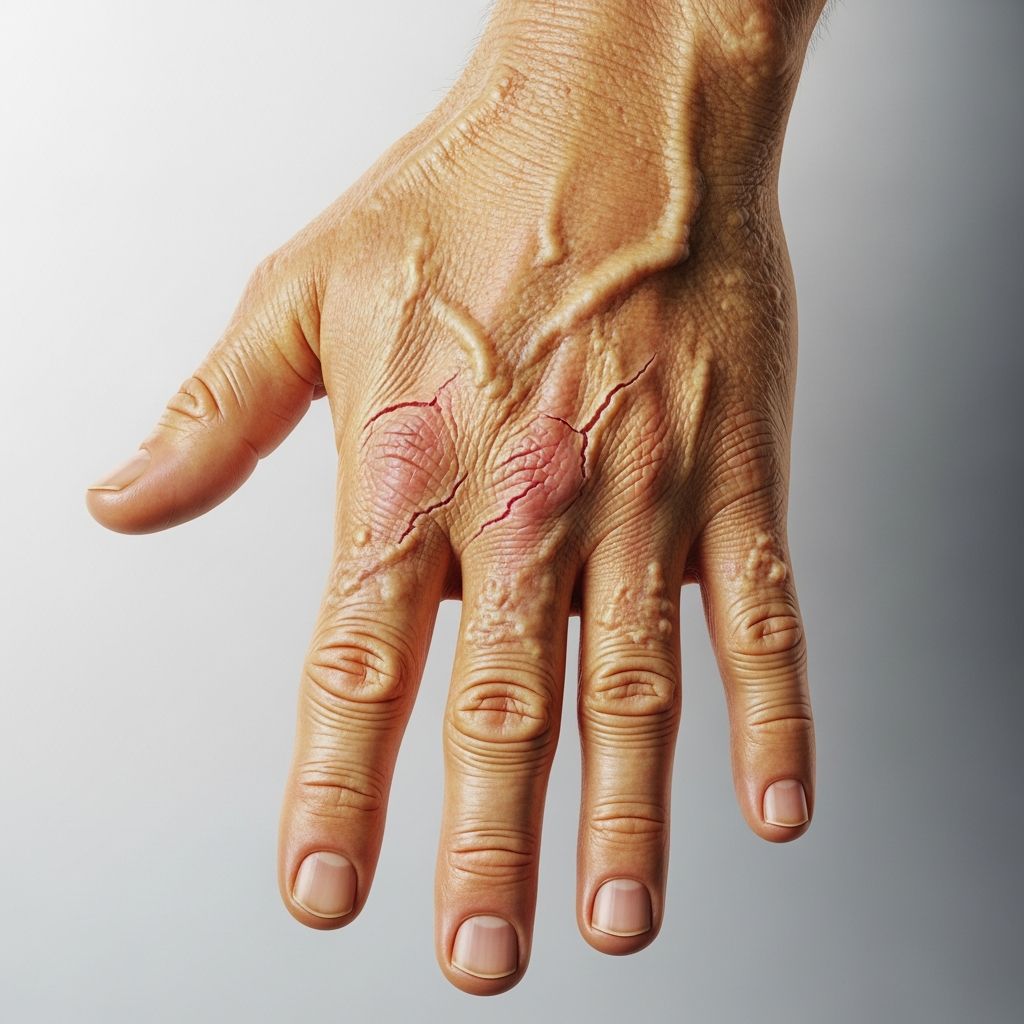
Palmoplantar keratoderma (PPK) refers to a diverse group of disorders characterized by abnormal thickening of the skin (hyperkeratosis) on the palms and soles. These conditions can be hereditary or acquired, often leading to painful fissures, secondary infections, and impaired daily function.
What is palmoplantar keratoderma?
Palmoplantar keratodermas encompass inherited and acquired disorders marked by persistent epidermal hyperkeratosis primarily affecting the palms and soles. They may be localized or involve other body sites and can be isolated or part of syndromes impacting organs like the eyes, ears, or cardiovascular system. Secondary infections are frequent due to skin barrier disruption.
The term ‘tylosis’ is sometimes used interchangeably with palmoplantar hyperkeratosis. Classification considers skin involvement extent, inheritance patterns, and syndromic associations.
Who gets palmoplantar keratoderma?
Hereditary PPK typically presents in infancy or early childhood, often with family history, though sporadic mutations occur. Acquired forms develop later, linked to underlying conditions.
- Hereditary: Autosomal dominant or recessive inheritance; affects all ages but onset is early.
- Acquired: Common in adults with comorbidities like chronic dermatitis or malignancies.
Severity varies within families, with some members showing mild symptoms and others severe disability.
What causes palmoplantar keratoderma?
Hereditary PPK results from mutations in keratin genes (e.g., KRT1, KRT9, KRT16) essential for epidermal integrity. Acquired PPK arises from chronic insults or systemic diseases.
Hereditary causes
- Mutations disrupting keratin filament assembly lead to epidermal fragility and compensatory hyperkeratosis.
- Syndromic forms associate with extracutaneous features, e.g., hearing loss or cardiomyopathy.
Acquired causes
Triggered by:
- Chronic contact dermatitis or friction.
- Infections like Norwegian scabies.
- Systemic conditions: myxoedema, lymphedema, myxedema.
- Paraneoplastic: Associated with cancers (bladder, breast, colon, esophagus, lung).
What are the clinical features of palmoplantar keratoderma?
Core feature is well-demarcated yellow-brown hyperkeratosis on palms/soles, causing pain, fissuring, and infection risk. Variants differ in pattern and associations.
Diffuse PPK
Uniform thickening covering entire palms/soles, often with erythematous borders. May blister (epidermolytic) or remain stable (non-epidermolytic).
Focal/striate PPK
Hyperkeratosis confined to pressure sites or linear along flexure lines.
Punctate PPK
Small, hard papules (cobblestone appearance), worsening with water exposure in some types.
Common symptoms:
- Painful fissuring impairing gait.
- Hyperhidrosis or anhidrosis.
- Nail dystrophy (thickening, ridging).
- Secondary bacterial/fungal infections, athlete’s foot.
Syndromic features
| Syndrome | Key Features |
|---|---|
| Vohwinkel syndrome | Mutilating keratoderma, starfish-shaped constrictions, hearing loss. |
| Mal de Meleda | Diffuse PPK with periorificial involvement, auto-inflammation. |
| Olmsted syndrome | Mutilating PPK, periorificial plaques, periodontitis. |
| Tyylosis with esophageal cancer | PPK + high esophageal carcinoma risk. |
Diagnosis of palmoplantar keratoderma
Primarily clinical, supported by family history, histopathology, and genetic testing. Skin biopsy shows compact orthokeratosis or epidermolytic hyperkeratosis. Molecular analysis confirms specific mutations.
- Differentiate from psoriasis, eczema, or pachydermoperiostosis.
- Screen for syndromic features and malignancies in acquired cases.
Treatment of palmoplantar keratoderma
No cure exists; management is symptomatic, targeting hyperkeratosis, pain, and complications. Multidisciplinary approach recommended.
General measures
- Emollients: Frequent application (e.g., petroleum-based) to hydrate and soften skin.
- Keratolytics: Salicylic acid (5-10%), urea (10-40%), lactic acid to reduce thickness.
- Physical removal: Paring, soaking, pumice after baths.
- Infection control: Antimicrobials for bacterial/fungal superinfections.
Advanced therapies
- Topical retinoids: Tretinoin 0.05-0.1% for mild cases, though irritating.
- Oral retinoids: Acitretin or isotretinoin mainstay for severe/refractory PPK; monitor lipids, liver.
- Other: Calcipotriol, botulinum toxin for hyperhidrosis, PUVA phototherapy.
Related Stories



Surgical options (debridement, grafting) for mutilating forms. Custom orthotics alleviate pain.
Acquired PPK
Treat underlying cause (e.g., malignancy, infection); skin improves with resolution.
Prevention for palmoplantar keratoderma
Hereditary forms unpreventable, but early intervention prevents complications. Avoid irritants, manage hyperhidrosis with antiperspirants or iontophoresis.
- Daily foot care: Soaks, emollients, protective footwear.
- Genetic counseling for families.
Outlook for palmoplantar keratoderma
Chronic, relapsing condition. Treatments provide symptomatic relief but require lifelong management. Prognosis varies: isolated PPK manageable; syndromic forms carry risks (e.g., cancer, auto-amputation).
Complications include disability, infections, and syndromic morbidity. Regular dermatology follow-up essential.
Frequently Asked Questions
Is palmoplantar keratoderma contagious?
No, PPK is genetic or acquired from non-infectious causes; secondary infections require treatment but are not the primary condition.
Can palmoplantar keratoderma be cured?
No cure, but symptoms controlled with consistent therapy. Oral retinoids offer best improvement for hereditary forms.
Does palmoplantar keratoderma affect nails?
Yes, often causing thickening, discoloration, or dystrophy due to proximity and shared pathology.
Is palmoplantar keratoderma hereditary?
Many forms are, via autosomal dominant/recessive patterns; acquired types link to other diseases.
What does palmoplantar keratoderma look like?
Thickened, waxy, yellow-brown skin on palms/soles with possible red margins, fissures, or papules.
How is palmoplantar keratoderma treated?
Emollients, keratolytics, retinoids, infection management. Severe cases use systemic retinoids.
Can palmoplantar keratoderma cause cancer?
Certain hereditary types (e.g., tylosis) increase esophageal cancer risk; acquired PPK may signal internal malignancy.
References
- Palmoplantar Keratodermas – Dermatologic Disorders — MSD Manuals Professional Edition. 2026. https://www.msdmanuals.com/professional/dermatologic-disorders/cornification-disorders/palmoplantar-keratodermas
- Palmoplantar Keratodermas — Merck Manuals Professional Edition. 2026. https://www.merckmanuals.com/professional/dermatologic-disorders/cornification-disorders/palmoplantar-keratodermas
- Palmoplantar Keratodermas — Foundation for Ichthyosis & Related Skin Types. Accessed 2026. https://www.firstskinfoundation.org/types-of-ichthyosis/palmoplantar-keratodermas
- Palmoplantar keratoderma — British Association of Dermatologists Skin Health Info. Accessed 2026. https://www.skinhealthinfo.org.uk/condition/palmoplantar-keratoderma/
- Diagnosis and Management of Inherited Palmoplantar Keratodermas — PMC (PubMed Central). 2022-05-20. https://pmc.ncbi.nlm.nih.gov/articles/PMC9128927/
- How To Diagnose And Manage Hereditary Palmoplantar Keratodermas — HMP Global Learning Network. Accessed 2026. https://www.hmpgloballearningnetwork.com/site/podiatry/how-diagnose-and-manage-hereditary-palmoplantar-keratodermas
Similar Articles








Read full bio of Sneha Tete