Papuloerythroderma Of Ofuji: What You Need To Know
Rare pruritic skin disorder with deck-chair sign: causes, diagnosis, and treatment insights.
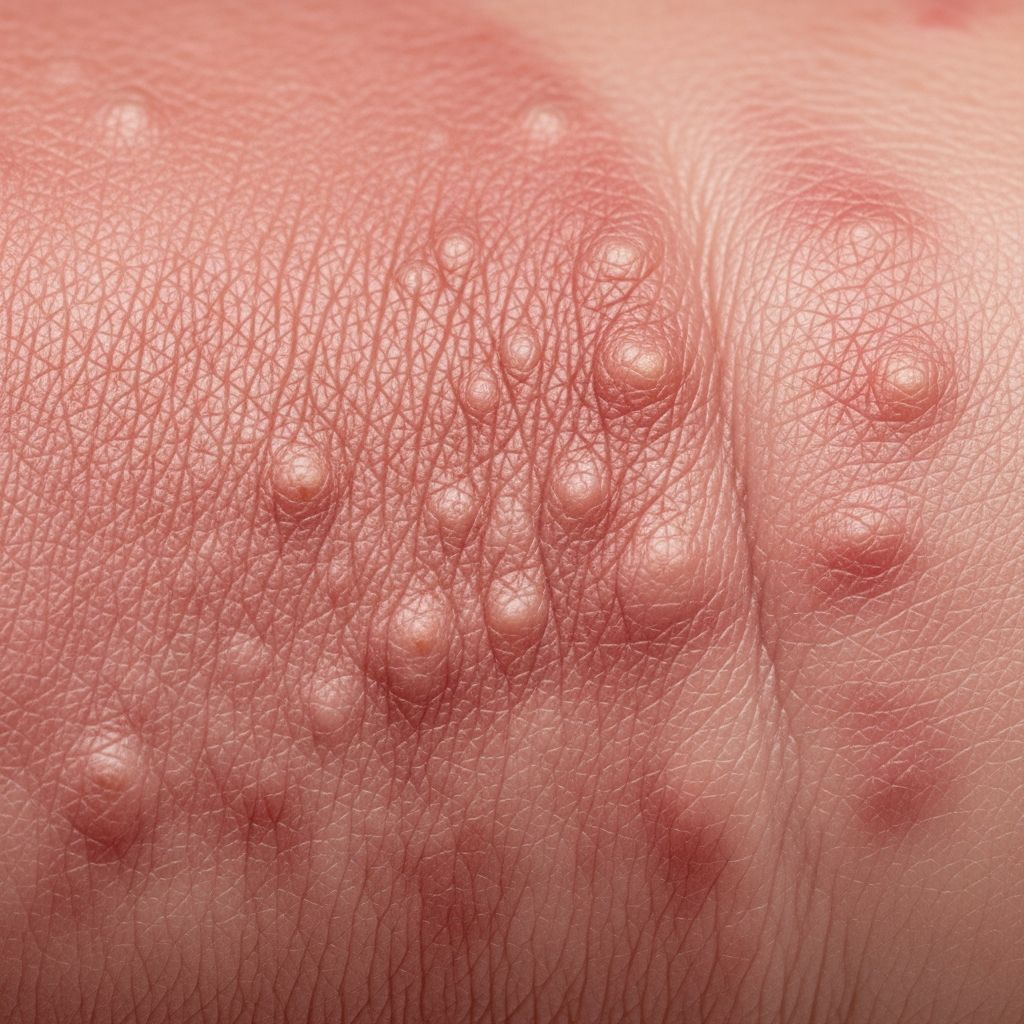
Papuloerythroderma of Ofuji (PEO) is a rare inflammatory skin disorder defined by widespread pruritic papular eruptions that coalesce into larger plaques while sparing skin folds, creating the pathognomonic ‘deck-chair sign’. First described in 1984 in Japan, PEO predominantly affects elderly men over 55 years, with a higher incidence in Asian populations but cases reported worldwide.
What is papuloerythroderma of Ofuji?
Papuloerythroderma of Ofuji represents a distinctive clinical entity characterized by the coalescence of flat-topped, polygonal papules into erythrodermic plaques across the body, notably sparing the flexural areas such as axillae, groin, and antecubital/posterior knee fossae—resulting in the ‘deck-chair sign’. This sparing pattern mimics the exposed fabric of a deck chair, distinguishing PEO from other erythrodermic conditions. The eruption typically involves the trunk, extremities, and sometimes the head and neck, with intense pruritus as a hallmark symptom.
While initially identified in Japanese patients, subsequent reports confirm its occurrence in diverse ethnic groups, including Northern Europeans. The disease’s rarity—fewer than 200 cases documented globally—complicates its recognition, often leading to diagnostic delays exceeding one year. Laboratory findings commonly include peripheral eosinophilia, elevated serum IgE, and lymphopenia, supporting an immune-mediated pathogenesis.
Who gets papuloerythroderma of Ofuji?
PEO primarily affects individuals over 55 years, with a marked male predominance (male-to-female ratio approximately 4:1). It is most frequently reported in Japan, though cases span various ethnicities. Patients are often otherwise healthy, but associations with atopy occur in about 20%.
Risk factors include:
- Age >55 years: Nearly all cases.
- Male gender: Predominant demographic.
- Asian descent: Especially Japanese, but not exclusive.
- Atopy history: Elevated IgE and Th2 skew in ~20%.
- Underlying conditions: Malignancies, infections, or drugs in secondary forms.
Causes
The aetiology of PEO remains incompletely elucidated, categorized as primary (idiopathic) or secondary. Roughly 50% of cases are idiopathic, while the remainder link to identifiable triggers. Immune dysregulation, particularly involving T-helper 2 (Th2) and Th22 cells, underlies the condition, promoting eosinophilia and IgE elevation.
Primary PEO
Idiopathic cases lack identifiable causes, potentially representing a distinct entity or early cutaneous T-cell lymphoma (CTCL) variant. Debate persists on whether PEO is independent or a shared phenotype across conditions.
Secondary PEO
Associated factors include:
- Malignancies: Gastric carcinoma, hepatocellular carcinoma, colon adenocarcinoma, prostate cancer, chronic lymphocytic leukaemia (CLL); ~25-30% of cases. Strong CTCL link raises paraneoplastic concerns.
- Infections: Hepatitis C virus (HCV), HIV; resolution follows viral suppression.
- Drugs: Furosemide, aspirin, diltiazem, didanosine, nicardipine, isoniazid, ranitidine, leuprorelin, ticlopidine, eperisone, etretinate; Th2 hypersensitivity implicated.
- Atopy: Eczema or allergic history in 20%; Th2/Th22 axis overlap.
Screening for these is mandatory, given malignancy associations.
Clinical features
PEO manifests as intensely pruritic, flat-topped polygonal papules (1-2 mm) with pink-to-brown hues, coalescing into cobblestone-like plaques covering >80% body surface, evolving to erythroderma. The deck-chair sign—sparing of folds—is pathognomonic.
| Feature | Description |
|---|---|
| Main Eruption | Pruritic papules coalescing to plaques on trunk/extremities |
| Deck-chair sign | Sparing of folds (axillae, groin) |
| Skin tones | Pink/red (Fitzpatrick I-III); violaceous/brown (IV-VI) |
| Other | Excoriations, lichenification, fine scaling |
Related Stories



In darker skin, erythema may appear violaceous or brown, with lichenification predominating. Complications: secondary bacterial infections from scratching; delayed CTCL diagnosis.
Diagnosis
Primary PEO is a diagnosis of exclusion, requiring ruling out secondary causes. Torchia et al. criteria are pivotal:
- Widespread papuloerythroderma sparing folds (deck-chair sign).
- Absence of lentigo-like lesions or purpura.
- Histology lacking atypical lymphocytes.
- No blood/nodal involvement by CTCL.
Supporting features: age >55, male, eosinophilia, high IgE, lymphopenia. Histology shows spongiotic dermatitis, perivascular lymphocytic/histiocytic/eosinophilic infiltrate; exocytosis present but lacks epidermotropism of CTCL. Flow cytometry and TCR clonality exclude lymphoma.
Differential diagnosis includes erythrodermic psoriasis, pityriasis rubra pilaris, drug eruptions, CTCL (mycosis fungoides), Sézary syndrome.
Investigations
To exclude secondary causes:
- Blood tests: FBC (eosinophilia, lymphopenia), IgE, LFTs, viral serology (HCV, HIV), tumour markers.
- Imaging: CT chest/abdomen/pelvis for malignancy.
- Skin biopsy: Histology, IHC, clonality.
- Other: Endoscopy/colonoscopy if GI symptoms.
All patients need malignancy/infection screening.
Management
Treatment targets symptoms and underlying causes.
- Secondary PEO: Remove offending drugs, treat infections/malignancies; rapid resolution often follows.
- Idiopathic PEO: Topical/oral corticosteroids (first-line, e.g., prednisone 0.5-1 mg/kg). PUVA/UVB phototherapy effective. Immunosuppressants (cyclosporine, methotrexate) for refractory cases.
Response varies; long-term therapy often needed.
Prevention
PEO is generally not preventable. Avoid known culprit drugs permanently; update records. Inform atopics, infection, or malignancy patients of risks.
Outcome
Idiopathic PEO remits in ~2.6 years (range 1-4). Secondary cases resolve faster with cause treatment. Relapses possible; monitor for CTCL evolution.
Frequently Asked Questions (FAQs)
What causes the deck-chair sign in PEO?
Skin folds are spared due to lower temperature/humidity, inhibiting papule formation.
Is PEO a type of cancer?
No, but strongly associated with malignancies (25-30%); screen thoroughly. May precede CTCL.
How is PEO treated?
Corticosteroids primary; treat underlying causes in secondary cases. Phototherapy for refractory idiopathic PEO.
Does PEO go away on its own?
Idiopathic cases often remit in 2-3 years; secondary resolve faster with intervention.
Who is at risk for PEO?
Elderly men >55, especially Asian; atopics or those on certain drugs.
References
- Papuloerythroderma of Ofuji — DermNet NZ. 2023-10-15. https://dermnetnz.org/topics/papuloerythroderma-of-ofuji
- Papuloerythroderma of Ofuji — PubMed (Clin Dermatol). 2021-04-01. https://pubmed.ncbi.nlm.nih.gov/34272018/
- Papuloerythroderma of Ofuji — NCBI StatPearls. 2023-07-17. https://www.ncbi.nlm.nih.gov/books/NBK539755/
- Papuloerythroderma of Ofuji — VisualDx. 2019-08-29. https://www.visualdx.com/visualdx/diagnosis/papuloerythroderma+of+ofuji
- Papuloerythroderma of Ofuji — Wikipedia. 2024-01-01. https://en.wikipedia.org/wiki/Papuloerythroderma_of_Ofuji
Similar Articles








Read full bio of Sneha Tete