Parakeratosis Pustulosa In Children: What You Need To Know
Rare childhood skin disorder affecting nails and fingertips: symptoms, causes, diagnosis, and management strategies.
Parakeratosis pustulosa (PP), also known as Hjorth-Sabouraud disease, is a rare, benign, self-limiting inflammatory skin disorder primarily affecting the distal fingers and toes in young children.
It typically manifests as erythematous, scaly plaques around the nail apparatus, leading to nail dystrophy. The condition is more common in girls and often involves the thumb or index finger on the hands and the great toe on the feet. While not itchy, it can cause mild pain and cosmetic concerns due to nail deformation.
What is parakeratosis pustulosa?
Parakeratosis pustulosa is a distinctive dermatological entity characterized by a chronic eczematoid eruption localized to the fingertips, particularly near the free margin of the nail. It begins with redness under the nail’s free edge, progressing to swelling of the nail fold, loss of the cuticle, and subungual hyperkeratosis that lifts and deforms the nail plate, resembling a ‘gaping toecap’.
Clinically, it presents as psoriasiform or eczematous lesions with occasional pustules. The nail shows onycholysis (separation from the bed), pitting, ridging, and thickening. Skin findings include hyperkeratosis, parakeratosis, and mild acanthosis on histopathology. PP is considered a clinical phenotype possibly overlapping with psoriasis, atopic dermatitis, or contact dermatitis rather than a unique disease.
In a study of 20 pediatric patients, complete resolution occurred in over half, while others evolved into psoriasis or persistent dermatitis. The protracted course features recurrences despite treatment.
Who gets parakeratosis pustulosa?
Parakeratosis pustulosa exclusively affects children, with onset typically before age 10, and is more prevalent in girls (up to 91 cases reviewed showed female predominance). It commonly involves one or a few digits: thumbs and index fingers on hands, great toes on feet.
Factors like thumb-sucking may contribute, as seen in case reports where cessation led to improvement. Family history is usually non-contributory, and no genetic inheritance is confirmed, though links to psoriasis suggest possible predisposition.
- Age: Infants to pre-adolescents
- Gender: Girls > boys
- Sites: Distal phalanges, nail apparatus
- Prevalence: Rare; exact incidence unknown
Clinical features
The hallmark is an erythematous, scaly patch at the nail’s hyponychium extending to the proximal nail fold. Thickened skin elevates the nail, causing onycholysis and dystrophy. Pustules may appear but are not always present.
Symptoms are minimally symptomatic—no pruritus, occasional tenderness. Progression: redness → swelling → hyperkeratosis → nail changes. On feet, similar involvement of hallux.
| Feature | Description |
|---|---|
| Skin | Scaly, erythematous plaques; occasional pustules |
| Nail | Subungual hyperkeratosis, onycholysis, pitting, ridging |
| Symptoms | Mild pain; no itch |
| Duration | Chronic, recurrent; resolves in months-years |
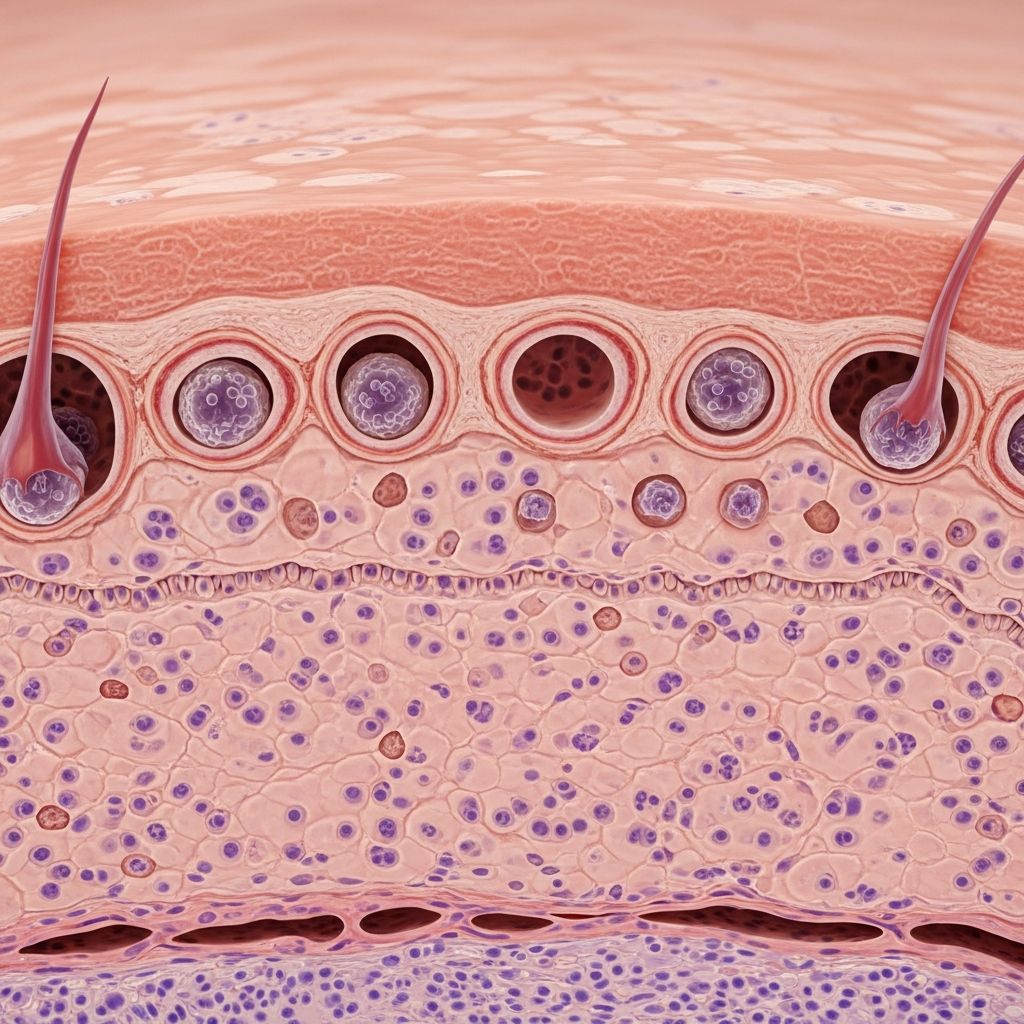
Histology reveals hyperkeratosis, parakeratosis, acanthosis, papillomatosis, and perivascular infiltrate.
Diagnosis
Diagnosis is clinical, based on characteristic fingertip involvement and nail changes in children. Differential includes:
- Pustular psoriasis (acrodermatitis continua of Hallopeau)
- Atopic/contact dermatitis
- Fungal infections (onychomycosis)
- Blistering distal dactylitis
- Koilonychia or trauma
Biopsy if atypical: shows psoriasiform dermatitis. Culture/mycology to exclude infection. Dermoscopy may highlight subungual debris. Long-term follow-up helps distinguish evolving psoriasis.
Related Stories



Treatment
No specific cure; management is supportive. Topical emollients are first-line, often sufficient, especially with habit cessation (e.g., thumb-sucking).
- Mild cases: Emollients, barrier creams
- Inflammatory: Low-potency topical corticosteroids (e.g., hydrocortisone)
- Persistent: Topical retinoids/tretinoin, calcipotriol
- Severe/recurrent: Systemic retinoids, methotrexate (rare in children)
Phototherapy or antibiotics/antimycotics if secondary infection. Counseling on avoidance of irritants. Prognosis favorable: >50% resolve completely.
Prognosis and evolution
PP follows a protracted, relapsing course but is self-limiting. In Tosti et al.’s series: 11/20 cured, 8 psoriasis, 4 contact dermatitis, 2 atopic. Recurrences common but severity diminishes with age.
No scarring typically; nail normalizes post-resolution.
Frequently Asked Questions
What causes parakeratosis pustulosa?
Etiology unknown; possible links to psoriasis, atopy, contact dermatitis, or thumb-sucking. Not genetic.
Is parakeratosis pustulosa contagious?
No, it is not infectious.
How is parakeratosis pustulosa treated?
Emollients primary; topical steroids if needed. Stop habits like thumb-sucking.
Does parakeratosis pustulosa go away?
Yes, often resolves in months-years; may evolve to psoriasis.
Can adults get parakeratosis pustulosa?
Exclusively pediatric; rare post-puberty.
References
- Parakeratosis Pustulosa: Symptoms and Cause — Medicover Hospitals. 2023. https://www.medicoverhospitals.in/diseases/parakeratosis-pustulosa/
- Parakeratosis pustulosa – a distinct but less familiar disease — Indian Journal of Dermatology, Venereology and Leprology. 2007-08-01. https://ijdvl.com/parakeratosis-pustulosa-a-distinct-but-less-familiar-disease/
- Parakeratosis pustulosa — VisualDx. Accessed 2026. https://www.visualdx.com/visualdx/diagnosis/parakeratosis+pustulosa
- Parakeratosis pustulosa — Wikipedia (primary sources referenced). Accessed 2026. https://en.wikipedia.org/wiki/Parakeratosis_pustulosa
- Parakeratosis pustulosa — DermNet NZ. Accessed 2026. https://dermnetnz.org/topics/parakeratosis-pustulosa
- Parakeratosis pustulosa; Blistering distal dactylitis — Altmeyer’s Encyclopedia. Accessed 2026. https://www.altmeyers.org/en/dermatology/parakeratosis-pustulosa-blistering-distal-dactylitis-fingertip-pustulation-hjorth-sabouraud-disease-hjorth-sabouraud-erkrnakung-132509
Similar Articles








Read full bio of medha deb