Parietal Lobe: Anatomy, Function & Damage
Understand the parietal lobe's vital role in sensory processing, spatial awareness, and brain function.
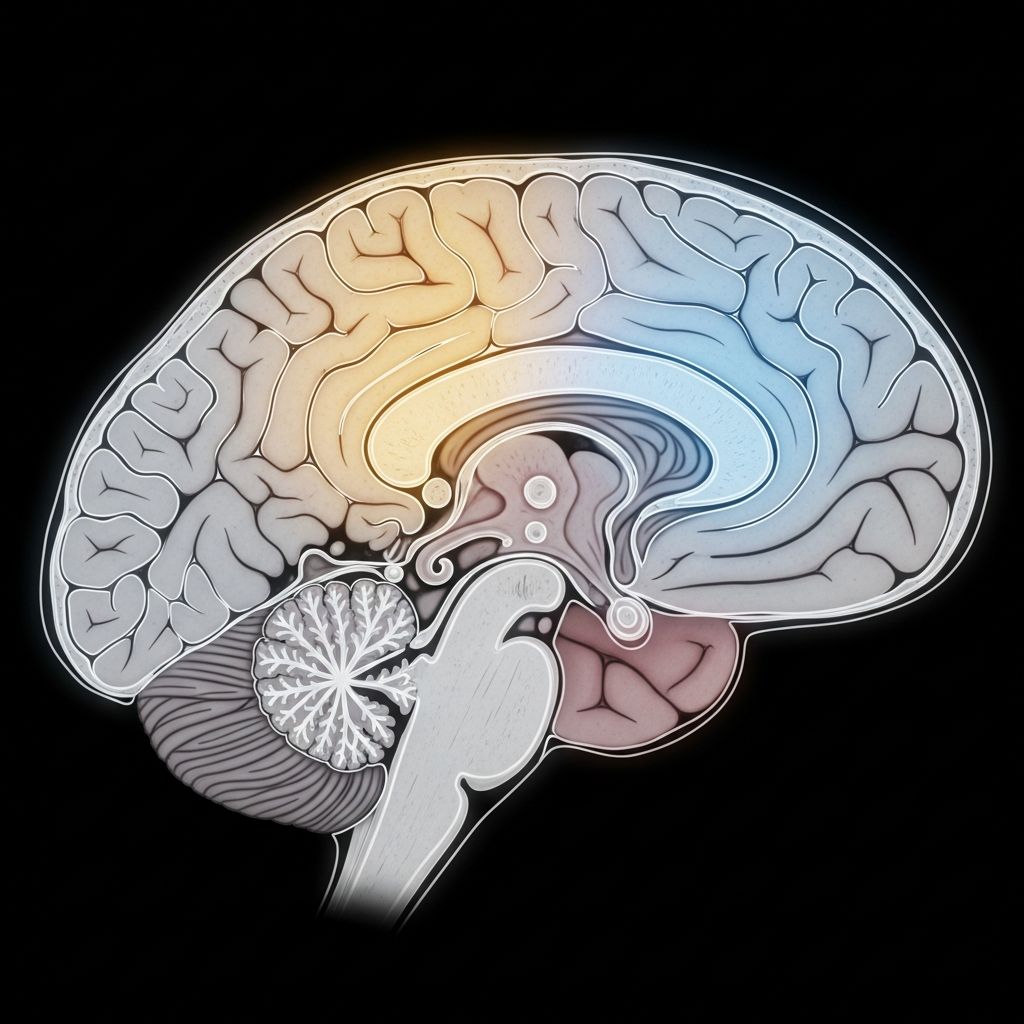
Understanding the Parietal Lobe: Structure and Function
The parietal lobe is one of the four major lobes of the brain, positioned between the frontal and occipital lobes and above the temporal lobe. Located near the back and top of the head, the parietal lobe plays a crucial role in how we perceive and interact with the world around us. This brain region is responsible for processing and interpreting somatosensory input—information that tells us about objects in our external environment through touch and about the position and movement of our body parts, known as proprioception. The parietal lobe’s integration of sensory information helps construct a spatial coordinate system that represents the world around us, allowing us to navigate and interact with our surroundings effectively.
Anatomy and Location of the Parietal Lobe
The parietal lobe accounts for approximately 19% of the total neocortical volume, making it only slightly larger than the occipital lobe. This lobe has distinct anatomical boundaries that define its location within the brain. Anteriorly, the parietal lobe extends from the central sulcus, which separates it from the frontal lobe. Posteriorly, it reaches the parieto-occipital fissure, which marks the boundary between the parietal and occipital lobes. The lateral sulcus forms the inferolateral boundary, separating the parietal lobe from the temporal lobe positioned below it. Medially, the medial longitudinal fissure confines the parietal lobe, dividing both cerebral hemispheres.
Blood Supply to the Parietal Lobe
Like all brain tissue, the parietal lobe requires a rich blood supply to function properly. This region receives blood from three primary arterial sources:
- The middle cerebral artery (MCA), which supplies the majority of the parietal lobe
- The anterior cerebral artery (ACA), which supplies the medial parietal lobe
- The posterior cerebral artery (PCA), which supplies the posterior medial parietal lobe
This multiple arterial supply ensures that the parietal lobe maintains adequate blood flow under normal conditions, though disruptions in any of these vessels can have significant consequences for parietal lobe function.
Primary Functions of the Parietal Lobe
The parietal lobe is vital for sensory perception and integration, managing taste, hearing, sight, touch, and smell. Its most critical function involves processing somatosensory information, which includes touch, temperature, pressure, and pain signals. The parietal lobe contains the brain’s primary somatic sensory cortex, a region where the brain interprets input from other areas of the body. This specialized area receives sensory information from receptors distributed throughout the body and translates these signals into our conscious perception of touch and bodily position.
Sensory Integration and the Somatosensory Cortex
Research indicates that the amount of surface area in the parietal lobe dedicated to processing sensory input from a particular body part correlates directly with how much sensory data that region provides. For example, the fingers and hands are primary sites for sensory data, so much of the parietal lobe is dedicated to receiving and processing their input. This creates what neuroscientists call a “sensory homunculus”—a disproportionate representation of the body on the brain’s surface that reflects the sensitivity of different body regions.
A key function mediated by the parietal lobe is two-point discrimination—the ability to discern whether two objects touching the skin at nearby points are distinct or represent a single object. Different areas of the body have varying numbers of sensory receptors, making some regions more sensitive than others at distinguishing distinct points of contact. This function can be tested using calipers or a folded paperclip, with the subject keeping their eyes closed while the tester alternates using one point and two points on different body areas.
Spatial Processing and Coordination
Beyond basic sensory perception, the parietal lobe facilitates spatial processing, which enables us to understand the positions of objects and our bodies in space. This function is essential for coordinated movement and navigation. For instance, when the motor cortex in the frontal lobe sends a message directing the muscles in your arm and hand to reach for a cup, the somatosensory cortex of the parietal lobe simultaneously assesses the sensory information delivered through your touch, including judgments about the cup’s temperature. Additionally, spatial processing in the parietal lobe allows you to grasp the cup accurately, flawlessly navigating hand-to-cup distance relative to the table and other surrounding objects. This seamless integration of sensory and spatial information demonstrates how the parietal lobe works in concert with other brain regions to enable everyday activities.
Related Stories



Effects of Parietal Lobe Damage
Because of the parietal lobe’s role in sensory integration, spatial reasoning, and language skills, damage to this region can have broad-ranging consequences. The specific prognosis depends largely on the location of the injury, its severity, and whether treatment is available. Damage can affect both motor and cognitive functions, disrupting the coordinated activities that depend on intact parietal lobe function.
Common Symptoms of Parietal Lobe Damage
Damage to the parietal lobe can result in various neurological and cognitive difficulties:
- Difficulty with drawing or creating visual representations of objects
- Difficulty distinguishing left from right (directional confusion)
- Spatial disorientation and navigation difficulties
- Problems with reading, a condition called Alexia
- Inability to locate the words for writing, known as Agraphia
- Difficulty with performing mathematical calculations, termed Dyscalculia
- Lack of awareness of certain body parts and/or surrounding space, referred to as Neglect
- Inability to focus visual attention appropriately
- Difficulty with motor planning and complex movements, a condition called Apraxia
Hemispheric Differences in Damage Effects
The consequences of parietal lobe damage often depend on which hemisphere is affected. Damage to the left parietal lobe typically results in difficulties in understanding language and writing. These language-related deficits reflect the left hemisphere’s dominant role in language processing for most individuals. Conversely, damage to the right parietal lobe results in difficulties with understanding spatial orientation and navigation. This hemispheric specialization reflects the right hemisphere’s particular involvement in spatial reasoning and visuospatial tasks. Understanding these differences helps clinicians predict and address the specific deficits that may arise from localized parietal lobe injuries.
The Integrated Nature of Brain Function
While we often discuss individual brain regions and their specific functions, it is important to recognize that the parietal lobe does not operate in isolation. Rather, each region of the brain works in conjunction with the body and the environment. Without the environment, the brain could do little or nothing, and the parietal lobe is no exception. This principle reflects the fundamental truth that brain function emerges from complex interactions between neural structures, bodily systems, and external stimuli.
The parietal lobe’s role in human cognition and perception remains an active area of neuroscientific research. New studies consistently make findings about how this brain region works, and it is unlikely that researchers have identified all of its functions. As our understanding deepens, we continue to appreciate the sophistication and complexity of this critical brain region.
Frequently Asked Questions
Q: Where is the parietal lobe located in the brain?
A: The parietal lobe is located between the frontal and occipital lobes and above the temporal lobe, near the back and top of the head. It is separated from the frontal lobe by the central sulcus and from the occipital lobe by the parieto-occipital fissure.
Q: What is the primary function of the parietal lobe?
A: The primary function of the parietal lobe is to process and integrate sensory information, including touch, temperature, pressure, and pain. It also plays a crucial role in spatial processing and helps us understand the position and movement of our body parts.
Q: What is the somatosensory cortex?
A: The somatosensory cortex is a primary sensory area located in the parietal lobe where the brain receives and interprets sensory information from throughout the body. Different regions of the body are represented disproportionately based on their sensory importance and the number of receptors they contain.
Q: What is two-point discrimination and how does it relate to the parietal lobe?
A: Two-point discrimination is the ability to distinguish whether two objects touching the skin at nearby points are separate or represent a single object. This function is mediated by the parietal lobe and can be tested using calipers or other tools while the subject’s eyes are closed.
Q: How does left parietal lobe damage differ from right parietal lobe damage?
A: Damage to the left parietal lobe typically affects language processing and writing abilities, while damage to the right parietal lobe impairs spatial awareness, orientation, and navigation abilities. This reflects the hemispheric specialization of brain functions.
Q: What conditions can result from parietal lobe damage?
A: Parietal lobe damage can result in various conditions including Alexia (reading problems), Agraphia (writing difficulties), Dyscalculia (math problems), Apraxia (motor planning difficulties), spatial disorientation, and Neglect (lack of awareness of body parts or surrounding space).
References
- Parietal Lobe — Physiopedia. Accessed December 1, 2025. https://www.physio-pedia.com/Parietal_Lobe
- Lobes of the Brain — Queensland Brain Institute, University of Queensland. https://qbi.uq.edu.au/brain/brain-anatomy/lobes-brain
- Cerebral Cortex: What It Is, Function & Location — Cleveland Clinic. https://my.clevelandclinic.org/health/articles/23073-cerebral-cortex
- Parietal Lobe: What Is It, Location, Function, and More — Osmosis. https://www.osmosis.org/answers/parietal-lobe
- Brain: Parts, Function, How It Works & Conditions — Cleveland Clinic. https://my.clevelandclinic.org/health/body/22638-brain
- Cerebrum: What It Is, Function & Anatomy — Cleveland Clinic. https://my.clevelandclinic.org/health/body/23083-cerebrum
Similar Articles








Read full bio of medha deb