PASI Score: Complete Guide To Calculation And Interpretation
Comprehensive guide to the Psoriasis Area and Severity Index (PASI) for assessing psoriasis severity and treatment response.
The
Psoriasis Area and Severity Index (PASI)
is a widely used tool in dermatology to quantify the severity and extent ofpsoriasis
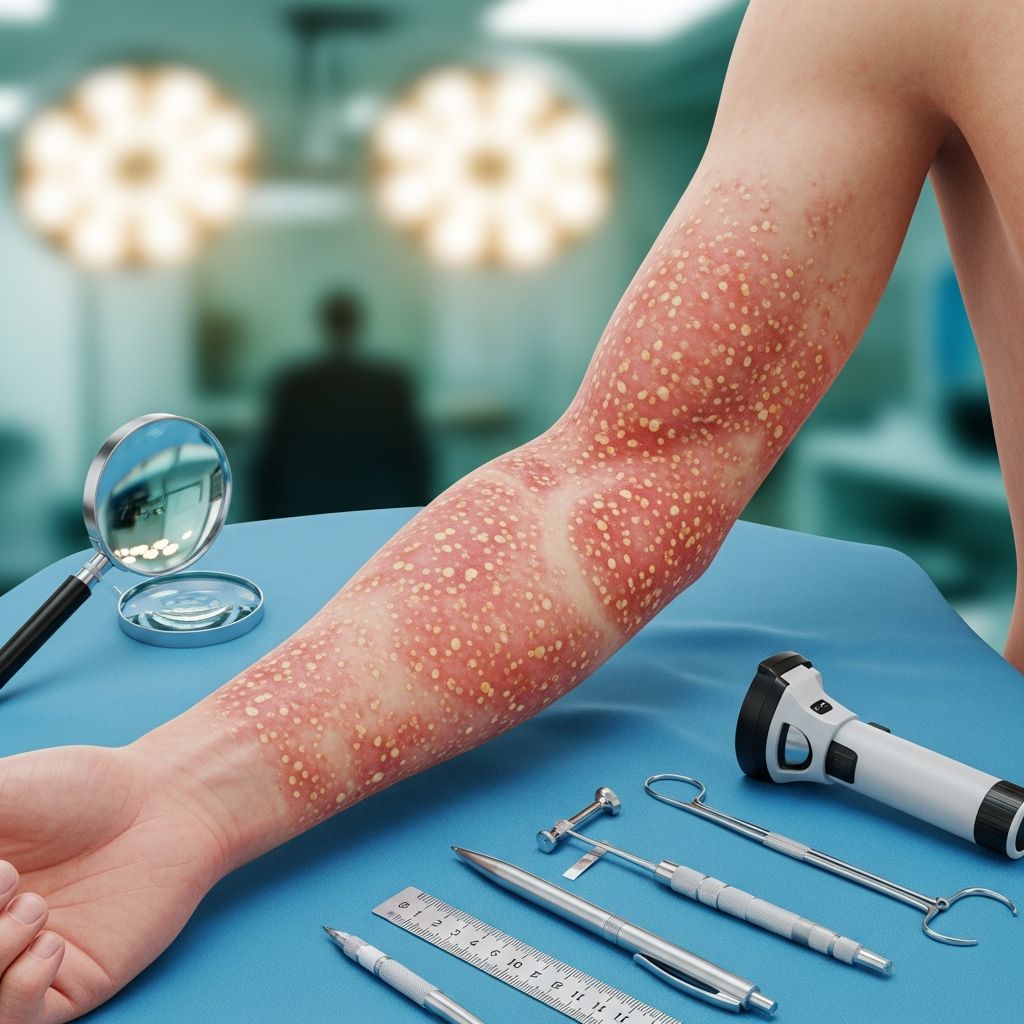
, particularly chronic plaque psoriasis. Developed in 1989, it provides an objective numerical score ranging from 0 (no disease) to 72 (most severe), aiding clinicians in assessing baseline severity, monitoring treatment efficacy, and determining eligibility for therapies.PASI combines assessments of
lesional severity
(redness/erythema, thickness/induration, scaling) andpercent body surface area (BSA)
affected, weighted by four body regions. It is the primary endpoint in most psoriasis clinical trials and guides treatment decisions worldwide.What is the PASI score?
The PASI score standardizes psoriasis evaluation by scoring
intensity
of three key plaque characteristics andarea
involvement in four anatomical regions: head/neck (10% BSA), upper limbs (20% BSA), trunk (30% BSA), and lower limbs (40% BSA). This area-weighted approach reflects the disproportionate impact of lesions on larger body parts like legs.Clinicians select a representative plaque per region, score its severity, estimate affected area, and apply the formula:
PASI = 0.1(Eh + Ih + Dh)Ah + 0.2(Eu + Iu + Du)Au + 0.3(Et + It + Dt)At + 0.4(El + Il + Dl)Al
Where E=erythema, I=induration, D=desquamation (scaling), and A=area score; subscripts h=head, u=upper limbs, t=trunk, l=lower limbs.
Who developed the PASI score?
Dr. Thomas Fredriksson and Dr. Ulrich Pettersson introduced the PASI in 1989 through a seminal paper establishing it as a composite index for psoriasis trials. Its reliability, validated across studies, led to universal adoption despite minor inter-rater variability. The US Food and Drug Administration (FDA) endorses PASI 75 (≥75% improvement) as a key efficacy measure in biologics approvals.
Intensity scores
For each region, average the three severity parameters (0-4 scale):
- Redness (erythema): 0=none, 1=light pink, 2=dark pink, 3=bright red, 4=fiery red
- Thickness (induration/plaque elevation): 0=none, 1=slight, 2=moderate (~3mm), 3=thick (~5mm), 4=very thick (>6mm)
- Scaling (desquamation): 0=none, 1=fine, 2=moderate, 3=thick, 4=very thick
The regional
intensity score
is the average: (E + I + D)/3, multiplied by area score.Area scores
Estimate psoriasis coverage per region:
| Score | % BSA Affected |
|---|---|
| 0 | 0% |
| 1 | 1-9% |
| 2 | 10-29% |
| 3 | 30-49% |
| 4 | 50-69% |
| 5 | 70-89% |
| 6 | 90-100% |
Clinicians use the hand palm (≈1% BSA) for estimation; e.g., 10 palms ≈10%.
How to calculate the PASI score — worked example
Step 1: Assess intensity and area per region.
Example patient:
- Head: Avg intensity=1.7 (mild), Area=2 (10-29%)
- Upper limbs: Avg intensity=2.3 (moderate), Area=3 (30-49%)
- Trunk: Avg intensity=1.0 (mild), Area=1 (1-9%)
- Lower limbs: Avg intensity=2.7 (moderate-severe), Area=4 (50-69%)
Step 2: Apply formula:
Head: 0.1 × 1.7 × 2 = 0.34
Upper: 0.2 × 2.3 × 3 = 1.38
Trunk: 0.3 × 1.0 × 1 = 0.30
Lower: 0.4 × 2.7 × 4 = 4.32
Total PASI = 0.34 + 1.38 + 0.30 + 4.32 = 6.34 (moderate psoriasis)
PASI score interpretation
| PASI Score | Severity | % Patients (approx.) |
|---|---|---|
| 0 | Clear | <1% |
| 0.1-5 | Mild | 40% |
| 6-10 | Moderate | 30% |
| 11-20 | Moderate-severe | 20% |
| 21-32 | Severe | 8% |
| 33-72 | Very severe | 2% |
Scores >10 often qualify for systemic/biologic therapy. Relative improvements: PASI 50 (50% reduction), PASI 75 (75%—FDA standard), PASI 90 (90%—’clear/almost clear’).
Uses of the PASI score
- Clinical practice: Baseline assessment, treatment selection (topicals for PASI<5; systemic/biologics for PASI>10), response monitoring.
- Trials: Primary endpoint; e.g., biologics show PASI 75 in 70-90% vs. 10% placebo.
- Funding: Eligibility for subsidized drugs (e.g., PASI>12 in many guidelines).
- Research: Correlates moderately with quality-of-life (DLQI); higher PASI predicts itch/pain.
Related Stories



Patient-oriented PASI (PO-PASI)
DermNet’s
PO-PASI
enables self-assessment via diagrams/photos matching body region involvement. Users select visuals, input severity, and get automatic score—empowering patients for telehealth/shared decision-making. Validation shows good correlation with clinician PASI (r=0.85).Calculator
Online tools like pasi.corti.li or apps simplify entry of regional scores for instant PASI calculation, with graphs tracking progress.
Limitations of PASI
- Subjectivity: Inter-rater variability ±1.5 points; area estimation challenging.
- Non-plaque psoriasis: Underestimates palmoplantar/guttate variants.
- Quality-of-life blind: PASI 10 may be mild (few lesions) or severe (extensive thin plaques).
- Face/genitals: Underweighted despite high impact.
- Alternatives: BSA (simpler, less precise), PGA (global 0-4), DLQI (patient-reported).
PASI remains superior for trials; combinations (PASI + DLQI) optimal clinically.
Frequently asked questions
What is a good PASI score?
A PASI <3 indicates good control; PASI 75 response (75% drop from baseline) is excellent.
Can patients calculate their own PASI?
Yes, using PO-PASI tools, though clinician assessment is gold standard.
How accurate is PASI?
Intra-class correlation 0.88; sensitive to change but subjective area scoring limits precision.
Does PASI guide treatment choice?
Yes: <5=topicals; 5-10=phototherapy/systemic; >10=biologics.
What if PASI doesn’t improve?
Switch therapies; reassess adherence/triggers. Combine with BSA/DLQI.
Related topics
References
- PASI score: Definition and how to calculate — Medical News Today. 2023-05-15. https://www.medicalnewstoday.com/articles/pasi-score
- Patient-oriented PASI score — DermNet NZ. 2024-01-10. https://dermnetnz.org/topics/patient-oriented-pasi-score
- Understanding Your PASI Score For Psoriasis — Healthline. 2023-08-22. https://www.healthline.com/health/pasi-psoriasis
- PASI (psoriasis area and severity index) — DermNet NZ. 2024-02-05. https://dermnetnz.org/topics/pasi-score
- Understanding key psoriasis outcome measures — Bristol Myers Squibb (official patient resource). 2024-06-12. https://www.bms.com/patient-and-caregivers/patient-resources-by-condition/immunology-resources/understanding-key-psoriasis-outcome-measures.html
- Psoriasis Area Severity Index (PASI) Calculator — Corti.li (clinical tool). 2023-11-01. http://pasi.corti.li
Similar Articles








Read full bio of medha deb