Patch Test Images: Visual Guide To Reactions And Grading
Visual guide to patch testing for allergic contact dermatitis diagnosis and interpretation.
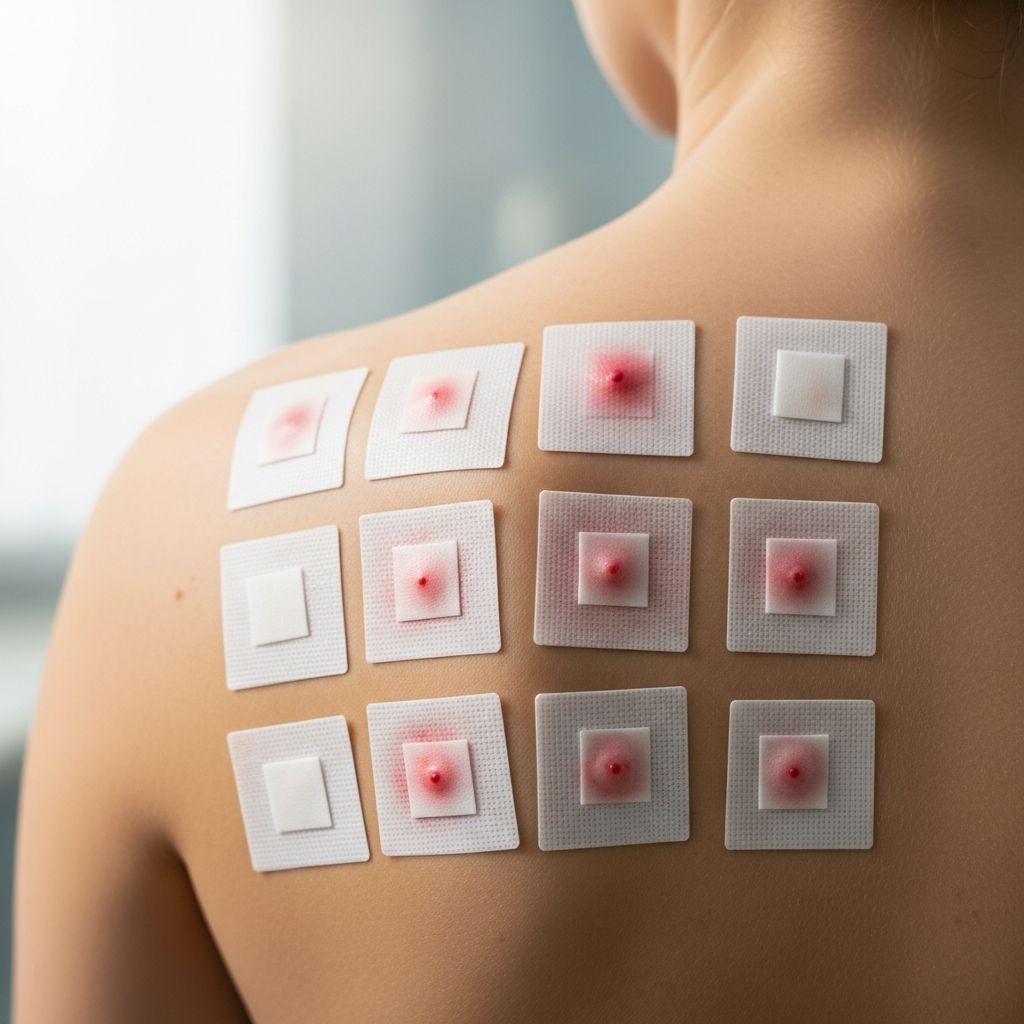
Patch testing is a critical diagnostic tool used by dermatologists to identify substances causing allergic contact dermatitis, a type of skin inflammation triggered by specific allergens upon skin contact. This method involves applying diluted allergens to the skin, typically the upper back, under occlusive patches for 48 hours, with readings taken at 48 and 96 hours to capture delayed hypersensitivity reactions. Unlike immediate IgE-mediated allergies tested via skin prick tests, patch tests detect type IV hypersensitivity, which manifests as eczematous reactions.
What is Patch Testing?
Patch testing confirms allergens responsible for contact dermatitis by mimicking real-life exposure in a controlled manner. Small aluminum chambers, such as Finn chambers, hold allergens on hypoallergenic tape applied to the patient’s back. Between 30 and over 100 allergens can be tested simultaneously using 2-3 panels, each containing 10-12 substances. Testing is ideally performed when active dermatitis is absent to avoid false positives from irritated skin.
- Standard allergens: Include the European Baseline Series or similar, covering common culprits like nickel, fragrances, preservatives, and rubber chemicals.
- Patient-specific tests: Incorporate suspected items like cosmetics, medications, or fabric samples.
- Site selection: Upper back preferred for space; alternatives include arms or abdomen if back is inflamed.
Concentrations are optimized to elicit allergy without irritation in non-sensitized individuals, ensuring result reliability.
Preparation for Patch Testing
Patients must avoid topical corticosteroids, systemic steroids, and immunosuppressants for 2-4 weeks prior, as these suppress reactions. Recent sun exposure or phototherapy should be disclosed. Bring suspect products, gloves, or clothing snippets (1 cm from seams) for custom testing.
| Pre-Test Instructions | Details |
|---|---|
| Avoid Topicals | No steroids, antihistamines, or irritants 7-14 days before. |
| Skin Prep | Clean back; no lotions day of test. |
| Photosensitivity | Inform if on photosensitizing meds. |
| Duration | Three visits: Day 0 (apply), Day 2 (remove/read), Day 4 (final read). |
Patch Test Application
Allergens are drawn into chambers using syringes in a quiet, organized setting to prevent errors. Chambers are placed on the back starting from the upper right, secured with hypoallergenic tape like Transpore. Press firmly to ensure contact and expel air. Mark sites with indelible pen and label series.
Image: Multiple patch test strips applied to the upper back, secured with tape. Each chamber contains a specific allergen.
- Patches remain 48 hours undisturbed; no bathing, sweating, or scratching.
- Supplied markers for re-marking if fading.
Removal and Initial Reading (48 Hours)
At 48 hours, patches are removed by a clinician. Allow 30 minutes for redness to settle. Outline sites, note displacements. Preliminary grading uses ICDRB criteria:
| Grade | Description |
|---|---|
| – | No reaction |
| ?/+ | Doubtful: Faint erythema |
| + | Weak positive: Erythema, papules, infiltration |
| ++ | Strong: Vesicles, edema |
| +++ | Extreme: Blisters, ulcers |
| IR | Irritant: Pustules, burn-like |
Sometimes additional patches are applied if needed.
Final Reading (96 Hours)
Re-inspect and re-mark sites. Record peak reactions. Dermatologist interprets relevance based on morphology, history, and exposure.
Image: Marked back post-removal showing outlined test sites for 96-hour evaluation.
Related Stories



Images of Patch Test Reactions
Visual identification is key for accurate grading. Below are described common reaction images:
Negative Reaction
Smooth, unchanged skin under chamber site. No erythema or induration.
Irritant Reaction (IR)
Follicular rash, pustules, or burn-like without vesicles. Often from high concentration or active dermatitis (‘angry back’).
Equivocal/Weak Positive (+/- or +)
Faint pink macule or slightly raised erythematous plaque. Maculopapular changes indicate mild allergy.
Strong Positive (++)
Papulovesicular eruption with edema, coalescing vesicles.
Extreme Positive (+++)
Large blisters, ulceration, necrosis. Rare, indicates high sensitization.
Photopatch Testing
For photoallergic contact dermatitis, allergens are applied bilaterally. After 48 hours, one side is irradiated with UVA (5 J/cm²). Readings at 48 and 96 hours post-irradiation compare sides. Positive if photo-exposed side reacts stronger.
- Allergens: Sunscreens, fragrances, antibacterials.
- Images: Persistent photoaggravated dermatitis on irradiated sites.
Adverse Reactions and Pitfalls
Common: Itching, mild redness resolving quickly. Rare: Persistent dermatitis, hyperpigmentation.
- Angry back: Multiple false positives from primed hyperirritability.
- False negatives: Suppressed by meds or inactive disease.
- Excited skin: Similar to angry back.
Patients photograph sites between visits; tape/pen marks preserved.
Baseline Series Allergens
Standard panels test prevalent allergens:
| Allergen | Common Source |
|---|---|
| Nickel sulfate | Jewelry, coins |
| Fragrance mix | Perfumes, cosmetics |
| Cobalt chloride | Metal tools |
| p-Phenylenediamine | Hair dyes, rubber |
| Formaldehyde | Preservatives |
Custom series added per history.
Frequently Asked Questions (FAQs)
What does a positive patch test mean?
A positive reaction indicates sensitization to that allergen; relevance confirmed by exposure history and dermatitis distribution.
Can I shower with patches on?
Avoid water, sweat, or friction for 48 hours to prevent dislodgement.
How long do reactions last?
Mild reactions fade in days; treat with emollients/steroids if needed post-final read.
Is patch testing painful?
No, but itchy. Extreme reactions may sting.
Who performs patch tests?
Dermatologists or trained allergists in specialized clinics.
Post-diagnosis, avoidance is key. Patch testing empowers patients to identify and eliminate triggers, preventing recurrent dermatitis. Consult dermatologists for personalized management.
References
- Patch tests_NZDermNet.pdf — DermNet New Zealand / Sussex CDS. 2019-10. https://sussexcds.co.uk/wp-content/uploads/2019/10/Patch-tests_NZDermNet.pdf
- PATCH TESTING: A BEST PRACTICE GUIDE — British Dermatological Nursing Group (BDNG). 2017-02. https://bdng.org.uk/wp-content/uploads/2017/02/FINAL130117.pdf
- Patch tests — DermNet New Zealand. Accessed 2026. https://dermnetnz.org/topics/patch-tests
- Patch tests image — DermNet New Zealand. Accessed 2026. https://dermnetnz.org/imagedetail/6858-patch-tests
- Patch testing — University Hospitals Sussex NHS Foundation Trust. 2024-11. https://www.uhsussex.nhs.uk/wp-content/uploads/2024/11/2445-Patch-Testing-2024.pdf
- Baseline series of patch test allergens — DermNet New Zealand. Accessed 2026. https://dermnetnz.org/topics/baseline-series-of-patch-test-allergens
Similar Articles








Read full bio of medha deb