Pathergy: Essential Guide To Diagnosis, Causes, And Management
Understanding pathergy: hyperreactivity to minor skin trauma in Behçet's disease and pyoderma gangrenosum.
What is pathergy?
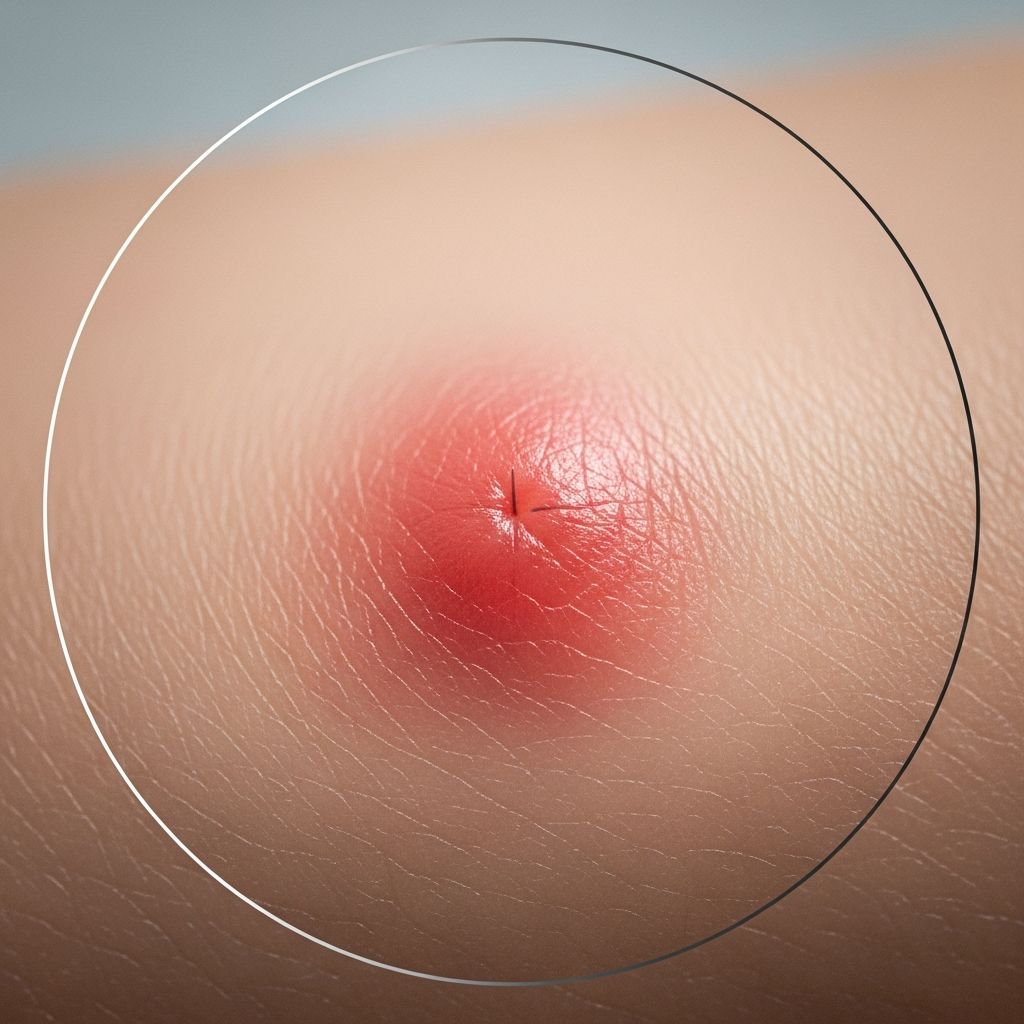
Pathergy refers to an exaggerated inflammatory response of the skin to minor trauma, such as a needle prick, bump, bruise, or surgical incision. This non-specific hyperreactivity manifests as the formation of pustules, papules, or ulcerative lesions at the site of injury, often within 24-48 hours. Unlike normal wound healing, pathergy involves excessive neutrophil infiltration and can lead to chronic, non-healing ulcers that worsen with further trauma.
The term ‘pathergy’ derives from the Greek words ‘pathos’ (suffering) and ‘ergon’ (work), highlighting the aberrant tissue reactivity triggered by seemingly innocuous stimuli. This phenomenon is not merely a local skin reaction but reflects underlying systemic dysregulation of innate immunity, particularly involving keratinocytes and cytokine release.
Pathergy is distinguished from the Koebner phenomenon, which produces disease-specific lesions (e.g., psoriatic plaques in psoriasis) at trauma sites, whereas pathergy results in non-specific pustular or ulcerative responses. Clinically significant pathergy poses challenges in patient management, as routine procedures like venipuncture or surgery may exacerbate lesions.
Who gets pathergy?
Pathergy is most strongly associated with certain neutrophilic dermatoses and systemic inflammatory conditions. It occurs in approximately 60-70% of patients with Behçet’s disease (BD), particularly those with active mucocutaneous involvement, and is more common in males and individuals from endemic regions like the Mediterranean, Middle East, and East Asia.
In pyoderma gangrenosum (PG), pathergy is reported in up to 25-50% of cases, often complicating wound care and surgical interventions. Other conditions exhibiting pathergy include:
- Behçet’s disease: Hallmark feature included in international diagnostic criteria.
- Pyoderma gangrenosum: Especially ulcerative and bullous variants.
- Sweet’s syndrome: Acute febrile neutrophilic dermatosis with pathergic pustules.
- Other neutrophilic dermatoses: Pustular vasculitis, erythema elevatum diutinum.
- Rare associations: Rheumatoid arthritis, inflammatory bowel disease (IBD), haematological malignancies.
Pathergy positivity correlates with disease activity, genetic factors (e.g., HLA-B51 in BD), and environmental triggers like infections. It is less common in Western populations, possibly due to diagnostic criteria evolution and declining prevalence.
Pathergy test
The skin pathergy test (SPR or PT) is a standardized diagnostic procedure to elicit and quantify pathergic responses. It involves sterile needle pricks on the forearm and reading reactions at 24-48 hours.
How is the pathergy test performed?
- Preparation: Clean the volar forearm with alcohol. Use sterile disposable needles (21-25 gauge, blunt or triangular bevel preferred for consistency).
- Pricking: Perform 3-5 vertical needle pricks (5mm depth) spaced 2cm apart. Include control sites without pricking.
- Readings: Examine at 24h, 48h (primary), and sometimes 72h. Positive if ≥1 sterile papule/pustule >2mm with erythematous halo forms. Pustules peak at 48h and resolve in 3-5 days.
- Variations: Oral pathergy test (needle prick on gums) shows higher specificity for BD but lower sensitivity.
| Reaction | Description | Interpretation |
|---|---|---|
| Positive | Papule/pustule ≥2mm + erythema | Hyperreactivity confirmed |
| Negative | Erythema without induration | Absent or weak pathergy |
| Doubtful | <2mm papule | Requires repeat testing |
Related Stories



Factors influencing test results include needle type (blunt > sharp), number of pricks, patient gender (males more reactive), and active disease state. False positives occur in 5-10% of healthy controls from endemic areas.
Clinical features of pathergy
Pathergic lesions typically develop 24-48 hours post-trauma:
- Early (4-24h): Erythematous macule or indurated papule due to perivascular neutrophilic infiltrate.
- Peak (48h): Sterile pustule (1-5mm) with halo, palpable induration.
- Late: Crusting, ulceration, or hyperpigmented scar in severe cases.
In PG, pathergy manifests as rapid ulcer enlargement post-debridement or biopsy. In BD, it mimics non-follicular papulopustular lesions. Systemic symptoms like fever or arthralgia may accompany in active disease.
Pathophysiology
The exact mechanisms remain incompletely understood but involve:
- Trauma-induced keratinocyte activation: Release of danger-associated molecular patterns (DAMPs), activating Toll-like receptors (TLRs) and NOD-like receptors, leading to IL-1β, IL-6, TNF-α production.
- Neutrophil hyper-recruitment: Perivascular infiltrates with mixed lymphocytes/eosinophils peak at 24h.
- Genetic/environmental factors: HLA associations, microbial antigens, hyperinflammatory response.
- Distinction from Koebner: Non-specific vs. disease-specific lesions.
Histopathology shows intraepidermal pustules and dermal inflammation, resembling innate immune dysregulation.
Diagnosis
Pathergy supports diagnosis in context:
- Behçet’s disease: Positive SPR in international criteria.
- Pyoderma gangrenosum: Clinical + biopsy; pathergy aids confirmation.
Differential includes infection (culture negative), Sweet’s syndrome, vasculitis. Biopsy if atypical.
Management
- Avoid trauma: Gentle handling, no aggressive debridement in PG.
- Wound care: Non-adherent dressings, topical steroids/antibiotics.
- Systemic therapy: For underlying disease (colchicine, dapsone for BD; cyclosporine, biologics for PG).
- Surgical caution: Preoperative pathergy testing; use minimally invasive techniques.
Frequently Asked Questions
Q: Is pathergy specific to Behçet’s disease?
A: No, while characteristic of BD, it occurs in PG, Sweet’s syndrome, and others; specificity is higher in endemic populations.
Q: How reliable is the pathergy test?
A: Sensitivity has declined (40-60% in modern series); still valuable for active disease and research.
Q: Can pathergy be treated directly?
A: Management targets underlying condition; avoid triggers and use anti-inflammatory agents.
Q: Does pathergy affect surgery?
A: Yes, increases risk of wound dehiscence; test beforehand and consider alternatives.
Q: Is pathergy contagious?
A: No, lesions are sterile; due to host hyperreactivity, not infection.
References
- Pathergy – Wikipedia — Wikipedia. 2023. https://en.wikipedia.org/wiki/Pathergy
- Pyoderma Gangrenosum – StatPearls — NCBI Bookshelf. 2023-10-05. https://www.ncbi.nlm.nih.gov/books/NBK482223/
- Pathergy: a review of potential mechanisms and novel therapeutic targets — Cambridge Media Journals. 2022. https://journals.cambridgemedia.com.au/wpr/volume-30-number-1/pathergy-review-potential-mechanisms-and-novel-therapeutic-targets
- Pyoderma Gangrenosum: Symptoms and Treatment — Patient.info. 2023. https://patient.info/doctor/dermatology/pyoderma-gangrenosum-pro
- Pathergy Phenomenon — Frontiers in Medicine. 2021-03-18. https://www.frontiersin.org/journals/medicine/articles/10.3389/fmed.2021.639404/full
- The oral and skin pathergy test — Indian Journal of Dermatology, Venereology and Leprology. 2014. https://ijdvl.com/the-oral-and-skin-pathergy-test/
- Pathergy Test – StatPearls — NCBI Bookshelf. 2023-04-22. https://www.ncbi.nlm.nih.gov/books/NBK558909/
Similar Articles








Read full bio of Sneha Tete