Pemphigoid: 5 Key Types, Symptoms, Diagnosis, Treatment
Rare autoimmune blistering skin disorders affecting mainly the elderly with tense blisters and intense itch.
Authoritative facts about pemphigoid and related diseases: what causes them, who gets them and what to do.
What is pemphigoid?
Pemphigoid refers to a group of rare, chronic autoimmune subepidermal blistering disorders primarily affecting the skin, with occasional mucous membrane involvement. These conditions arise when the immune system produces autoantibodies targeting proteins in the basement membrane zone between the epidermis and dermis, leading to tense blisters that do not rupture easily, distinguishing them from intraepidermal blistering diseases like pemphigus.
Bullous pemphigoid (BP), the most common subtype, represents about 80% of subepidermal immunobullous cases and typically occurs in individuals over 60 years old, with peak incidence between 70-80 years. The disease causes intense pruritus often preceding visible lesions by months or years, followed by urticarial plaques and tense bullae on the trunk, flexures, and extremities.
Other variants include mucous membrane pemphigoid (MMP), pemphigoid gestationis, epidermolysis bullosa acquisita (EBA), and linear IgA disease, each with distinct clinical features and autoantigens.
Who gets pemphigoid?
Pemphigoid predominantly affects older adults, with bullous pemphigoid incidence reported at 4.3 per 100,000 persons per year in the UK, rising with age. It is uncommon before age 60, though cases occur in younger patients, particularly with certain triggers.
- Bullous pemphigoid: Elderly (>70 years), equal male-female ratio.
- Mucous membrane pemphigoid: Older adults, slight female predominance; can cause scarring in eyes, mouth, genitals.
- Pemphigoid gestationis: Pregnant women, second/third trimester onset.
- Linear IgA disease: Children (chronic bullous disease of childhood) or adults (>60 years).
- Epidermolysis bullosa acquisita: Adults, associated with inflammatory bowel disease.
Risk factors include prior skin trauma, UV exposure, medications (e.g., diuretics, neuroleptics), and neurological diseases like stroke or Parkinson’s.
What causes pemphigoid?
Pemphigoid is autoimmune: IgG autoantibodies target hemidesmosomal proteins BP180 (BPAg2/collagen XVII) and/or BP230 (BPAg1) in the dermal-epidermal junction, triggering inflammation, eosinophil recruitment, and subepidermal cleavage. Complement activation and protease release cause blister formation.
In bullous pemphigoid, anti-BP180 NC16A domain antibodies are pathogenic, detected in 70-80% of sera via ELISA. Triggers may include drugs (furosemide, penicillamine), vaccinations, or radiotherapy, but most cases are idiopathic.
Genetic factors (HLA-DR4/DRB1*1101) and environmental exposures contribute to loss of immune tolerance.
What are the clinical features of pemphigoid?
Prodrome: Severe pruritus (weeks to years) without visible changes.
Lesions:
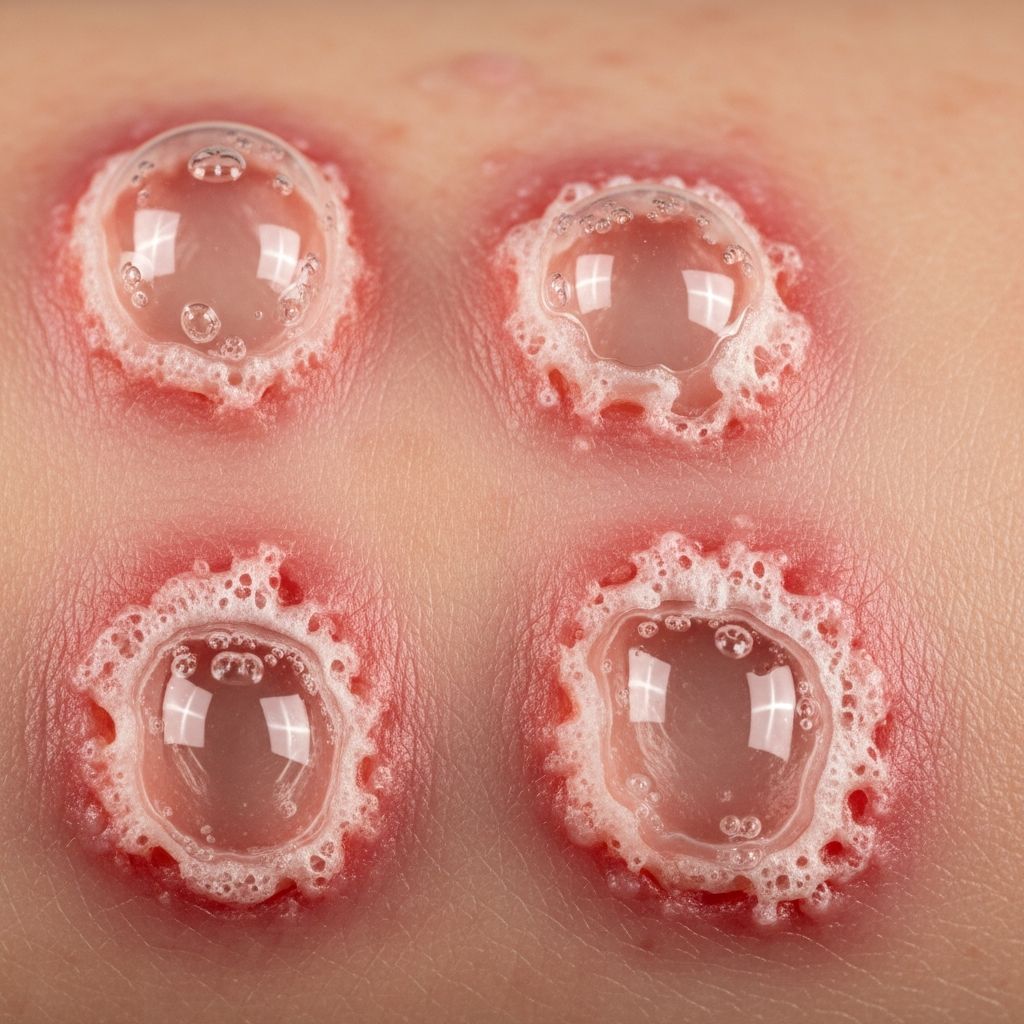
- Tense bullae (1-10 cm), clear/hemorrhagic fluid, on normal or erythematous/urticarial skin.
- Flexural sites: axillae, groin, trunk; extremities less common.
- Erosions, crusts after rupture; heal slowly without scarring.
- Polymorphic: vesicles, nodules, targetoid lesions.
Mucosal involvement rare in BP (<20%), unlike MMP (oral/genital erosions). Eosinophilia common; Nikolsky sign negative.
Bullous pemphigoid variants
- Localized: Pretibial, stomal, dyshidrotic (hands/feet).
- Vegetating: Warty plaques in flexures.
- Generalized erythroderma: Rare, exfoliative.
Other pemphigoid types
| Type | Key Features | Autoantigens |
|---|---|---|
| Mucous membrane pemphigoid | Scarring erosions: eyes (symblepharon), mouth, genitals; females > males. | BP180, laminin 332, integrin α6β4. |
| Pemphigoid gestationis | Pruritic urticarial plaques, bullae around umbilicus spreading; third trimester. | BP180 NC16A. |
| Linear IgA bullous dermatosis | Annular ‘string of pearls’ vesicles; children/adults; drug-induced (vancomycin). | LAD-1 (shed ectodomain of BP180). |
| Epidermolysis bullosa acquisita | Mechano-bullous (trauma-induced) or inflammatory (mimics BP); nails, mouth. | Collagen VII. |
Related Stories



Diagnosis of pemphigoid
Clinical suspicion + histopathology + immunofluorescence.
- Biopsy: Subepidermal blister with eosinophils; papillary dermal edema.
- Direct immunofluorescence (DIF): Linear C3 ± IgG at basement membrane.
- Indirect immunofluorescence (IIF): Circulating IgG on salt-split skin (epidermal roof).
- ELISA: Anti-BP180/BP230; >97% sensitivity for BP.
Differential: Pemphigus (suprabasal, positive Nikolsky), arthropod bites, urticaria, dermatitis herpetiformis (papular, IgA).
Treatment of pemphigoid
First-line: High-potency topical corticosteroids (e.g., clobetasol 0.05%) for mild-moderate; systemic if extensive.
- Topical CS: 10-30g/day; very potent for 12 weeks, taper.
- Superpotent + doxycycline/minocycline: Reduces relapse.
Severe/extensive:
- Oral prednisolone: 0.5-1 mg/kg/day, rapid taper with steroid-sparing agents.
- Immunosuppressants: Azathioprine, mycophenolate mofetil, methotrexate.
- Biologics: Dupilumab (anti-IL4/13), rituximab (B-cell depletion) for refractory.
- Others: IVIG, plasmapheresis.
MMP: Dapsone, rituximab for ocular scarring prevention. Supportive: Emollients, wound care, antihistamines for itch.
Complications of pemphigoid
- Skin: Secondary infection, erosions.
- Systemic steroids: Osteoporosis, diabetes, hypertension; monitor BMD.
- MMP: Blindness from corneal scarring.
- High mortality in first year (up to 40% in elderly, akin to 4-year stroke mortality).
Possible outcome and prognosis of pemphigoid
BP remits in 50-60% within 2-6 years; 30% chronic relapsing. Treatment-related complications cause most deaths. Early control improves prognosis; biologics reduce long-term steroids.
Frequently asked questions about pemphigoid
What is the difference between pemphigoid and pemphigus?
Pemphigoid: subepidermal tense blisters (dermis-epidermis split); pemphigus: intraepidermal flaccid blisters (acantholysis within epidermis).
Does pemphigoid affect mucous membranes?
Rarely in BP (<20%); common/scarring in MMP (eyes, mouth).
Is pemphigoid curable?
Not curative but manageable; spontaneous remission in many, long-term therapy often needed.
Can pemphigoid be triggered by medications?
Yes, e.g., furosemide, penicillamine, PD-1 inhibitors; resolves on discontinuation sometimes.
How is bullous pemphigoid diagnosed?
Biopsy + DIF (linear IgG/C3) + serum ELISA for BP180.
References
- Pemphigus and Pemphigoid – Symptoms, Causes, Treatment — NORD (rarediseases.org). 2023. https://rarediseases.org/rare-diseases/pemphigus/
- Bullous Pemphigoid — Merck Manuals Professional Edition. 2024-10-01. https://www.merckmanuals.com/professional/dermatologic-disorders/bullous-diseases/bullous-pemphigoid
- Bullous pemphigoid — Primary Care Dermatology Society (PCDS). 2024-08-10. https://www.pcds.org.uk/clinical-guidance/bullous-pemphigoid1
- Bullous Pemphigoid — MSD Manuals Consumer Version. 2024. https://www.msdmanuals.com/home/skin-disorders/blistering-diseases/bullous-pemphigoid
- Bullous Pemphigoid – StatPearls — NCBI Bookshelf. 2023-07-17. https://www.ncbi.nlm.nih.gov/books/NBK535374/
- Pemphigus & Pemphigoid Patient Guide — International Pemphigus & Pemphigoid Foundation. 2020-11. https://www.pemphigus.org/wp-content/uploads/Pemphigus-and-Pemphigoid-Patient-Guide-November-2020.pdf
Similar Articles








Read full bio of Sneha Tete