Pemphigus Foliaceus Pathology: 4 Key Histology Images
Detailed histopathological and immunofluorescence analysis of pemphigus foliaceus, a superficial autoimmune blistering disorder.
Author: Dr. Harriet Cheng, Dermatopathologist, Reviewed: Dr. Brandon Newell, Dermatopathologist
Pemphigus foliaceus is a superficial form of pemphigus characterised by autoantibodies against desmoglein 1 (Dsg1), resulting in acantholysis confined to the superficial epidermis. This leads to fragile intraepidermal blisters that rupture easily, producing erosions, scales and crusts predominantly on the seborrhoeic areas.
Histology of pemphigus foliaceus
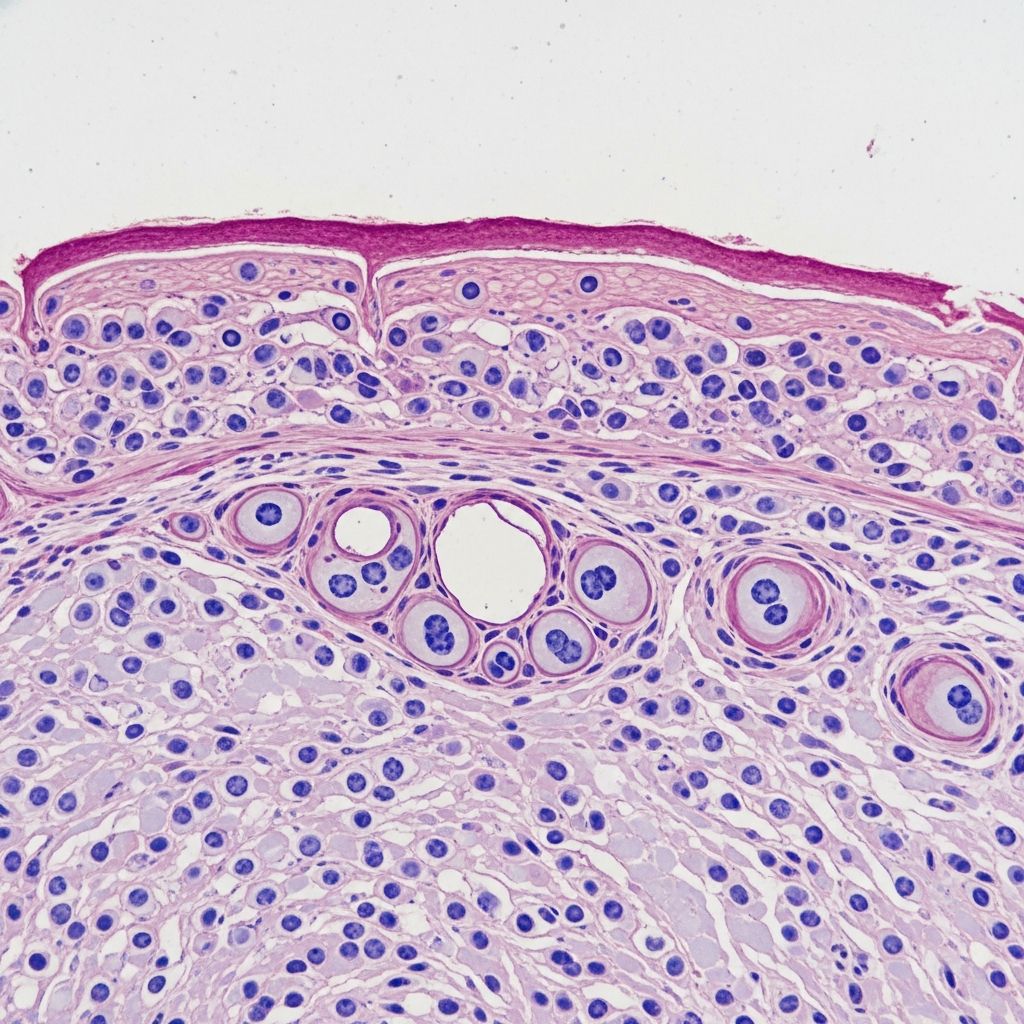
The key histopathological feature of pemphigus foliaceus is suprabasal acantholysis (loss of adhesion between keratinocytes) localised to the superficial epidermis, often in the granular layer or just beneath the stratum corneum (subcorneal split). In early lesions, a small blister or cleft may be seen containing a few rounded acantholytic keratinocytes. More commonly, ruptured blisters result in erosions covered by parakeratotic hyperkeratosis and neutrophils. The underlying epidermis shows only focal dyshesion without the extensive suprabasal clefts typical of pemphigus vulgaris.
Mild spongiosis (intercellular oedema) and lymphocytic exocytosis may be present in the upper spinous and granular layers adjacent to acantholytic foci. The dermis shows a superficial perivascular lymphocytic infiltrate with occasional eosinophils. Direct damage to keratinocytes from autoantibodies can produce individual necrotic or dyskeratotic cells in the upper epidermis.
- Low power: Erosions with overlying parakeratosis and scant acantholytic cells; minimal cleft formation
- Medium power: Subcorneal clefts with rounded acantholytic keratinocytes; sparse neutrophils
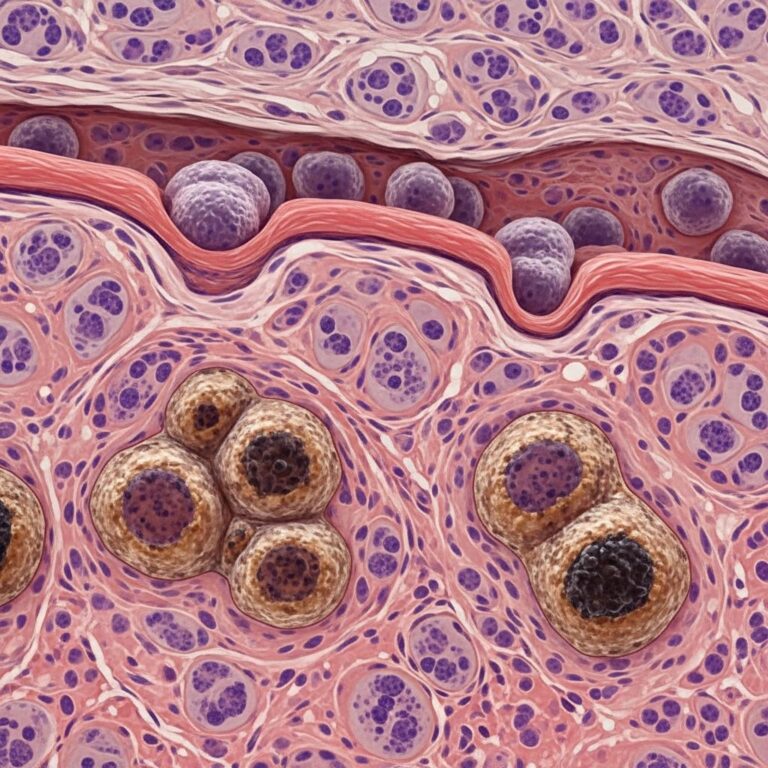
- High power: ‘Row of tombstones’ appearance where basal keratinocytes remain attached to basement membrane while suprabasal cells separate


Histopathology images
- Image 1: Low magnification shows erosion with parakeratotic crust and minimal cleft formation (H&E)
- Image 2: Characteristic subcorneal cleft containing acantholytic keratinocytes (H&E ×400)
- Image 3: Higher magnification demonstrates rounded acantholytic cells with hyperchromatic nuclei
- Image 4: Direct immunofluorescence showing intercellular IgG deposition throughout epidermis
Direct immunofluorescence
Direct immunofluorescence (DIF) is the gold standard for confirming pemphigus foliaceus and shows the classic "chicken-wire" or "fishnet" pattern of intercellular deposition of IgG and/or C3 throughout the epidermis. The fluorescence outlines individual keratinocytes in a honeycomb pattern due to binding of autoantibodies to desmoglein 1 on cell membranes. In pemphigus foliaceus, staining may be stronger in the superficial epidermis where Dsg1 expression is highest compared to deeper layers.
Key DIF findings:
- Pattern: Intercellular (epidermal cell surface) "chicken-wire" pattern
- Immunoglobulins: IgG (most common), IgA (rare IgA pemphigus variant)
- Complement: C3 deposition co-localises with IgG
- Distribution: Uniform throughout epidermis; stronger superficially in PF
Negative or weak basement membrane zone (BMZ) staining helps distinguish pemphigus from bullous pemphigoid. DIF sensitivity approaches 100% in active lesions.

Electron microscopy
Transmission electron microscopy (TEM) reveals the precise level of split formation in pemphigus foliaceus. Acantholysis occurs at the interface between desmosomes and the plasma membrane, with widening of intercellular spaces. The subcorneal split is localised to the uppermost granular layer. Desmosomes initially appear widened with decreased electron density before complete separation. Keratin filaments remain attached to desmosomal plaques even after cell separation.
Related Stories



Ultrastructural hallmarks:
- Desmosome-keratin filament detachment
- Superficial desmosomal splitting (granular layer)
- Preserved tonofilaments in acantholytic cells
- No BMZ or hemidesmosome abnormalities
Differential diagnosis
| Condition | Key distinguishing features |
|---|---|
| Pemphigus vulgaris | Suprabasal acantholysis (full-thickness clefts), mucosal involvement, weaker DIF in superficial epidermis |
| Hailey-Hailey disease | "Dilapidated brick wall", full-thickness "villous" acantholysis, no DIF positivity |
| Grover disease | Focal suprabasal clefting with necrotic keratinocytes, no intercellular DIF |
| Subcorneal pustular dermatosis | Neutrophilic pustules, no acantholysis, negative DIF |
| IgA pemphigus | Intercellular IgA (not IgG), intraepidermal neutrophils |
Pathology comparison table
| Feature | Pemphigus foliaceus | Pemphigus vulgaris | Bullous pemphigoid |
|---|---|---|---|
| Cleavage level | Subcorneal/granular | Suprabasal | Subepidermal |
| Acantholysis | Focal/superficial | Extensive | Absent |
| DIF pattern | Chicken-wire IgG | Chicken-wire IgG | Linear BMZ IgG/C3 |
| Mucosal involvement | Rare | Common | Rare |
Clinicopathological correlation
The superficial level of acantholysis explains the clinical features of pemphigus foliaceus:
- Flaccid, easily ruptured blisters → erosions/scales rather than intact vesicles
- Seborrhoeic distribution → highest Dsg1 expression in these areas
- Positive Nikolsky sign → superficial split extends laterally with friction
- No mucosal lesions → absent Dsg1 expression in mucosa
Prognosis and treatment correlation
Superficial disease extent correlates with better prognosis than pemphigus vulgaris. Topical/superpotent steroids suffice for limited disease as penetration reaches superficial split. Systemic immunosuppression reserved for extensive cases. Monitoring anti-Dsg1 titres guides therapy as antibody levels correlate with disease activity.
Frequently asked questions
What is the most important histopathological finding in pemphigus foliaceus?
Subcorneal acantholysis with a "row of tombstones" appearance is pathognomonic.
Is direct immunofluorescence always positive in pemphigus foliaceus?
DIF shows chicken-wire IgG in nearly 100% of active lesions, making it the diagnostic gold standard.
How does pemphigus foliaceus pathology differ from pemphigus vulgaris?
PF shows superficial subcorneal splits while PV demonstrates extensive suprabasal acantholysis through the full spinous layer.
Can pemphigus foliaceus be diagnosed clinically alone?
No. Biopsy with H&E and DIF confirmation is essential to distinguish from clinical mimics like impetigo or seborrhoeic dermatitis.
What is the significance of the Nikolsky sign in pathology?
Positive Nikolsky reflects the superficial acantholytic level allowing easy lateral extension of cleavage with friction.
References
- Retrospective analysis of clinic-based data for pemphigus foliaceus patients — Clinical and Experimental Dermatology, Oxford Academic. 2024-10-15. https://academic.oup.com/ced/advance-article/doi/10.1093/ced/llaf408/8250814
- Pemphigus Foliaceus – StatPearls — NCBI Bookshelf / K Lepe et al. 2023-07-17. https://www.ncbi.nlm.nih.gov/books/NBK499829/
- Pemphigus Foliaceus – Dermatologic Disorders — MSD Manual Professional Edition. 2026. https://www.msdmanuals.com/professional/dermatologic-disorders/bullous-diseases/pemphigus-foliaceus
- Pemphigus foliaceus: A rare blistering skin lesion — Electronic Journal of General Medicine. 2023-02-01. https://www.ejgm.co.uk/download/pemphigus-foliaceus-a-rare-blistering-skin-lesion-12831.pdf
- Pemphigus Foliaceus — DermNet NZ. 2024. https://dermnetnz.org/topics/pemphigus-foliaceus
Similar Articles








Read full bio of Sneha Tete