Percutaneous Nephrolithotomy (PCNL): Kidney Stone Removal
Advanced surgical procedure for removing large kidney stones through minimally invasive techniques.
Percutaneous Nephrolithotomy (PCNL): A Comprehensive Overview
Percutaneous nephrolithotomy (PCNL) is a minimally invasive surgical procedure used to remove large kidney stones that cannot be treated with other methods such as shock wave lithotripsy or laser ureteroscopy. The term “percutaneous” refers to accessing the kidney through the skin, while “nephrolithotomy” means removing a stone from the kidney. This procedure is considered the gold standard treatment for patients with symptomatic large or complex renal stones measuring 2 centimeters or larger. Unlike open surgery, PCNL offers fewer complications, less impact on the body, and allows for faster healing while maintaining high success rates in stone removal.
Who Is a Good Candidate for PCNL?
Not all patients with kidney stones require PCNL. Healthcare providers typically recommend this procedure for individuals who meet specific criteria. The ideal candidate for PCNL is someone who cannot pass a kidney stone on their own and whose stone is too large to treat with shock wave lithotripsy or laser ureteroscopy. Patients with stones larger than 2 centimeters, those with complex stone burdens, or individuals whose stones have not responded to less invasive treatments are prime candidates for this procedure.
Additionally, patients with certain anatomical considerations may benefit from PCNL. These include individuals with obese body habitats, those with horseshoe kidneys, patients with stones located in caliceal diverticula, and those with ectopic or malrotated kidneys where traditional access techniques may be difficult. Your urologist will evaluate your specific condition, stone characteristics, and medical history to determine whether PCNL is the most appropriate treatment option for you.
Understanding the PCNL Procedure
Pre-Procedure Preparation
Before undergoing PCNL, you will receive comprehensive pre-operative evaluations and instructions. Your medical team will review your medical history, current medications, and perform necessary imaging studies to precisely locate and characterize your kidney stones. You will be instructed to avoid eating and drinking for a specific period before the procedure, typically starting at midnight the evening before surgery. It is essential to inform your healthcare provider about any allergies, particularly to contrast dye or anesthesia, as this information is critical for your safety during the procedure.
The Surgical Team
Percutaneous nephrolithotomy requires a specialized team of healthcare professionals working in coordination. This multidisciplinary team typically includes a urologist who performs the stone removal, an interventional radiologist who assists with kidney access and imaging guidance, an anesthesiologist to manage your sedation, nursing staff to provide support during and after the procedure, and technicians to assist with specialized equipment. This collaborative approach ensures the best possible outcomes by combining surgical expertise with advanced imaging capabilities.
Patient Positioning and Access
During most PCNL procedures, you will be positioned on your stomach, known as the prone position, which allows the urologist to access your kidney through your back. However, your urologist may choose alternative positioning strategies depending on your anatomy and stone location. Some patients may be positioned supine (on their back) or in a modified supine position with a cushion under the flank to provide approximately a 30-degree inclination. The prone split-leg position is particularly advantageous as it provides access to all kidney calyces, including the upper pole calyces, and allows the surgeon to work through Brodel’s avascular plane to minimize bleeding.
The initial phase of the procedure involves placing you in a lithotomy position to insert a cystoscope (a telescope-like instrument) into your bladder. A tube is then passed up the ureter into the kidney, allowing the kidney to be filled with dye (contrast medium) so the surgeon can localize the kidney using x-rays. Once this preparatory step is complete, you are repositioned to your front (prone position) for the main procedure.
Creating the Access Tract
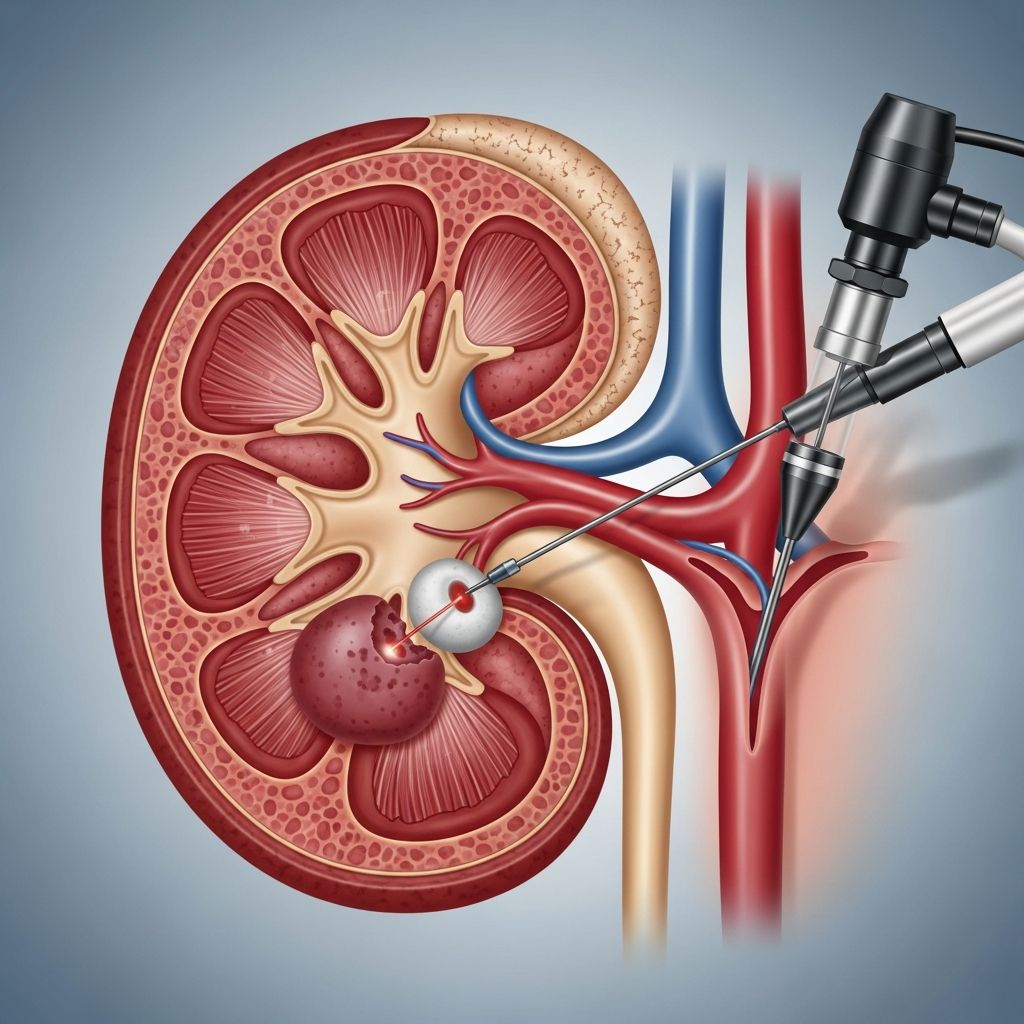
With the aid of fluoroscopic x-ray guidance, the surgeon carefully punctures the kidney with a fine needle. The needle position is confirmed by either outflow of urine or dye from the needle, ensuring accurate placement within the kidney’s collecting system. Once the kidney has been successfully entered, a small incision (approximately 1 to 1.5 centimeters) is made in the back. The needle tract is then progressively dilated (widened) to allow for the insertion of larger instruments.
Related Stories



The dilation process is crucial for creating a working channel into the kidney while minimizing tissue damage. Various dilating techniques and instruments are available, and your surgeon will choose the most appropriate method based on your anatomy and stone characteristics. Different PCNL variants exist depending on the size of the final working channel created, ranging from standard PCNL with sheaths larger than 22 French to ultra-mini PCNL with sheaths as small as 11-13 French, and even micro-PCNL with sheaths smaller than 7 French.
Stone Fragmentation and Removal
Once adequate access has been established, a protective sheath is inserted through the incision and into your kidney. A small video camera called a nephroscope is then inserted through the sheath to directly visualize the kidney stone. This direct visualization is a key advantage of PCNL, allowing the surgeon to see exactly what they are working with and ensure complete stone removal.
The surgeon then uses specialized stone fragmentation devices to break up the kidney stone into smaller, more manageable pieces. These devices may include laser energy, ultrasonic probes, or pneumatic jackhammer-like instruments, all chosen based on stone composition and size. Unlike procedures where large fragments must pass through the urinary tract, PCNL allows for simultaneous removal of stone fragments, achieving the most complete stone clearance expeditiously. Large fragments are quickly evacuated without waiting for passage through narrow channels, which would be problematic with large amounts of stone debris.
Procedure Duration
Percutaneous nephrolithotomy typically requires two to four hours to complete, though the exact duration depends on stone size, complexity, and location. In some cases, particularly with straightforward stone cases, the procedure may be completed closer to two hours, while more complex cases may extend toward four hours.
Post-Operative Care and Recovery
Immediate Post-Operative Management
After the kidney stone has been removed, your surgeon may install a drainage tube or a ureteral stent to ensure proper urine drainage and promote healing. A tube is typically left in the kidney, and a catheter is placed in the urethra (the tube that carries urine from your bladder and out of your body) to ensure good urinary drainage during the initial healing phase. These tubes are removed over the following days depending on clinical progress and will be reviewed daily by the medical team. The skin incisions are closed using stitches and covered with bandages.
Recovery Timeline
Recovery from PCNL is generally faster than open surgery due to the minimally invasive nature of the procedure. Most patients experience mild to moderate discomfort at the incision site, which can be managed with prescribed pain medications. You may notice blood-tinged urine for several days after the procedure, which is normal. Full recovery typically takes two to four weeks, during which you should avoid strenuous activities, heavy lifting, and contact sports as directed by your medical team.
Discharge Instructions
Before leaving the hospital, you will receive detailed discharge instructions regarding wound care, pain management, activity restrictions, and signs of complications that require immediate medical attention. It is essential to keep all follow-up appointments so your healthcare provider can monitor your recovery and confirm that the kidney stone has been completely removed.
When PCNL Is Recommended
Your healthcare provider may initially suggest less invasive treatments for smaller kidney stones. Shock wave lithotripsy and laser ureteroscopy are typically recommended first-line treatments for smaller stones that cannot pass on their own. However, when stones are too large for these techniques, too dense, or located in positions that make them inaccessible to less invasive methods, PCNL becomes the preferred treatment option. Additionally, PCNL is recommended when other treatments have failed to achieve stone-free status or when patients have multiple stones requiring removal.
Minimally Invasive Technique Variants
Modern PCNL has evolved to include several minimally invasive variations designed to reduce tissue trauma while maintaining effectiveness. Standard PCNL uses sheaths larger than 22 French. Mini-PCNL employs sheaths of 22 French or smaller, reducing tissue injury. Minimally invasive PCNL uses 18 French sheaths, ultra-mini PCNL uses 11-13 French sheaths, mini-micro PCNL uses 8 French sheaths, and micro-PCNL uses sheaths smaller than 7 French. These smaller variants are particularly beneficial for patients seeking reduced morbidity while still achieving effective stone removal, though their use depends on stone characteristics and surgeon expertise.
Advantages of PCNL Over Open Surgery
Percutaneous nephrolithotomy offers several significant advantages compared to traditional open surgical stone removal. The procedure involves only a small incision rather than a large surgical cut, resulting in less tissue trauma and reduced blood loss. Because PCNL is minimally invasive, patients experience fewer complications, spend less time in the hospital, and recover much faster than with open surgery. The direct visualization provided by the nephroscope ensures high stone-free rates and allows for complete removal of all stone fragments, reducing the likelihood of residual stones requiring future treatment.
Frequently Asked Questions
Q: Is PCNL considered major surgery?
A: Yes, PCNL is classified as major surgery despite being minimally invasive. However, it has fewer complications and faster recovery times compared to open surgical procedures for kidney stone removal.
Q: How long does it take to return to normal activities after PCNL?
A: Most patients can return to light activities within one to two weeks, though full recovery typically takes two to four weeks. Your healthcare provider will give you specific guidelines based on your individual recovery progress.
Q: Will I experience pain after PCNL?
A: Some mild to moderate discomfort at the incision site is normal and can be managed with prescribed pain medications. Most pain resolves within the first week after the procedure.
Q: Can kidney stones return after PCNL?
A: While PCNL effectively removes existing stones, some patients may develop new stones in the future. Your healthcare provider can recommend lifestyle modifications and dietary changes to reduce recurrence risk.
Q: What are the risks associated with PCNL?
A: Like any surgical procedure, PCNL carries some risks including infection, bleeding, and injury to surrounding structures. However, these complications are relatively uncommon when the procedure is performed by experienced surgeons. Your medical team will discuss specific risks based on your individual circumstances.
Q: Will I need anesthesia for PCNL?
A: Yes, PCNL is performed under general anesthesia to ensure you are completely unconscious and pain-free throughout the procedure. An anesthesiologist will monitor you continuously during the surgery.
Q: How is success measured for PCNL?
A: Success is typically measured by achieving a “stone-free” status, meaning all or nearly all stone fragments have been removed. Follow-up imaging studies are usually performed to confirm complete stone removal.
References
- Percutaneous nephrolithotomy (PCNL) — University Hospitals Sussex NHS Trust. 2024. https://www.uhsussex.nhs.uk/resources/percutaneous-nephrolithotomy-pcnl/
- Percutaneous Nephrolithotomy (PCNL) in Atlanta for Kidney Stones — Georgia Urology. 2024. https://www.gaurology.com/percutaneous-nephrolithotomy/
- Technique of Percutaneous Nephrolithotomy — Endourological Society. 2024. https://www.endourology.org/education-articles/
- Percutaneous nephrolithotomy: Current concepts — National Center for Biotechnology Information (NIH). 2024. https://pmc.ncbi.nlm.nih.gov/articles/PMC2684301/
- Percutaneous Nephrolithotomy: Procedure, Risks & Recovery — Cleveland Clinic. 2024. https://my.clevelandclinic.org/health/treatments/17349-percutaneous-nephrolithotomy
Similar Articles








Read full bio of medha deb