Perifolliculitis Capitis Abscedens et Suffodiens
Rare chronic scalp inflammation causing pustules, nodules, abscesses, and scarring alopecia – comprehensive guide to symptoms, causes, and treatment.
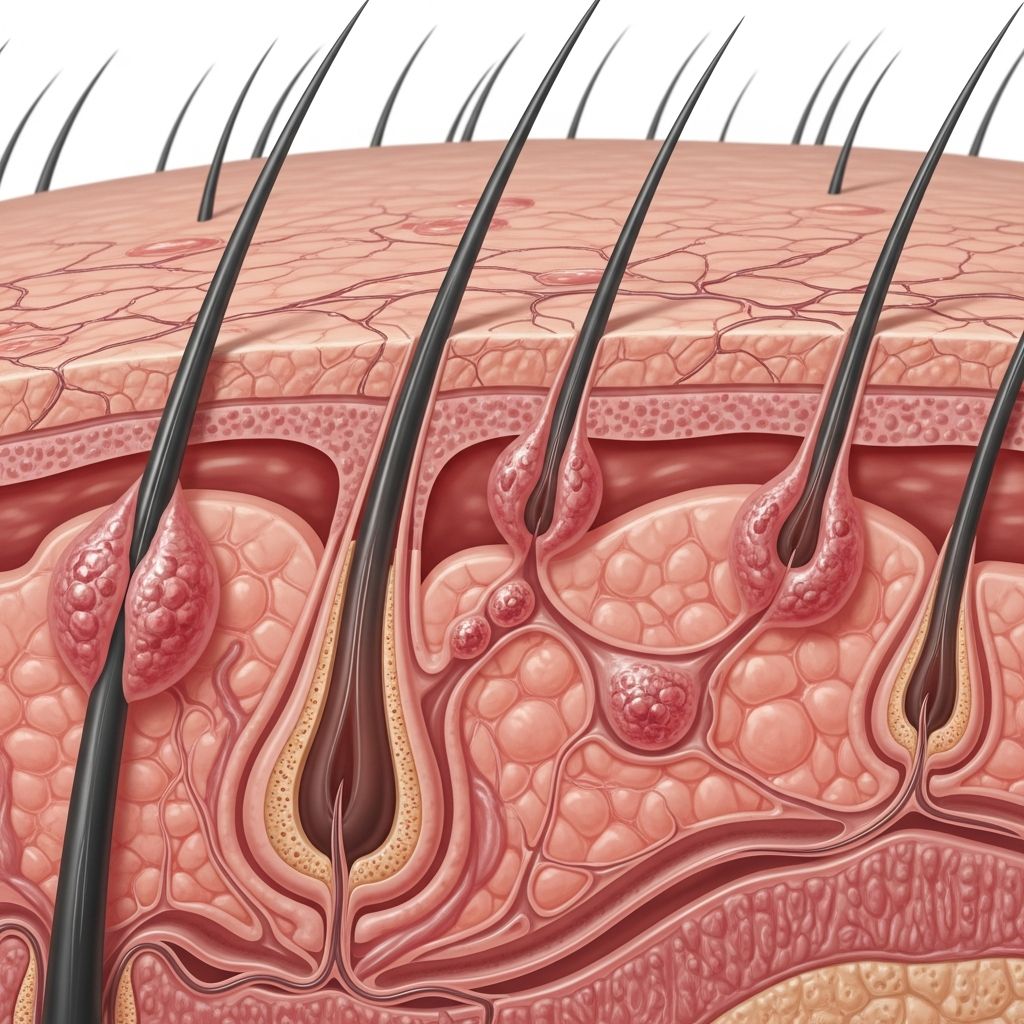
Perifolliculitis capitis abscedens et suffodiens is a rare chronic inflammatory disorder of the scalp follicles, also known as dissecting cellulitis of the scalp or Hoffman disease. It manifests with perifollicular pustules, nodules, and abscesses that lead to progressive scarring alopecia.
Introduction
Perifolliculitis capitis abscedens et suffodiens (PCAS) represents an uncommon yet severe form of neutrophilic scarring alopecia affecting the scalp. First described by Hoffman in 1908, this condition involves deep follicular inflammation progressing to suppuration, sinus tract formation, and irreversible hair loss. The disease typically presents with painful, fluctuant nodules and boggy plaques on the scalp, predominantly over the vertex and crown. Without intervention, it can cause extensive cicatricial alopecia, significantly impairing quality of life due to pain, drainage, and cosmetic disfigurement.
The pathology stems from occlusion of follicular infundibula, leading to rupture, secondary bacterial overgrowth, and aberrant immune responses. Common commensals like coagulase-negative staphylococci may trigger inflammation. PCAS often clusters within the ‘follicular occlusion tetrad’ alongside acne conglobata, hidradenitis suppurativa, and pilonidal sinus, suggesting shared pathogenic mechanisms involving keratinization defects and immune dysregulation.
Demographics
PCAS predominantly affects young adult males, with peak onset between 20-40 years. It shows a marked racial predilection for individuals of African descent, occurring in approximately 80% of reported cases. Familial forms exist, underscoring genetic susceptibility. While rare in females and other ethnicities, cases have been documented across demographics. The male-to-female ratio exceeds 3:1, possibly linked to androgen influences on follicular hyperkeratosis.
- Age: 20-40 years (peak incidence)
- Sex: Male predominance (3:1 ratio)
- Ethnicity: African/Black (80% of cases)
- Familial occurrence: Reported in genetic variants
Causes
The exact etiology of PCAS remains multifactorial, centered on defective follicular keratinization causing infundibular plugging and rupture. This initiates a cycle of inflammation, suppuration, and fibrosis. Key contributors include:
- Follicular occlusion: Abnormal keratinization blocks pilosebaceous units, leading to dilation and rupture.
- Immune dysregulation: Aberrant response to normal scalp flora, especially coagulase-negative staphylococci; neutrophils predominate in early lesions.
- Genetic factors: Familial clustering suggests heritability; associated with SAPHO syndrome (synovitis, acne, pustulosis, hyperostosis, osteitis).
- Hormonal influences: Androgens may exacerbate in post-pubertal males.
- Secondary infection: Superimposed Staphylococcus aureus, Pseudomonas, or anaerobes in advanced lesions.
No single infectious agent causes PCAS; cultures are often sterile in early disease, distinguishing it from superficial folliculitis.
Clinical features
PCAS evolves through stages: initial perifollicular pustules progress to deep nodules, abscesses, and interconnecting sinus tracts under a boggy, tender scalp. Lesions favor the vertex, occiput, and posterior scalp but can generalize.
Key signs include:
- Painful follicular pustules (early)
- Fluctuant nodules (0.5-2 cm), coalescing into plaques
- Abscesses with purulent drainage via sinus tracts
- Boggy, tender scalp induration
- Patchy alopecia evolving to scarring
- Dermoscopy: Dilated follicular openings as yellow ‘soap bubbles’, coalescing pustules
Symptoms: Severe pain during flares, pruritus, malodorous discharge, fever in extensive disease. Quality of life suffers from chronic pain and visible scalp deformity.
Complications
Untreated PCAS leads to profound morbidity:
Related Stories



- Scarring alopecia: Permanent, patchy to extensive baldness with fibrotic bands.
- Secondary infection: Bacterial superinfection causing cellulitis, sepsis.
- Sinus tracts: Chronic drainage, poor hygiene.
- Squamous cell carcinoma: Rare malignant transformation in chronic sinus tracts.
- Systemic associations: Sacroiliitis (75%), spondyloarthropathy, arthritis.
Diagnosis
Diagnosis is clinical, supported by history, exam, and targeted investigations. No pathognomonic test exists.
- Clinical: Characteristic nodules/abscesses on scalp biopsy not always needed initially.
- Swab culture: Rules out secondary infection; often sterile.
- Biopsy: Perifollicular neutrophilic abscesses, granulomas, sinus tracts, fibrosis. Three dermoscopic stages described.
- Imaging: Ultrasound/MRI for deep extension; exclude osteomyelitis.
Differential diagnoses
| Condition | Key Distinguishing Features |
|---|---|
| Folliculitis decalvans | Superficial pustules, tufted hairs; less deep suppuration |
| Tinea capitis | Fungal culture positive; scaling, less nodularity |
| Acne keloidalis nuchae | Occipital; keloidal scars, no abscesses |
| Hidradenitis suppurativa (scalp) | Apocrine involvement; axillary/gluteal extension |
| Pyoderma gangrenosum | Rapid ulceration; pathergy; systemic disease |
Treatment
Multimodal therapy targets inflammation, infection, and scarring. No cure; aim for remission and hair preservation.
Medical
- Antibiotics: Prolonged tetracyclines (e.g., lymecycline 408mg BD), clindamycin + rifampicin for flares.
- Retinoids: Isotretinoin 0.5-1mg/kg/day; first-line for severe disease.
- Anti-inflammatories: Intralesional triamcinolone; oral corticosteroids for acute flares.
- Biologics: Adalimumab, infliximab for refractory cases associated with hidradenitis.
Surgical
- Incision/drainage of abscesses
- Excision of sinus tracts/scarring with grafting
- Laser depilation (Nd:YAG) to reduce follicular units
Supportive
- Topical antiseptics, gentle cleansing
- Avoid trauma, occlusion
Treatment response varies; early intervention prevents progression.
Outcome
Prognosis depends on timeliness: early cases may remit with medical therapy, preserving hair. Advanced disease causes extensive alopecia. Burns-out after years, leaving fibrotic scalp. Recurrence common; monitor for malignancy in chronic tracts. Multidisciplinary care (dermatology, rheumatology, surgery) optimizes outcomes.
Frequently Asked Questions
What is perifolliculitis capitis abscedens et suffodiens?
A chronic scalp inflammation causing pustules, nodules, abscesses, and scarring hair loss; aka dissecting cellulitis.
Who gets PCAS?
Primarily young Black males aged 20-40; genetic predisposition.
Is it infectious?
Not primarily; follicular occlusion triggers sterile inflammation, with possible secondary bacterial role.
Can it be cured?
No cure, but treatments induce remission and limit scarring.
Does it affect quality of life?
Yes, due to pain, drainage, alopecia, and associations like arthritis.
References
- Perifolliculitis Capitis Abscedens et Suffodiens — Medicover Hospitals. 2023. https://www.medicoverhospitals.in/fr/diseases/perifolliculitis-capitis-abscedens-et-suffodiens/
- Perifolliculitis capitis abscedens et suffodiens — DermNet NZ (Authoritative dermatology resource). 2024-10-15. https://dermnetnz.org/topics/perifolliculitis-capitis-abscedens-et-suffodiens
- Hoffman disease or perifolliculitis capitis abscedens and suffodiens — PMC/NCBI (Peer-reviewed). 2013-06-20. https://pmc.ncbi.nlm.nih.gov/articles/PMC3683530/
- Perifolliculitis Capitis Abscedens Et Suffodiens, Familial — MalaCards (Malacards.org, genetic database). 2024. https://www.malacards.org/card/perifolliculitis_capitis_abscedens_et_suffodiens_familial
- Perifolliculitis Capitis Abscedens et Suffodiens — JAMA Dermatology (Peer-reviewed). 1956-01-01. https://jamanetwork.com/journals/jamadermatology/fullarticle/524598
Similar Articles








Read full bio of medha deb