Periorificial Dermatitis In Children: A Parent’s Guide
Comprehensive guide to periorificial dermatitis in children: symptoms, causes, diagnosis, and effective treatments for this rosacea-like facial rash.
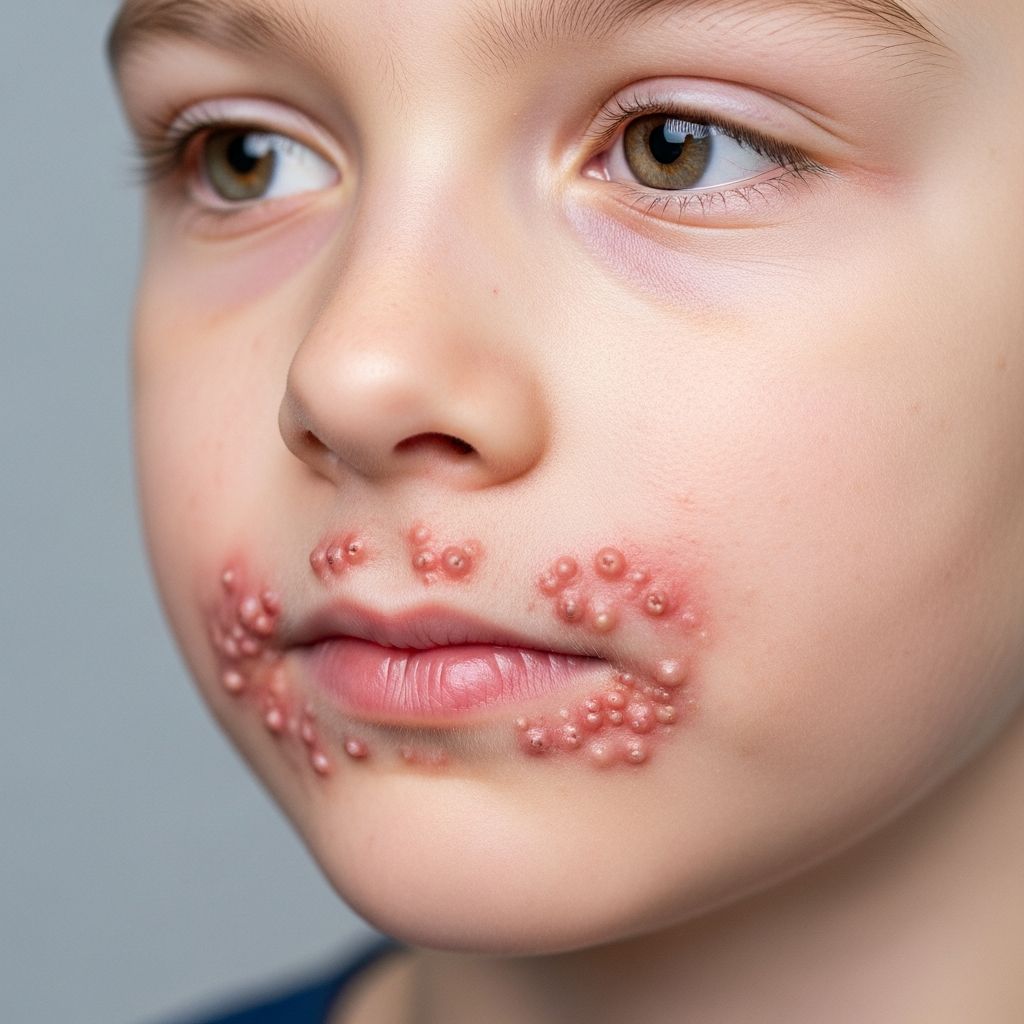
Periorificial dermatitis in children is a distinctive inflammatory skin condition characterized by clusters of small erythematous papules, pustules, or vesicles primarily around the mouth, nose, and eyes. Although the term suggests an eczematous process, it more closely resembles a paediatric form of rosacea, often linked to prior topical corticosteroid use on the face.
Introduction
Periorificial dermatitis, also known as perioral dermatitis when primarily affecting the mouth area, manifests as multiple small papules in the periorificial regions. This condition is frequently misdiagnosed as acne, eczema, or allergic reactions, leading to inappropriate treatments that can prolong the eruption. In children, it typically emerges between 3 months and prepubertal ages, with an average onset around 6.6 years. Early recognition is crucial to avoid triggers and initiate targeted therapy, which often leads to resolution within weeks to months.
The condition spares the vermilion border of the lips and may be asymptomatic or associated with mild burning, itching, or sensitivity. Its resemblance to adult rosacea underscores shared pathophysiological pathways, including perifollicular inflammation and potential microbial influences.
Demographics
Periorificial dermatitis predominantly affects children aged 3 months to 12 years, with a mean age of 6.6 years. It shows a slight female predominance, particularly in girls, though it occurs in both sexes. Children with darker skin tones are more prone to the granulomatous variant, presenting with flesh-coloured or hyperpigmented papules rather than erythematous ones.
- Age range: 3 months to prepubertal (average 6.6 years)
- Gender: Slightly more common in girls
- Skin type: Granulomatous form prevalent in darker skin
- Prevalence: Increasingly recognized in paediatric dermatology clinics, often in those with history of facial topical steroids
Adult periorificial dermatitis mainly impacts women aged 16–45 years, but paediatric cases highlight its occurrence across age groups, emphasizing the need for age-specific management.
Causes
The precise aetiology of periorificial dermatitis remains elusive, but it is widely regarded as multifactorial. A strong association exists with prior or ongoing use of topical corticosteroids on the face, which may initially suppress symptoms but lead to rebound worsening upon withdrawal. This steroid-induced variant is the most common trigger in children.
Other implicated factors include:
- Topical corticosteroids: Especially potent fluorinated steroids applied to the face
- Inhaled or nasal corticosteroids: Such as budesonide inhalers, depositing residue around orifices
- Fluorinated toothpaste: High-fluoride formulations irritating perioral skin
- Microbial factors: Fusiform bacteria, Candida albicans, or Demodex mites
- Cosmetics and skincare: Heavy creams, sunscreens, or foundations occluding follicles
- Hormonal influences: Possible role in pubertal or prepubertal children
- Other: Chewing gum, dental materials, facemasks, or improper CPAP use
Inhaled corticosteroids like budesonide can exacerbate the condition by direct contact with periorificial skin. Genetic predisposition and environmental factors contribute to perifollicular inflammation, akin to rosacea pathophysiology.
Clinical Features
Related Stories



The hallmark of periorificial dermatitis is multiple grouped erythematous papules (1–3 mm), often with pustules, vesicles, or scale, distributed around the mouth (perioral), nose (nasolabial folds), and eyes (periocular). Lesions are typically symmetrical but can be unilateral. The skin immediately adjacent to the lip vermilion is spared, distinguishing it from other perioral eruptions.
| Feature | Description |
|---|---|
| Primary lesions | Erythematous papules, papulopustules, vesicles; occasional scale or erythema |
| Distribution | Perioral (sparing vermilion), nasolabial, periocular; rarely genitals, trunk |
| Symptoms | Mild burning, sensitivity; less commonly itch; often asymptomatic |
| Variants | Granulomatous: flesh-coloured/monomorphic papules in darker skin |
As papules resolve, residual post-inflammatory erythema or scale may persist. In granulomatous periorificial dermatitis, common in children of colour, lesions appear as discrete 1–2 mm skin-coloured to pink papules without pustules, often larger (2–3 mm) and more inflammatory. Associated ocular findings like blepharitis or conjunctivitis may occur, mirroring ocular rosacea.
Diagnosis
Diagnosis is primarily clinical, based on characteristic morphology and periorificial distribution. History of topical steroid use or potential triggers is key. Skin biopsy is rarely needed but reveals perifollicular lymphocytic inflammation, granulomas in the variant form, or rosacea-like features.
Wood’s lamp or dermoscopy may aid in ruling out fungal infections. Laboratory tests are unnecessary unless systemic associations (e.g., SLE) are suspected.
Differential Diagnoses
Periorificial dermatitis must be differentiated from several mimicking conditions:
- Lip-licker’s dermatitis: Irritant contact from saliva; confined to tongue-reachable perioral area, with erythema/scaling but no papules; involves vermilion border
- Tinea faciei: Annular scaly plaques, not restricted to orifices; KOH-positive
- Acne vulgaris: Comedones present; post-pubertal predominance
- Seborrhoeic dermatitis: Greasy scale in nasolabial folds, eyebrows
- Allergic contact dermatitis: More diffuse, pruritic; patch testing if suspected
- Impetigo: Honey-crusted erosions; bacterial culture
The extension beyond tongue reach, papular morphology, and vermilion sparing favour periorificial dermatitis.
Treatment
Treatment centres on trigger avoidance, particularly discontinuing topical corticosteroids, which may cause temporary flare (steroid withdrawal). Gentle skincare is essential: use mild cleansers, avoid fluoridated toothpaste, heavy cosmetics, and irritants.
Topical therapies (first-line for mild cases):
- Metronidazole 0.75–1% gel/cream (once/twice daily, 3–8 weeks)
- Clindamycin 1% lotion/gel
- Erythromycin 2% gel
- Sulfacetamide preparations
- Topical ivermectin or pimecrolimus for refractory cases
Oral antibiotics (moderate-severe or persistent): Tetracycline-class (doxycycline, minocycline) not for young children; alternatives include erythromycin or azithromycin for 4–12 weeks.
Improvement typically occurs in 3–8 weeks with compliance. Zero-therapy (triggers cessation alone) suffices in mild steroid-induced cases. Monitor for ocular involvement.
Outcome
With appropriate management, periorificial dermatitis resolves fully without scarring, though recurrence is possible if triggers persist. Clearance takes 3–8 weeks for topical therapy; longer for severe cases. Post-inflammatory hyperpigmentation may linger in darker skin. Long-term avoidance of steroids and irritants prevents relapse. Prognosis is excellent in children.
Frequently Asked Questions (FAQs)
Q: Is periorificial dermatitis contagious?
A: No, it is not infectious; it is an inflammatory condition, not caused by viruses or bacteria transmissible person-to-person.
Q: Can it be cured permanently?
A: Yes, with trigger removal and treatment, it resolves completely, though avoiding steroids prevents recurrence.
Q: Is it related to rosacea?
A: Yes, considered a childhood variant sharing histological and clinical features, especially ocular associations.
Q: What if my child has darker skin?
A: They may develop granulomatous form with flesh-coloured papules; treatment is similar.
Q: How long does treatment take?
A: Typically 3–8 weeks for clearance with topical antibiotics.
References
- What’s the Diagnosis?: Periorificial Dermatitis — Children’s Mercy. 2024-12. https://www.childrensmercy.org/health-care-providers/refer-or-manage-a-patient/connect-with-childrens-mercy/newsletter-the-link/2024/the-link—december-2024/whats-the-periorificial-dermatitis/
- Periorificial Dermatitis in Children — DermNet NZ. 2024. https://dermnetnz.org/topics/periorificial-dermatitis-in-children
- Perioral Dermatitis — StatPearls, NCBI Bookshelf. 2023-08-08. https://www.ncbi.nlm.nih.gov/books/NBK525968/
- Perioral Dermatitis: Treatment, Symptoms & Causes — Cleveland Clinic. 2023. https://my.clevelandclinic.org/health/diseases/21458-perioral-dermatitis
Similar Articles








Read full bio of Sneha Tete