Peripheral Odontogenic Fibroma: Diagnosis And Treatment Guide
Uncommon benign gum tumour: slow-growing firm lump, mainly mandibular, diagnosed via histopathology post-excision.
Introduction
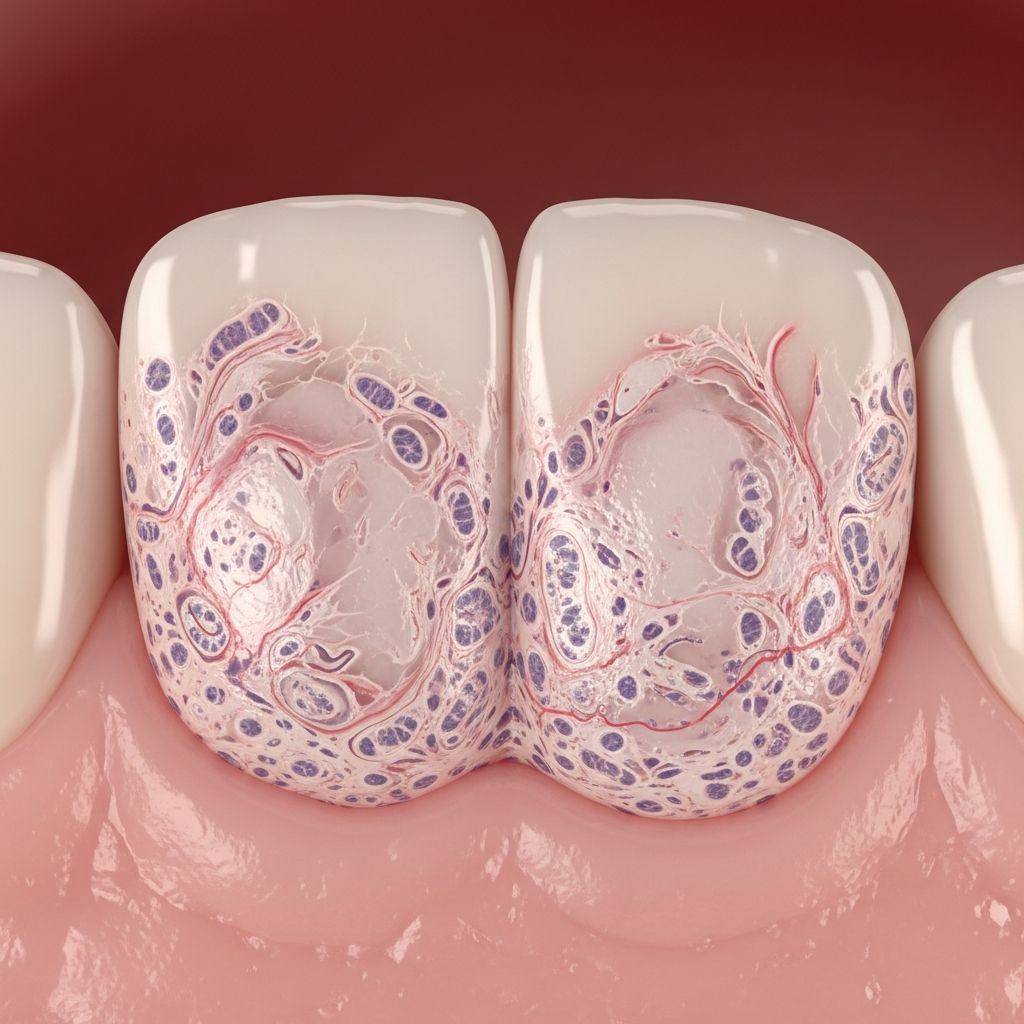
Peripheral odontogenic fibroma (POF) is an uncommon benign tumour arising from the soft tissues of the gingiva, representing the extraosseous counterpart to the central odontogenic fibroma, which occurs within the bone. Unlike the more prevalent peripheral ossifying fibroma, POF is classified as a true odontogenic neoplasm due to its origin from periodontal ligament cells and the presence of odontogenic epithelium. This tumour is characterized by a fibrous connective tissue stroma containing islands of odontogenic epithelium, occasionally with calcified material, distinguishing it from reactive gingival hyperplasias.
POF accounts for a small fraction of gingival lesions but holds significance in oral pathology for its potential to mimic other proliferative conditions. Accurate diagnosis relies on histopathological examination, as clinical features alone are nonspecific. While generally benign with low recurrence rates, long-term follow-up is recommended due to rare reports of recurrence years post-excision. This article explores the demographics, clinical presentation, diagnostic criteria, treatment approaches, and key differentials of POF, drawing from established pathological insights.
Demographics
Peripheral odontogenic fibroma manifests across a broad age spectrum, with cases documented from 2 to 80 years, though a slight peak incidence occurs in the third decade of life, around the twenties. Both males and females are affected equally, with no pronounced sex predilection reported in human cases. In veterinary literature, POF is notably the most common benign oral tumour in dogs, comprising 77.8% of benign oral tumours and 2.8% of all biopsied oral lesions, often in the mandibular premolar and maxillary anterior regions, mirroring human distribution patterns.
In humans, mandibular involvement predominates, particularly in the anterior region on the buccal gingival surface, though maxillary cases occur less frequently. Studies indicate around 73% of cases (11 out of 15) arise in the mandible. The lesion’s rarity underscores the need for awareness among oral surgeons and pathologists, as it can present asymptomatically for years before detection.
Clinical Features
Clinically, POF presents as a slow-growing, firm, sessile or pedunculated lump on the gingiva, typically measuring from a few millimeters to several centimeters in diameter. It develops more frequently on the mandibular gingiva than the maxillary, with equal distribution on lingual-palatal or labial-buccal surfaces. The surface appears smooth, pink, and non-ulcerated in most instances, progressing from subtle gingival thickening to expansive, cauliflower-like proliferations.
Symptoms are often minimal; patients may report painless swelling causing facial asymmetry if large, tooth displacement, or interference with occlusion. In a reported case, a 4 cm x 4 cm exophytic growth in the upper left premolar-molar region displaced adjacent teeth palatally within one year, highlighting occasional aggressive local behaviour atypical of its benign nature. Radiographically, superficial bone loss may occur without significant resorption, and the lesion remains confined to soft tissues.
In dogs, similar presentations include gingival masses at the front of the upper jaw, leading to drooling, eating discomfort, jaw chattering, or appetite loss due to bone involvement in subtypes like acanthomatous ameloblastomas. Growth is locally invasive, potentially causing tooth mobility or loss if untreated.
Related Stories



Diagnosis
Definitive diagnosis of peripheral odontogenic fibroma requires histopathological evaluation following excisional biopsy, as no capsule defines the lesion’s borders clinically. Microscopically, POF features a fibrous or fibromyxomatous stroma of proliferated fibroblasts interspersed with islands, strands, or trabeculae of odontogenic epithelium—often inactive columnar cells resembling epithelial rests of Malassez. Variable calcifications, including osteoid, cementum-like, or dentinoid material, may be present but are not invariably seen.
This epithelial-mesenchymal admixture classifies POF as a mixed odontogenic tumour, differentiating it from purely mesenchymal lesions. The odontogenic epithelium’s presence is the hallmark distinguishing feature from focal fibrous hyperplasia. Incisional biopsy is advised for larger lesions to confirm diagnosis preoperatively, with radiological assessment ruling out bony involvement.
Differential diagnoses include:
- Peripheral ossifying fibroma: More common reactive lesion with prominent calcification and mineralized foci, lacking true odontogenic epithelium.
- Focal fibrous hyperplasia: Dense collagenous tissue without odontogenic epithelium, often irritation-induced in brachycephalic breeds.
- Peripheral giant cell granuloma, pyogenic granuloma, peripheral ameloblastoma: Distinguished by giant cells, vascular proliferation, or ameloblastic islands respectively.
| Lesion | Key Features | Epithelium | Calcification |
|---|---|---|---|
| POF | Fibrous stroma, odontogenic islands | Present (strands/islands) | Variable |
| Ossifying Fibroma | Cellular fibrous, mineralized drops | Absent or minimal | Prominent |
| Fibrous Hyperplasia | Dense collagen, mature fibroblasts | Absent | Absent |
Treatment
The standard treatment for peripheral odontogenic fibroma is wide surgical excision with a 3-5 mm margin of clinically normal gingiva to ensure complete removal, given the lack of a fibrous capsule. Tooth extraction is indicated if the lesion encircles roots or causes significant bone loss. Conservative approaches like curettage are insufficient due to local invasiveness. Postoperative prosthetic rehabilitation may be necessary for edentulous areas.
Recurrence is rare but documented, with one case reported after 11 years, emphasizing rigorous long-term follow-up at 6 months, then annually. In veterinary cases, early intervention prevents extensive invasion. Healing typically occurs uneventfully with primary intention closure.
Pathogenesis
POF originates from periodontal ligament fibroblasts with entrapped odontogenic epithelium, explaining its gingival exclusivity. The World Health Organization (1992) defines it as a fibroblastic neoplasm with varying odontogenic epithelium, potentially producing calcified elements. While mesenchymal dominance prevails, epithelial components are diagnostic. Genetic or inductive factors may drive proliferation, though aetiology remains unclear; chronic irritation is not causal, unlike reactive lesions.
Frequently Asked Questions
Q: Is peripheral odontogenic fibroma cancerous?
A: No, it is a benign neoplasm with no metastatic potential, though locally invasive and requiring complete excision.
Q: How common is POF compared to other gum growths?
A: Rare in humans; more prevalent in dogs as the top benign oral tumour (77.8%).
Q: Does POF cause pain?
A: Usually asymptomatic, but large lesions may cause discomfort, tooth displacement, or eating difficulties.
Q: Can POF recur?
A: Rare, but follow-up is essential; one case recurred after 11 years.
Q: What is the difference from peripheral ossifying fibroma?
A: POF has odontogenic epithelium (true tumour); ossifying fibroma is reactive with calcifications but no epithelium.
References
- Peripheral Odontogenic Fibroma in Dogs: Vet Clinical Guide — VeterinaryDentistry.net. 2023. https://veterinarydentistry.net/peripheral-odontogenic-fibroma/
- Peripheral odontogenic fibroma — DermNet NZ. 2010 (updated). https://dermnetnz.org/topics/peripheral-odontogenic-fibroma
- A rare benign odontogenic neoplasm: peripheral odontogenic fibroma — PMC (NCBI). 2014-06-12. https://pmc.ncbi.nlm.nih.gov/articles/PMC4069815/
- Oral Tumors – Peripheral Odontogenic Fibromas — VCA Animal Hospitals. 2023. https://vcahospitals.com/know-your-pet/oral-tumors—peripheral-odontogenic-fibromas
Similar Articles








Read full bio of medha deb