Perpendicular White Lines Dermoscopy: 6 Lesions To Recognize
Discover perpendicular white lines in dermoscopy: key diagnostic feature for BCC, melanoma, and more under polarized light.
In dermoscopy,
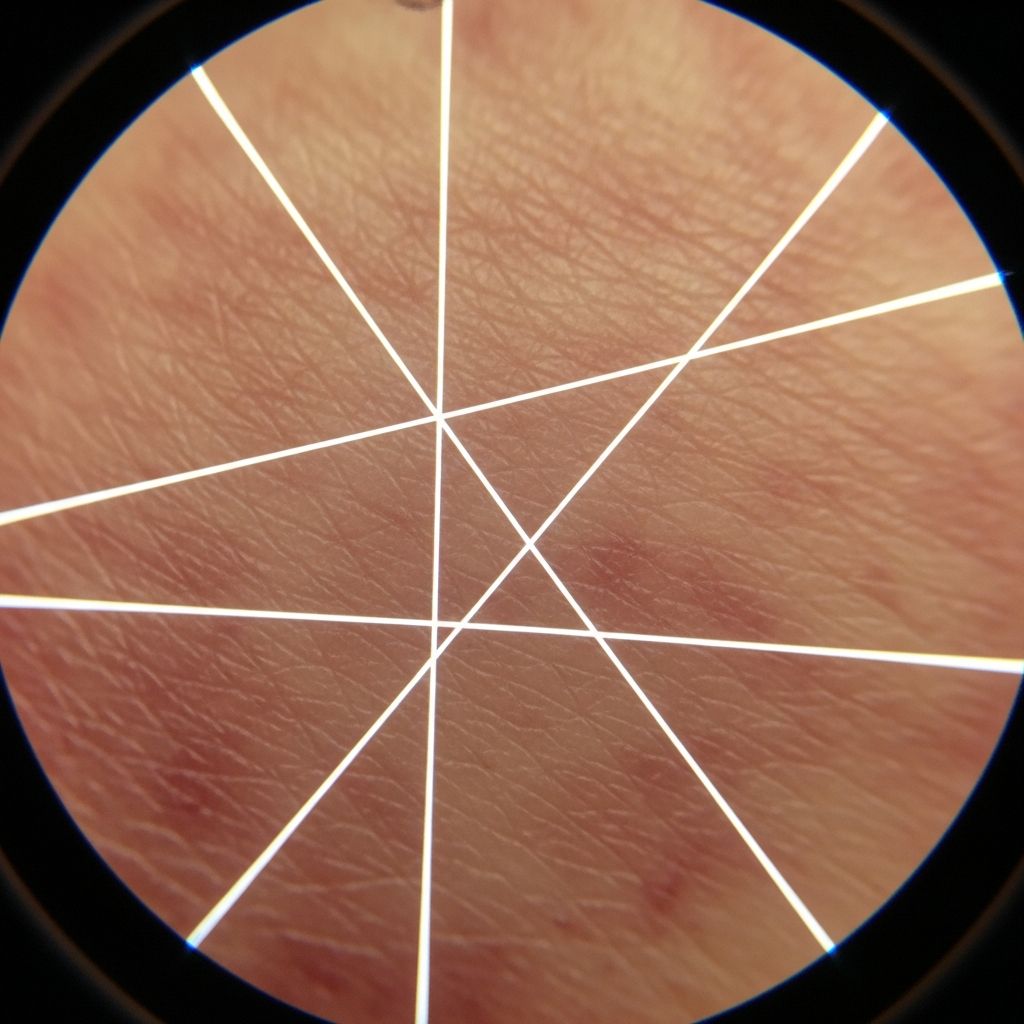
perpendicular white lines
represent a distinctive feature characterized by short, discrete white lines oriented parallel and orthogonal to each other, visible exclusively under polarized light. These lines, also referred to as polarizing white lines, short white lines, shiny white lines, shiny white streaks, chrysalis, chrysalids, or crystalline structures, serve as important diagnostic clues primarily for basal cell carcinoma (BCC) and certain melanomas.What are Perpendicular White Lines?
Perpendicular white lines are subtle yet critical dermoscopic structures that emerge prominently when polarized light is employed during examination. Unlike many other dermoscopic patterns, these lines do not appear under non-polarized light, making the use of polarized dermoscopy essential for their detection. They manifest as brief, gleaming white streaks that shift orientation as the dermatoscope is tilted or moved across the lesion’s surface, creating a dynamic visual effect.
This phenomenon arises from the interaction between polarized light and the optical properties of dermal structures. The lines’ perpendicular arrangement—some running horizontally, others vertically—forms a grid-like pattern that dermatologists have learned to recognize as a red flag for specific pathologies. Their discovery stemmed from comparative studies in 2012, which highlighted their exclusive visibility under polarized conditions, distinguishing them from other white structures.
Clinical Features Under Dermatoscope
Under the dermatoscope, perpendicular white lines present as
short, shiny white lines
that are highly conspicuous due to their brightness against the lesion’s background. They are best appreciated in lesions with a pink or hypopigmented appearance, where pigmentation might otherwise obscure subtle features. Experts recommend using hybrid dermoscopes that allow switching between polarized and non-polarized modes to confirm their presence, as the lines ‘blink’ on and off with light mode changes.In basal cell carcinoma (BCC), these lines often accompany other classic features like arborizing vessels, ulceration, or blue-gray ovoid nests. For melanomas, they may appear in both in situ and invasive forms, sometimes alongside atypical pigment networks or irregular globules. The lines’ movement with lens adjustment is a hallmark, aiding differentiation from static white structures like fibrosis streaks seen in other contexts.
Polarised and Non-Polarised Light
A key diagnostic attribute of perpendicular white lines is their
exclusive visibility under polarised light
. Paired images from clinical cases illustrate this stark contrast: under non-polarized dermoscopy, the lesion may show vascular patterns, pigmentation, or dots, but the white lines remain absent. Switching to polarized mode reveals the characteristic grid of shiny lines, which can dramatically alter the diagnostic impression.This polarity dependence is not merely technical but biologically rooted. Non-polarized light scatters in all directions, masking the birefringence, while polarized light aligns photons to highlight collagen’s optical properties. Clinicians must always perform both modes in suspicious pink or amelanotic lesions to avoid missing this clue.
- Non-polarized light: No perpendicular white lines; focus on vessels, pigment, or scales.
- Polarized light: Shiny perpendicular white lines emerge, often orthogonal and parallel.
- Hybrid mode benefit: Allows real-time confirmation by toggling light types.
Lesions Visible with Perpendicular White Lines
Perpendicular white lines are observed across a spectrum of benign and malignant lesions, necessitating careful correlation with other dermoscopic and clinical features for accurate diagnosis. The most common associations include:
Related Stories



- Pigmented and non-pigmented basal cell carcinoma (BCC): Seen in superficial, nodular, and infiltrative subtypes; often with leaf-like areas or arborizing vessels.
- Melanoma: Including melanoma in situ, superficial spreading, nodular (e.g., Breslow 2.5–6.8 mm), and amelanotic variants.
- Spitz nevus: Particularly in atypical or genital presentations; lines may be less structured.
- Dermatofibroma: Often radial or peripheral rather than strictly perpendicular; may feature central white rings.
- Scar tissue: Common in healed or fibrotic areas; lines reflect post-inflammatory fibrosis.
- Benign lichenoid keratosis: Irritated seborrheic keratosis variant with shiny lines amid comedo-like openings.
In chaotic lesions, their presence heightens suspicion for malignancy, especially when combined with negative pigment networks or irregular borders.
Histological Explanation
Histopathologically, perpendicular white lines correspond to
altered collagen in the dermis, specifically fibrosis
. The birefringent properties of thickened collagen bundles cause rapid randomization of polarized light, rendering them bright white and prominent under polarized dermoscopy. This optical effect is absent under non-polarized illumination, explaining the feature’s specificity.In melanomas, these lines correlate with dermal invasion, where tumor cells induce stromal fibrosis. Notably, they can appear in melanoma in situ without invasion, suggesting early stromal reaction. In BCC, they align with sclerosing or fibrotic subtypes. Dermatofibromas show similar collagen changes but often with epidermal hyperplasia.
Studies confirm that white shiny structures, including lines, are significantly more prevalent in BCC (up to 31.9% showing combined lines and areas), underscoring their diagnostic value (P<0.001). This collagen-mediated birefringence is a fundamental principle in polarized dermoscopy.
Diagnostic Significance and Differential Diagnosis
While highly suggestive of BCC or melanoma, perpendicular white lines are not pathognomonic. A table summarizes key differentials:
| Lesion | Key Associated Features | Line Pattern |
|---|---|---|
| BCC | Arborizing vessels, ulceration, blue ovoids | Perpendicular, strands/blotches |
| Melanoma | Atypical network, blue-white veil, polymorphous vessels | Shiny, orthogonal |
| Dermatofibroma | Central white ring, peripheral pigment | Radial white lines |
| Spitz nevus | Starburst, globular pattern | Less structured |
| Scar | Homogeneous fibrosis, no pigment | Grid-like |
In pink lesions, their detection prompts biopsy consideration. Specificity increases with reticular white lines alongside pigmented networks.
Frequently Asked Questions (FAQs)
Q: Are perpendicular white lines only seen in skin cancer?
A: No, they appear in benign lesions like dermatofibromas, scars, Spitz nevi, and lichenoid keratosis, but raise suspicion for BCC and melanoma.
Q: Why are they invisible under non-polarized light?
A: Polarized light exploits collagen birefringence; non-polarized scatters, hiding the effect.
Q: Do they indicate invasion in melanoma?
A: Often correlate with dermal invasion but seen in in situ cases too.
Q: What equipment is best for viewing them?
A: Hybrid polarized/non-polarized dermoscopes for confirmation.
Q: How common are they in BCC?
A: Up to 38.7% of lesions show white shiny structures, with 31.9% combined lines/areas in BCC.
Clinical Implications and Best Practices
Incorporating perpendicular white lines into dermoscopic algorithms enhances non-invasive diagnostic accuracy. For hypopigmented or pink lesions—often challenging—they provide a vital clue amid subtle vascular or textural changes. Training emphasizes pattern recognition, with studies validating their role in reducing unnecessary biopsies while flagging malignancies.
Dermatologists should document light mode, lesion dynamics, and adjunct features. Future research may refine specificity through AI-assisted image analysis, but current evidence solidifies their place in routine practice.
References
- Perpendicular white lines dermoscopy — DermNet NZ. 2023. https://dermnetnz.org/topics/perpendicular-white-lines-dermoscopy
- Dermatoscopy of perpendicular white lines — Doctor Hoogstra. 2022. https://doctorhoogstra.com/en/wiki/dermatoscopy-of-perpendicular-white-lines/
- Expert offers tips for sorting out pink lesions dermoscopy — MDedge Dermatology. 2020-10-15. https://blogs.the-hospitalist.org/content/expert-offers-tips-sorting-out-pink-lesions-dermoscopy
- Dermoscopy Essentials: Shiny White Lines — Dermatoscopes.com. 2023. https://dermatoscopes.com/blogs/dermatoscope-reviews/shiny-white-lines
- Dermatoscopy in routine practice — RACGP. 2012-07. https://www.racgp.org.au/afp/2012/july/dermatoscopy-in-routine-practice
- Shiny white structures — Dermoscopedia. 2023. https://dermoscopedia.org/Shiny_white_structures
- White shiny structures: dermoscopic features revealed under polarized dermoscopy — PubMed (Br J Dermatol). 2011-10. https://pubmed.ncbi.nlm.nih.gov/22035217/
Similar Articles








Read full bio of medha deb