Peutz-Jeghers Syndrome: An Essential Guide To Risks And Care
Rare genetic disorder with GI polyps and mucocutaneous pigmentation, increasing cancer risk.
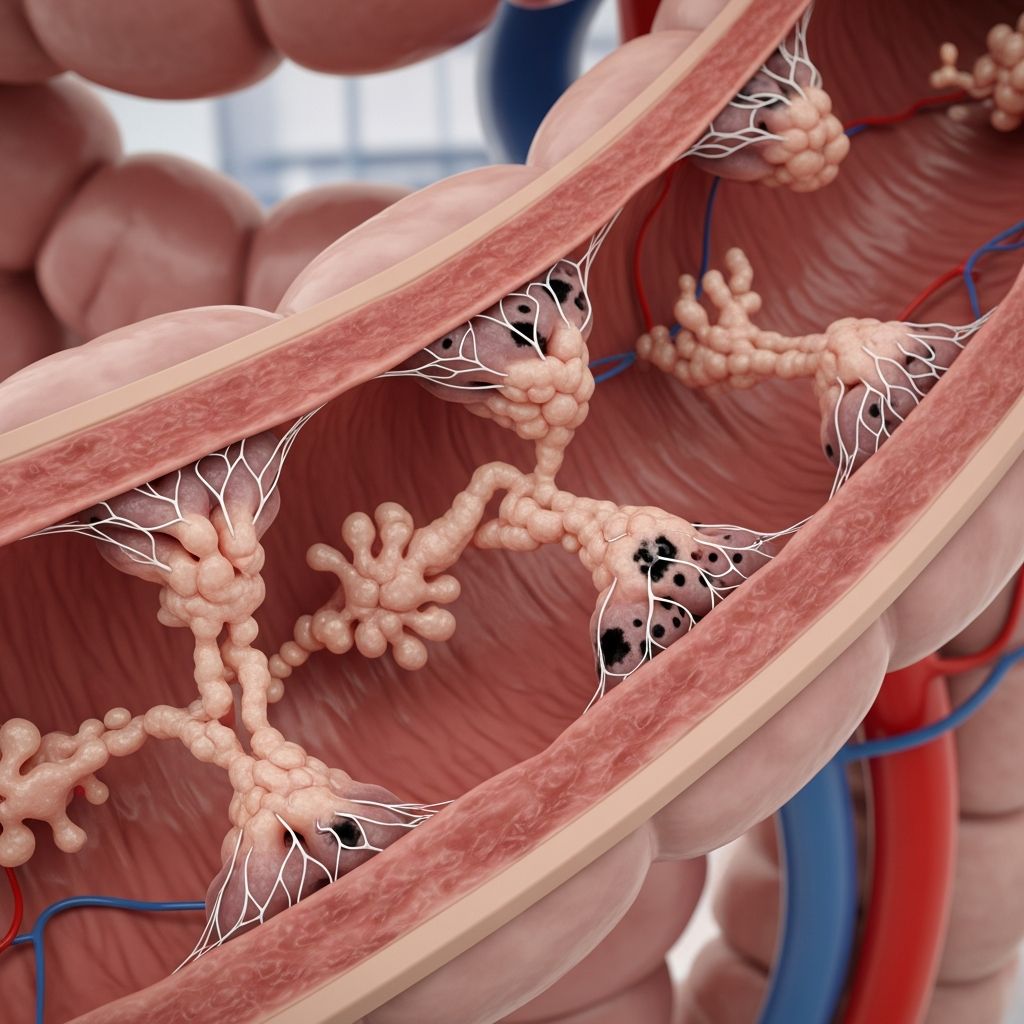
Peutz-Jeghers syndrome (PJS) is a rare autosomal dominant genetic disorder characterized by the development of hamartomatous polyps throughout the gastrointestinal tract and distinctive mucocutaneous hyperpigmentation, particularly around the lips, oral mucosa, and digits. These features typically manifest in childhood, with polyps causing complications like intussusception, bleeding, and obstruction, while affected individuals face significantly elevated lifetime cancer risks across multiple organ systems.
What is Peutz-Jeghers Syndrome?
Peutz-Jeghers syndrome is a hereditary cancer predisposition syndrome defined by multiple hamartomatous polyps in the gastrointestinal (GI) tract—most commonly the small intestine—and periorificial mucocutaneous pigmentation. Hamartomas are benign growths composed of disorganized normal tissue elements, distinguishing them from neoplastic polyps. The syndrome confers a markedly increased risk of developing various malignancies, including GI, pancreatic, breast, ovarian, and others, necessitating lifelong surveillance.
The condition affects approximately 1 in 50,000 to 1 in 200,000 individuals worldwide. Symptoms often begin in the first or second decade of life, though pigmentation may appear at birth or infancy. Polyps can lead to acute presentations like bowel obstruction via intussusception, particularly in children, while chronic issues include anemia from recurrent bleeding.
Who gets Peutz-Jeghers Syndrome? (Epidemiology)
PJS occurs equally in males and females and across ethnic groups, with no known environmental risk factors. It follows an autosomal dominant inheritance pattern, meaning a 50% chance of transmission from an affected parent to each child. Up to 25-50% of cases arise de novo (sporadically) without family history, complicating early detection.
- Incidence: Rare, estimated at 1:50,000–1:200,000 live births.
- Age of onset: Pigmentation in infancy/childhood; polyp-related symptoms by adolescence (median age 10-12 years).
- Familial cases: ~50% have affected relatives; sporadic mutations account for the rest.
What causes Peutz-Jeghers Syndrome?
PJS results primarily from germline mutations in the STK11 (serine/threonine kinase 11) gene on chromosome 19p13.3, a tumor suppressor regulating cell polarity, growth, and metabolism via the LKB1-AMPK pathway. Over 90% of clinically diagnosed cases harbor STK11 pathogenic variants, which are heterogeneous (missense, nonsense, frameshift, deletions).
Loss of the remaining wild-type STK11 allele in somatic cells (second hit) drives hamartoma and carcinoma formation per the Knudson two-hit hypothesis. Rarely (5-10%), PJS phenotype arises from biallelic mutations in STK11-like genes or unknown loci.
| Gene | Proportion of PJS Cases | Function |
|---|---|---|
| STK11/LKB1 | ~90% | Tumor suppressor, cell polarity/growth regulation |
| Other/Unknown | ~10% | Not fully elucidated |
What are the clinical features of Peutz-Jeghers Syndrome?
Mucocutaneous Pigmentation
The hallmark is dark brown to blue-black lentiginous macules (1-5 mm) on the vermilion border and inner lips (95% of cases), buccal mucosa, perioral area, fingers/toes, palms/soles, and perianal region. Lesions appear in infancy, may fade post-puberty (50-80%), but oral/genital ones persist.
Gastrointestinal Polyps
Multiple (dozens to hundreds) hamartomatous polyps develop throughout the GI tract: small bowel (jejunum/ileum, 60-90%), stomach (20-50%), colon (25-50%), rarely duodenum/rectum. Polyps >1 cm cause complications; histology shows arborizing smooth muscle core.
Extraintestinal Manifestations
- Genital: Sertoli cell tumors (5-9% males, prepubertal gynecomastia), sex cord tumors with annular tubules (30% females, minimal malignancy risk).
- Pancreas: Non-calcified cysts/microcystic adenomas.
- Lungs: Bullae/emphysema, rare cysts.
- Other: Gallbladder polyps, nasal polyps, congenital heart defects.
Related Stories



Symptoms of Peutz-Jeghers Syndrome
Many remain asymptomatic until polyps cause obstruction or bleeding. Common presentations include:
- Abdominal pain/cramps: Recurrent, colicky from partial obstruction/intussusception (50% by age 20).
- GI bleeding: Melena/hematochezia (20-40%), leading to iron-deficiency anemia/fatigue.
- Nausea/vomiting: Proximal obstruction.
- Intussusception: 50-90% of pediatric obstructions; requires surgery in 30%.
- Endocrine: Gynecomastia (pubertal males), precocious puberty (rare).
How is Peutz-Jeghers Syndrome diagnosed?
Diagnosis relies on clinical criteria (Table 1) plus genetic confirmation. Pigmentation + polyps/family history is pathognomonic.
| Clinical Criteria (any one sufficient) |
|---|
| 2+ histologically confirmed PJS polyps |
| Mucocutaneous pigmentation + 1 PJS polyp |
| Mucocutaneous pigmentation + family history of PJS |
| STK11 pathogenic variant |
Genetic testing (multigene panel) confirms in 80-95%. Endoscopy/capsule endoscopy visualizes polyps; biopsy distinguishes hamartomas.
Genetic Testing in Peutz-Jeghers Syndrome
Offered to index cases/families post-counseling. Identifies variants for cascade screening (50% at-risk relatives). Negative STK11 prompts reevaluation or research testing. Prenatal/PGD available for known familial mutations.
Management and Surveillance
Multidisciplinary: gastroenterology, genetics, surgery, oncology. Focus: polyp debulking, symptom relief, cancer screening.
Polyp Surveillance
- Age 8-10: Baseline upper endoscopy + small bowel imaging (MRE/MRCP/capsule).
- Repeat q2-3y if polyps; q3y from age 18 if clear.
- Colonoscopy q2-3y from age 18.
- Endoscopic/surgical polypectomy for ≥1cm polyps.
Cancer Surveillance
| Organ | Cumulative Risk | Screening |
|---|---|---|
| GI | ~50% | Endoscopy as above |
| Pancreas | 11-36% | MRI/MRCP q1-2y age 30-40 |
| Breast (F) | 32-54% | Mammo/MRI q1-2y age 25 |
| Cervix/Ovary (F) | 10%/17% | Pap q1-3y age 20; TVUS age 25 q1-2y |
| Testes (M) | 9% | US q1y puberty onward |
Treatment of Complications
Acute intussusception/obstruction: Air enema reduction or laparotomy/polypectomy. Chronic bleeding: Iron supplementation/endotherapy.
Complications of Peutz-Jeghers Syndrome
- High cancer risk: 85-93% lifetime (GI 50%, extra-GI variable); earlier onset.
- Recurrent obstruction: 50%+ require surgery.
- Anemia/nutritional deficits: From occult bleeding.
- Psychosocial: Anxiety from surveillance/cancer fear.
Prognosis and Cancer Risks
Without surveillance, malignancy causes 50% mortality by age 50. Intensive screening reduces this via early detection. Polyp burden decreases with age; pigmentation fades.
| Cancer Type | Lifetime Risk |
|---|---|
| Colorectal | 39% |
| Stomach | 29% |
| Pancreas | 36% |
| Breast | 54% |
| Ovary | 21% |
Frequently Asked Questions (FAQs)
What is the main cause of Peutz-Jeghers syndrome?
Germline mutations in the STK11 gene, accounting for over 90% of cases.
At what age should screening begin?
GI endoscopy and small bowel imaging at ages 8-10; cancer-specific screens per guidelines from late teens/adulthood.
Can pigmentation fade over time?
Yes, skin lesions often fade after puberty, but oral/perianal spots persist.
Is PJS curable?
No, but surveillance and polyp management mitigate complications and cancer risk.
What is the inheritance pattern?
Autosomal dominant; 50% risk to offspring, with 25-50% de novo cases.
References
- Peutz-Jeghers Syndrome – StatPearls — McGarrity TJ et al., NCBI Bookshelf. 2023-10-01. https://www.ncbi.nlm.nih.gov/books/NBK535357/
- Peutz-Jeghers Syndrome (PJS) — Children’s Hospital of Philadelphia. 2023. https://www.chop.edu/conditions-diseases/peutz-jeghers-syndrome-pjs
- Peutz-Jeghers Syndrome — NORD (National Organization for Rare Disorders). 2023. https://rarediseases.org/rare-diseases/peutz-jeghers-syndrome/
- The Management of Peutz–Jeghers Syndrome — Syngal S et al., Insight-group.org (ESPEN/ESPGHAN guideline). 2021-02-01. https://insight-group.org/wp-content/uploads/2021/02/PJS-guideline.pdf
- Management of Peutz-Jeghers Syndrome in Children — ESPGHAN. 2019. https://www.espghan.org/dam/jcr:f5328de4-2e6c-4941-a7eb-1095dffcd292/2019_Management_of_Peutz-Jeghers_Syndrome_in_children.pdf
- Peutz-Jeghers Syndrome — American Cancer Society. 2023. https://www.cancer.org/cancer/risk-prevention/genetics/family-cancer-syndromes/peutz-jeghers-syndrome.html
Similar Articles








Read full bio of Sneha Tete