Phimosis and Paraphimosis: Causes, Symptoms, and Treatment
Understanding foreskin conditions: Learn about phimosis and paraphimosis symptoms and treatment options.
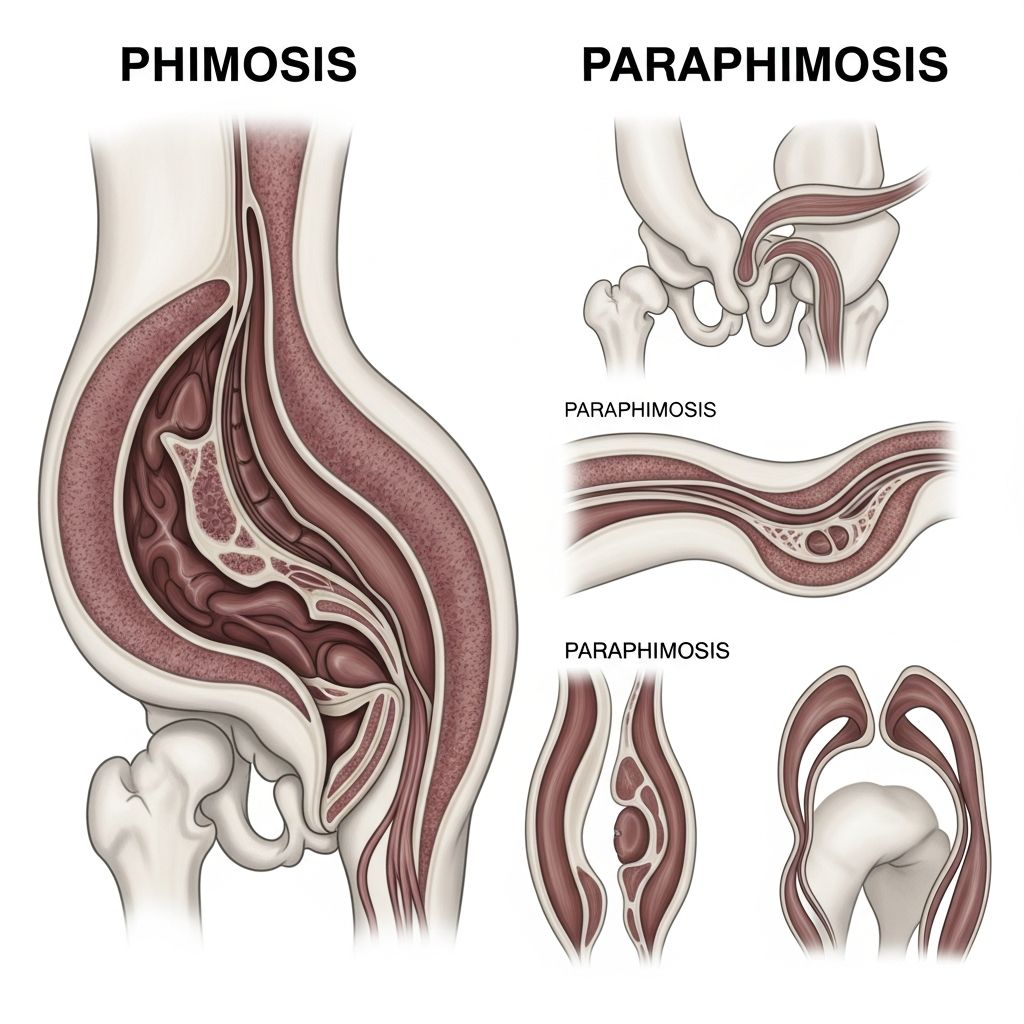
Understanding Phimosis and Paraphimosis
Phimosis and paraphimosis are two distinct conditions affecting the foreskin of the penis, each presenting unique challenges and requiring different approaches to treatment. While these conditions may sound similar, they represent different medical scenarios with distinct causes and symptoms. Understanding the differences between these conditions is essential for proper diagnosis and effective management. Both conditions are relatively common, particularly in children and adolescents, though they can occur at any age.
What is Phimosis?
Phimosis is a condition in which the foreskin of the penis cannot be pulled back or retracted from the tip of the penis. This tightness of the foreskin opening is actually a normal condition in newborn babies and young infants. The foreskin is designed to be tight at birth as a protective mechanism. Over time, as children grow and develop, the foreskin gradually loosens and becomes more flexible. Most boys are able to fully retract their foreskin by age 7, though this timeline can vary among individuals.
Phimosis becomes a concern only when the tightness persists beyond the expected developmental period or when it causes functional problems. In some cases, phimosis can develop later in childhood or even in adulthood due to scarring or inflammation of the foreskin tissue.
Causes of Phimosis
Understanding the underlying causes of phimosis is important for determining the most appropriate treatment strategy. The causes of phimosis include:
- Natural tightness at birth: This is the most common cause and typically resolves naturally over time as the child grows.
- Forced retraction: One of the most preventable causes of phimosis occurs when the foreskin is forcibly retracted before it is ready to be retracted naturally. This premature or forceful retraction can cause scarring of the delicate tissue, which may prevent the foreskin from retracting properly later in life.
- Infection or inflammation: Recurrent infections or inflammatory conditions can lead to scarring and subsequent tightness of the foreskin.
- Poor hygiene: Inadequate cleaning can lead to buildup of smegma and subsequent inflammation.
- Trauma or injury: Any injury to the penile region can result in scarring that contributes to phimosis.
Symptoms of Phimosis
The symptoms associated with phimosis can vary considerably from one individual to another, depending on the severity of the condition. Common symptoms include:
- Inability to retract the foreskin
- Swelling and tenderness of the foreskin
- Pain or discomfort during urination
- Weak urinary stream
- Blood in the urine in some cases
- Recurrent urinary tract infections
- Ballooning of the foreskin during urination
- Difficulty with penile hygiene
It is important to note that many boys with phimosis are asymptomatic and may not experience any of these symptoms, particularly if the condition is mild.
What is Paraphimosis?
Paraphimosis is a different condition from phimosis, though the two are often confused. In paraphimosis, the foreskin is retracted behind the crown or corona of the penis but cannot be moved back to its normal, unretracted position. When the foreskin remains retracted and cannot move forward, it acts like a tight ring or tourniquet around the penis. This constriction prevents normal fluid and blood flow, causing the tissue to swell and the situation to worsen progressively.
Paraphimosis is considered a medical emergency that requires prompt treatment to prevent serious complications, including tissue damage and loss of function.
Causes of Paraphimosis
Paraphimosis commonly develops in specific medical situations. The most common causes include:
- Medical procedures: Paraphimosis often occurs iatrogenically, meaning it is caused inadvertently during medical care. Common procedures that can lead to paraphimosis include urinary catheter placement, cystoscopy, and physical examination of the penis for medical purposes.
- Inadequate replacement: Failure to return the retracted foreskin over the glans promptly after an initial retraction is the primary cause. This is particularly important when caregivers change Foley catheters, as the foreskin must be routinely replaced at the end of the procedure to prevent paraphimosis development.
- Penile trauma: Sexual trauma or coital injury can lead to paraphimosis.
- Self-inflicted injuries: In rare cases, intentional or unintentional self-injury can result in paraphimosis.
- Cleaning and hygiene: Overzealous cleaning or manipulation of the foreskin can occasionally result in paraphimosis if the foreskin is not promptly returned to its normal position.
Related Stories



Symptoms of Paraphimosis
Paraphimosis presents with distinctive symptoms that reflect the compromised blood flow and swelling of the affected tissue. Typical symptoms include:
- Severe pain in the penile region
- Marked swelling of the foreskin and glans penis
- Erythema (redness) of the affected tissue
- Discoloration of the tip of the penis (may appear dark red, purple, blue, or even black as circulation is compromised)
- Inability to pull the foreskin back over the tip of the penis
- Pain or difficulty with urination
- Decreased urinary stream
- A visible constricting ring of tissue around the penis
Unlike phimosis, which may be asymptomatic in many cases, paraphimosis is almost always symptomatic and presents as an acute medical problem requiring urgent attention.
Diagnosis of Phimosis and Paraphimosis
Diagnosis of both conditions typically involves a straightforward medical history and physical examination. A careful physical examination by a qualified physician normally provides satisfactory information to make an accurate diagnosis. The healthcare provider will assess the appearance of the foreskin, evaluate the ability to retract it, and determine the presence of any associated symptoms.
For phimosis, the diagnosis is confirmed when the foreskin cannot be retracted even with gentle traction. For paraphimosis, the diagnosis is evident from the visual appearance of the retracted foreskin that cannot be repositioned, combined with the associated swelling and discoloration.
Additional diagnostic testing is rarely necessary, though in some cases, healthcare providers may inquire about recent medical procedures, trauma, or infections to understand the etiology of the condition.
Treatment Options for Phimosis
Treatment for phimosis depends on several factors, including the patient’s age, severity of symptoms, and whether the condition is causing functional problems. Both medical and surgical treatment options are available.
Conservative Medical Treatment
Steroid cream application: A topical corticosteroid cream is often the first-line treatment for phimosis. A prescription cream such as betamethasone 0.05% is typically applied two to three times daily to the tip of the foreskin and the area touching the glans. The treatment duration usually ranges from 4 to 6 weeks, though some protocols recommend up to one month or three months of continuous application. This non-invasive approach works by reducing inflammation and helping to loosen the tight foreskin tissue. Research indicates that in approximately 80% of boys, this simple treatment is sufficient to resolve the condition.
Gentle stretching: In conjunction with steroid cream application, gentle manual stretching of the foreskin can be effective. This involves carefully stretching the foreskin with two fingers or over an erect penis for 2 to 3 weeks, taking care not to cause paraphimosis.
Improved hygiene: Maintaining proper penile hygiene and avoiding forced retraction can help prevent worsening of the condition and reduce the risk of infection.
Surgical Treatment
Circumcision: For cases where conservative treatment fails or in children age 7 or older who continue to experience problems such as bulging foreskin during urination, circumcision may be recommended. Circumcision involves surgical removal of all or part of the foreskin. If the foreskin is unable to be retracted and significant scarring is present, surgical intervention becomes the preferred approach. Circumcision is generally considered the definitive treatment for phimosis when medical therapy is unsuccessful.
Treatment Options for Paraphimosis
Paraphimosis requires more urgent intervention than phimosis due to the risk of compromised blood flow and tissue damage. Treatment approaches range from non-surgical to surgical interventions.
Manual Reduction
For mild, uncomplicated paraphimosis, manual reduction can often be successful without the need for sedation or analgesia. Several manual techniques are available:
- Compression and traction method: A simple but effective approach involves manually compressing the edematous (swollen) foreskin while pulling slowly upward on the penis. This technique is often facilitated by first applying gentle compression to the glans and swollen foreskin for several minutes. This allows the edematous swelling to diminish somewhat before attempting the reduction, making repositioning easier and less painful.
- Lubrication and gentle squeezing: Under local anesthesia or sedation when necessary, the foreskin and tip of the penis are lubricated, then the tip of the penis is gently squeezed while pulling the foreskin forward.
- Hyaluronidase injection: In more difficult cases, particularly in children and infants, directly injecting hyaluronidase into the edematous foreskin has proven effective. This enzyme increases the diffusion of trapped fluid within the tissue planes of the malpositioned foreskin, reducing swelling and edema and allowing for easier manual reduction of the paraphimosis.
Procedural Interventions
More difficult or complicated cases of paraphimosis may require procedural interventions. These include:
- Local anesthesia with dorsal penile block: Application of local anesthesia or a dorsal penile block provides pain relief during manual reduction attempts.
- Procedural sedation: In some cases, systemic analgesia or procedural sedation may be necessary to allow safe reduction of the paraphimosis.
- Surgical incision: If manual reduction fails, a small incision (incision) may be made in the foreskin to relieve tension and allow the foreskin to be pulled forward.
Emergency Surgical Treatment
Emergency circumcision: If other treatment methods fail or if there is evidence of compromised tissue viability, emergency circumcision may be recommended. In rare severe cases where necrosis (tissue death) has already occurred, more extensive surgical intervention such as partial penectomy or resection of the glans may be necessary, though conservative management with suprapubic tube drainage and surgical debridement is increasingly preferred to preserve penile function when possible.
Complications and Prevention
Both phimosis and paraphimosis can lead to complications if not properly managed. Complications of phimosis include recurrent urinary tract infections, difficulty with hygiene, and potential urinary retention in severe cases. Paraphimosis can lead to much more serious complications, including restricted blood flow, tissue necrosis, gangrene, and even loss of penile tissue if not treated promptly.
Prevention strategies include avoiding forced retraction of the foreskin in young children, ensuring proper replacement of the foreskin after medical procedures such as catheterization, and maintaining adequate penile hygiene without aggressive manipulation.
Frequently Asked Questions
Q: Is phimosis normal in infants and young children?
A: Yes, phimosis is completely normal in newborns and infants. The foreskin is naturally tight at birth as a protective mechanism. Most boys develop the ability to retract their foreskin by age 7, though this timeline varies among individuals. Phimosis only becomes a concern if it persists with associated symptoms or causes functional problems.
Q: Is paraphimosis a medical emergency?
A: Yes, paraphimosis is considered a medical emergency requiring immediate treatment. The constricted foreskin can compromise blood flow to the penis, potentially leading to tissue damage if not promptly addressed. If you suspect paraphimosis, seek medical care right away.
Q: How effective is steroid cream treatment for phimosis?
A: Steroid cream treatment is quite effective, successfully resolving phimosis in approximately 80% of boys when applied consistently for 4 to 6 weeks. It is typically the first-line conservative treatment approach for phimosis.
Q: Can paraphimosis be treated without surgery?
A: Many cases of paraphimosis can be treated without surgery using manual reduction techniques, sometimes combined with local anesthesia or procedural sedation. However, emergency surgical intervention may be necessary if manual reduction fails or if there is evidence of tissue damage.
Q: How can paraphimosis be prevented?
A: Paraphimosis can be prevented by ensuring that the foreskin is always returned to its normal position after medical procedures involving catheterization or penile examination. Caregivers should be particularly careful when changing Foley catheters to replace the foreskin at the end of the procedure, reducing the risk of paraphimosis development.
References
- Phimosis and Paraphimosis Treatment — University Hospitals Rainbow Babies & Children’s. Accessed 2025. https://www.uhhospitals.org/rainbow/services/pediatric-urology/conditions-and-treatments/phimosis-paraphimosis
- Paraphimosis — StatPearls, National Center for Biotechnology Information (NCBI). 2024. https://www.ncbi.nlm.nih.gov/books/NBK459233/
- Phimosis and Paraphimosis — MSD Manuals. Accessed 2025. https://www.msdmanuals.com/home/men-s-health-issues/penile-and-testicular-disorders/phimosis-and-paraphimosis
- Phimosis and Paraphimosis in Children — University of Rochester Medical Center. Accessed 2025. https://www.urmc.rochester.edu/encyclopedia/content?ContentTypeID=90&ContentID=P03104
- Paraphimosis & Phimosis — Children’s Hospital Colorado. Accessed 2025. https://www.childrenscolorado.org/conditions-and-advice/conditions-and-symptoms/conditions/phimosis-and-paraphimosis/
- Phimosis and Paraphimosis — Merck Manuals Professional Version. Accessed 2025. https://www.merckmanuals.com/professional/genitourinary-disorders/penile-and-scrotal-disorders/phimosis-and-paraphimosis
- Tight Foreskin (Phimosis) — National Health Service (NHS). Accessed 2025. https://www.nhs.uk/conditions/phimosis/
Similar Articles








Read full bio of Sneha Tete