Photoreceptors: Rods & Cones Anatomy and Function
Understanding how rods and cones detect light and enable vision in all lighting conditions.
What Are Photoreceptors?
Photoreceptors are specialized light-detecting nerve cells located on the retinas at the back of your eyes. These remarkable cells are responsible for converting light into electrical signals that your brain processes to create the visual images you see. The term “photoreceptor” comes from two ancient Greek words that combine to mean “light receivers,” perfectly describing their essential function in the visual system.
Your eyes contain approximately 100 to 125 million photoreceptors, making them among the most abundant specialized cells in your body. These cells represent the first critical step in the visual process, working in harmony to detect light across a wide spectrum of brightness levels, from the brightest sunlight to the dimmest starlight. Without these remarkable cells, vision as we know it would be impossible.
The Two Main Types of Photoreceptors
The human eye contains two distinct types of photoreceptors: rods and cones. These cells are named after their characteristic shapes, which reflect their different functions and light-detection capabilities. Understanding the differences between these two cell types is fundamental to understanding how your visual system works.
Rod Photoreceptors
Rods are tall, cylindrical (tubelike) cells that make up approximately 95% of all photoreceptors in your eyes, numbering between 95 to 120 million cells. These cells are extraordinarily sensitive to light, capable of detecting even the tiniest amounts of illumination. This exceptional sensitivity makes rods the primary photoreceptors responsible for vision in low-light conditions.
Rod photoreceptors excel at low-light vision, which is why they’re essential for seeing in dim environments, such as poorly lit rooms or during nighttime. The type of vision enabled by rods is called scotopic vision, derived from Greek words meaning “dim light vision.” However, this specialization comes with trade-offs. Rods cannot detect colors and are not as effective at perceiving fine visual details as cones.
The structure of rods allows for remarkable light sensitivity through a process called convergence, where signals from many rods combine to create a stronger response. This pooling of signals makes the rod system exceptionally good at detecting minimal amounts of light, but it reduces the spatial resolution and detail that can be perceived.
Cone Photoreceptors
Cones are photoreceptors with a distinctive cone-like shape—circular at the base and tapered to a point at the top. While cones represent only about 5% of your total photoreceptors, they play a disproportionately important role in your daytime vision and visual perception of detail and color. Unlike rods, cones require significantly more light to become activated, but they offer substantial advantages when light is abundant.
Most cones are concentrated in a specific area of your retina called the macula, with the highest concentration at the center in a region called the fovea. This strategic positioning allows the center of your visual field to perceive colors and fine details with remarkable clarity. Cones are responsible for photopic vision, which is vision in bright light conditions.
Related Stories



One critical difference between rods and cones involves their neural circuitry. Cones typically have a one-to-one relationship with bipolar and ganglion cells, meaning each cone connects directly to individual neurons that transmit its signal to the brain. This arrangement maximizes visual acuity and allows for the perception of fine details and color gradations that would be impossible with the convergent system of rods.
How Photoreceptors Work
The Light Detection Process
Both rods and cones detect light through a sophisticated biochemical process called phototransduction. This process begins when light enters your eye and strikes the photoreceptor cells. The light energy activates a light-sensitive protein called opsin, which contains a chromophore molecule called 11-cis-retinal. When light strikes this molecule, it undergoes a photochemical transformation, converting to all-trans-retinal and triggering a conformational change in the opsin protein.
This conformational change initiates a cascade of molecular events that ultimately converts light energy into electrical signals. These electrical signals are then transmitted through the neural circuitry of the retina and eventually sent to the brain via the optic nerve, where they are interpreted as visual images.
Sensitivity and Response Differences
A striking difference between rods and cones lies in their sensitivity thresholds. A single rod photoreceptor can produce a reliable response to just one photon of light—the smallest possible unit of light energy. In contrast, a cone requires more than 100 photons to produce a comparable response. This dramatic difference in sensitivity explains why rods are so effective for night vision while cones require bright light to function optimally.
Another important distinction involves saturation. At high levels of steady illumination, rod responses become saturated, meaning they reach their maximum response capability and cannot signal increases in brightness beyond that point. Cones, however, continue to respond proportionally to increasing light levels, allowing them to function effectively across a wide range of bright conditions. This difference enables cones to provide detailed color and spatial information throughout the day, even in very bright sunlight.
Distribution and Organization in the Retina
The distribution of rods and cones throughout your retina reflects their specialized functions. The fovea, located at the center of the macula, contains the highest concentration of cones and very few rods. In fact, approximately one-quarter of the photons that reach the fovea fall within a central region containing only about 30 cones, with additional cones capturing the remaining photons in the surrounding foveal area.
Outside the fovea, the remaining retina is predominantly populated by rods, which explains why your peripheral vision is more sensitive to motion and low light but less capable of perceiving color and fine detail. This organization creates a division of labor: the center of your visual field provides detailed color vision, while the periphery provides motion detection and low-light sensitivity.
The Role of Photoreceptors in Different Lighting Conditions
Low-Light Vision
When you enter a dark room or look up at the night sky, your rods become your primary visual tools. The exceptional sensitivity of rods allows vision in conditions where cones cannot function. This transition from cone vision to rod vision is not instantaneous; it takes several minutes for your eyes to fully adapt to darkness as your rods become progressively more sensitive. This adaptation process is called dark adaptation.
The convergent neural circuitry of the rod system, while reducing fine detail perception, dramatically enhances light detection capability. Small signals from many rods are pooled together to generate a large response in the bipolar cells, which then transmit this amplified signal to the brain. This pooling effect makes rods ideal for detecting the presence of light sources and navigating in dim environments.
Bright-Light and Color Vision
In bright light, your cones take over as the dominant visual photoreceptors. The one-to-one neural connections of cones enable them to provide sharp visual acuity and detailed color information. Cones contain three different types of light-sensitive pigments that are tuned to different wavelengths of light: blue, green, and red. The combined signals from these three cone types allow your brain to perceive all the colors in the visible spectrum.
The concentration of cones in the macula creates the sharp, detailed central vision you use for reading, recognizing faces, and performing tasks that require precise visual acuity. Without this cone-rich region at the center of your retina, detailed daytime vision would be impossible.
Photoreceptor Renewal and Maintenance
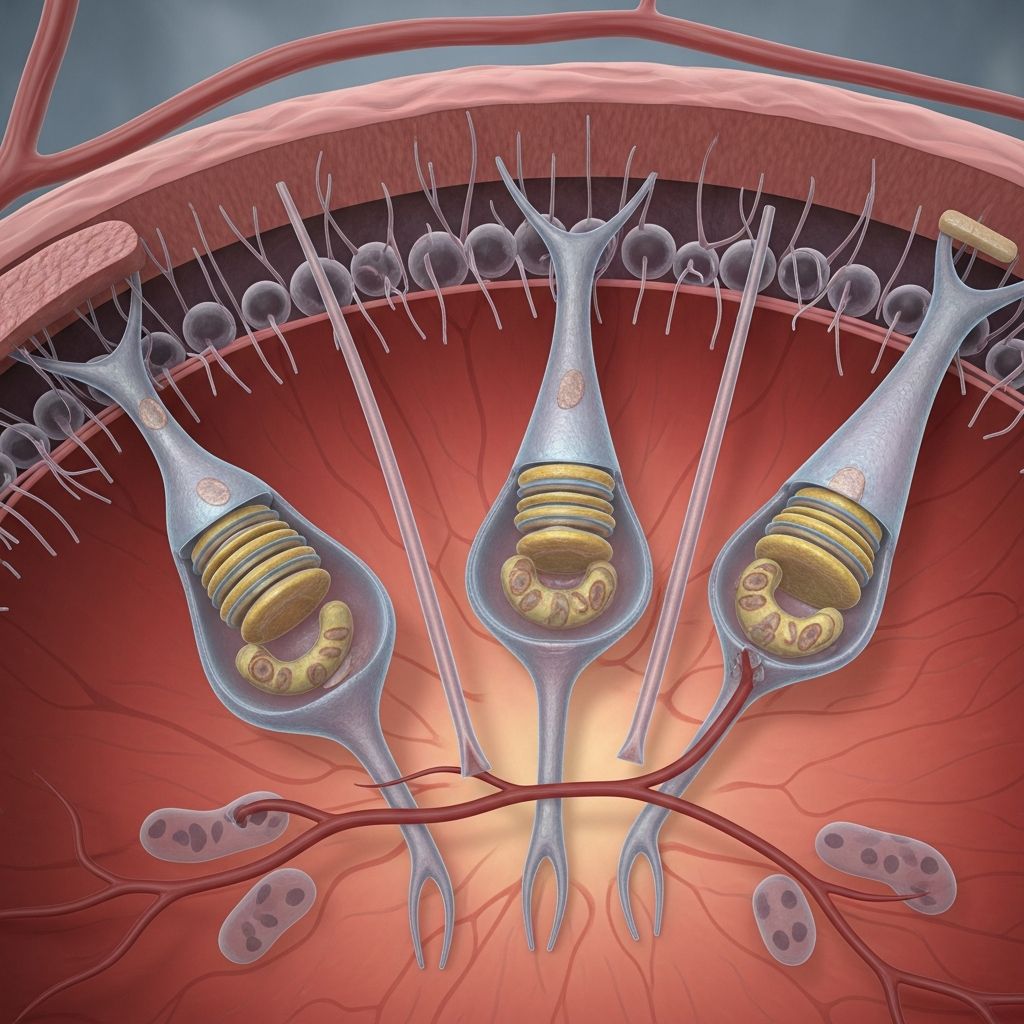
Photoreceptors face unique challenges due to their constant exposure to light and their metabolically demanding function. Both rods and cones contain specialized outer segments packed with stacked membranes (discs) that contain the light-sensitive pigments. These outer segments are continuously renewed through a process of disc shedding and replacement.
Rods exhibit a highly efficient and rapid renewal mechanism for their outer segments, with complete replacement occurring roughly every 10 days. This rapid turnover is unusual among cells and suggests that rods evolved from cones as a specialized adaptation for low-light vision. The efficient renewal system helps maintain rod sensitivity over time and prevents the accumulation of damaged light-sensitive molecules.
Cones have a slower outer segment renewal rate compared to rods, though the precise turnover rate remains incompletely understood. This difference in renewal kinetics reflects the different functional demands placed on these photoreceptors. The slower turnover in cones may be related to their lower sensitivity requirements and different metabolic needs.
Genetic and Molecular Basis of Rod and Cone Function
Recent advances in molecular and genetic research have revealed the distinct genetic programs that control rod and cone development and function. Gene expression studies show that rod-dominant and cone-dominant retinas possess fundamentally different genetic signatures, reflecting their specialized roles in vision. Central cone-rich regions show enrichment of genes related to signal transduction, transcription, and cellular transport, supporting the complex neural circuitry required for high-resolution vision.
Proteins like peripherin/rds play crucial roles in maintaining the proper structure of photoreceptor outer segments. Interestingly, mutations in this protein affect rods and cones differently: in rods, peripherin/rds deletion produces non-functional cells that undergo apoptosis (programmed cell death), whereas cones remain viable despite developing atypical outer segments with reduced light sensitivity. This differential vulnerability reflects the specialized structural and functional requirements of these two photoreceptor types.
Clinical Significance and Photoreceptor Disease
Understanding photoreceptor anatomy and function is essential for addressing vision disorders and developing treatments for photoreceptor-related diseases. Conditions like retinitis pigmentosa, which causes progressive degeneration of photoreceptors, and cone dystrophies that specifically affect cone function, have their basis in photoreceptor structure and genetics.
Night blindness (nyctalopia) represents one category of photoreceptor-related disorder, typically resulting from rod dysfunction or damage. Color blindness involves abnormalities in cone function or development, with the most common forms resulting from mutations affecting the genes for red or green cone pigments. Some individuals possess an uncommon fourth type of cone pigment, a condition called tetrachromacy, which allows perception of a much broader range of color variations than typical vision.
Frequently Asked Questions
Q: Why are rods more sensitive to light than cones?
A: Rods contain higher concentrations of light-sensitive pigment molecules and have neural circuitry that pools signals from many rods together, amplifying weak light signals. A single rod can respond to just one photon of light, while cones require more than 100 photons. This difference reflects their specialized functions in low-light and bright-light vision respectively.
Q: Why can’t you see colors in dim light?
A: In dim light, only your rod photoreceptors are sensitive enough to be activated. Rods do not contain the three types of light-sensitive pigments needed for color vision; they contain only one pigment type. Therefore, in low-light conditions when rods are the only active photoreceptors, color vision is impossible, and you perceive the world in shades of gray.
Q: Where are most cones located in the eye?
A: Most cones are concentrated in the macula, a small central region of the retina. The highest concentration occurs at the fovea, the very center of the macula. This strategic positioning allows the center of your visual field to have the sharpest detail and best color perception.
Q: What is scotopic vision?
A: Scotopic vision is the low-light vision produced by your rod photoreceptors. The term comes from Greek words meaning “dim light.” This is the type of vision you rely on in dark environments, at night, or in dimly lit rooms where your cones cannot function effectively.
Q: Can photoreceptor damage be repaired?
A: Photoreceptors have limited capacity for repair. While they continuously renew their outer segments, they cannot regenerate if completely destroyed. This is why photoreceptor degeneration diseases typically cause permanent vision loss. However, ongoing research into gene therapy and photoreceptor regeneration offers hope for future treatments.
References
- Photoreceptors (Rods & Cones): Anatomy & Function — Cleveland Clinic. Updated 2024. https://my.clevelandclinic.org/health/body/photoreceptors-rods-and-cones
- Structure of Cone Photoreceptors — National Center for Biotechnology Information, PubMed Central. https://pmc.ncbi.nlm.nih.gov/articles/PMC2740621/
- Transcriptome analysis reveals rod/cone photoreceptor specific gene expression patterns — Oxford University Press, Human Molecular Genetics. 2015. https://academic.oup.com/hmg/article/25/20/4376/2525878
Similar Articles








Read full bio of Sneha Tete