Phyllodes Tumors: Types, Symptoms & Treatment
Understand phyllodes tumors: benign to malignant breast lesions requiring surgical intervention.
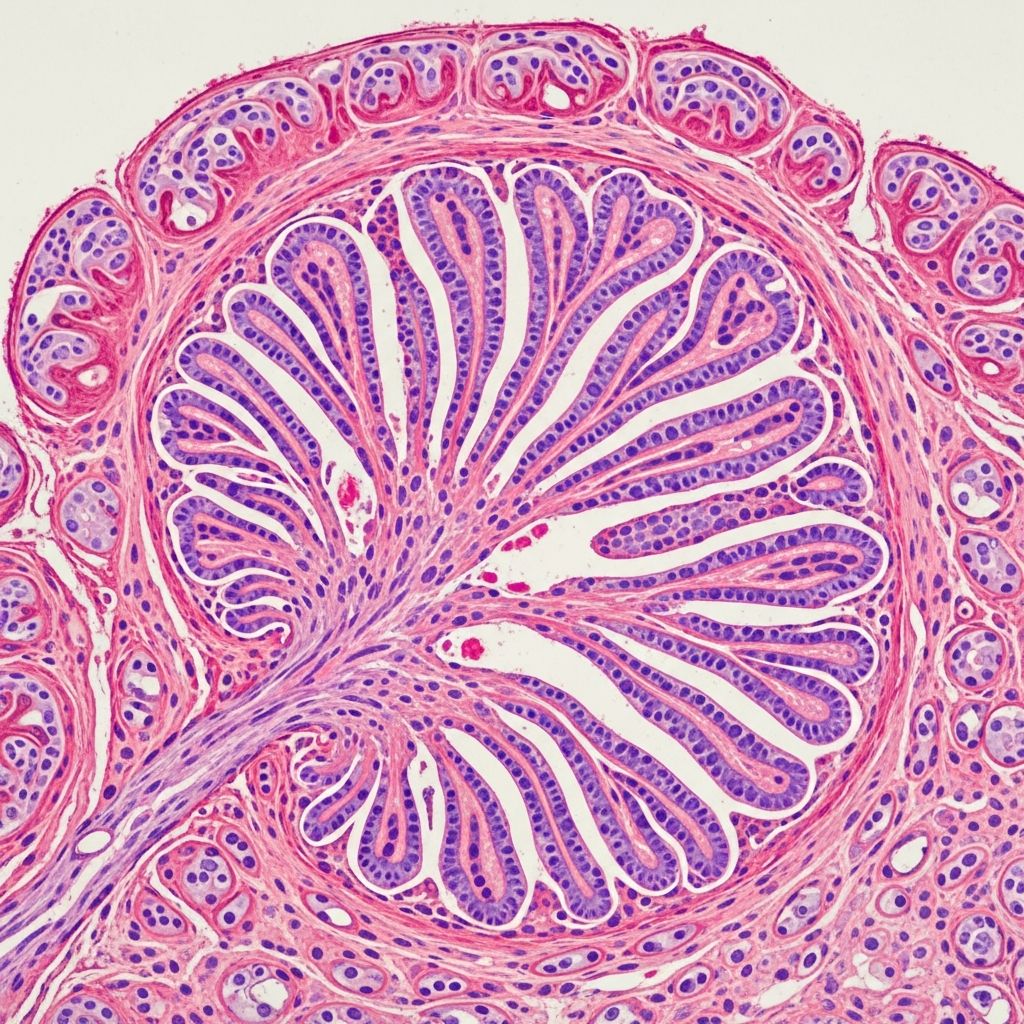
Phyllodes tumors are rare fibroepithelial lesions that develop within the connective tissue of the breast. These tumors represent less than 1% of all breast lesions and are characterized by a distinctive leaf-like pattern of growth. While most phyllodes tumors are benign, some can be borderline or malignant, requiring careful diagnosis and treatment planning. Understanding these tumors, their characteristics, and available treatment options is essential for patients and healthcare providers alike.
What Are Phyllodes Tumors?
Phyllodes tumors develop within the connective tissue of the breast, distinct from ductal carcinomas that arise from the epithelial lining. The tumors are tough and fibrous, similar to scar tissue, and display a characteristic leaf-like pattern that gives them their name. The term “phyllodes” comes from Greek, meaning “leaf-like,” referring to the branching pattern visible under microscopic examination.
These tumors are frequently large at diagnosis, often measuring 4 to 5 centimeters in diameter. They typically present as firm, palpable masses that can demonstrate rapid growth, particularly in younger women. Unlike many breast cancers, phyllodes tumors originate from the stromal (supporting) tissue rather than the epithelial (lining) tissue of the breast.
Classification and Types
The World Health Organization (WHO) classifies phyllodes tumors based on histologic criteria that evaluate several factors to determine whether the tumor is benign, borderline, or malignant. These assessment criteria include tumor border characteristics, stromal cellularity, stromal atypia, mitotic activity, and stromal overgrowth. Proper classification is crucial for determining treatment approaches and predicting patient outcomes.
Benign Phyllodes Tumors
Benign phyllodes tumors represent the majority of cases diagnosed. These tumors grow slowly and have a favorable prognosis with appropriate treatment. However, healthcare providers recommend surgical removal of benign phyllodes tumors to prevent future growth, reduce pain, and eliminate the risk of transformation into malignant forms. Removing benign tumors also saves patients from requiring frequent monitoring and repeated biopsy examinations.
Borderline Phyllodes Tumors
Borderline phyllodes tumors fall between benign and malignant categories and require careful management. These tumors show intermediate histologic features that make classification somewhat subjective, with variance in classification among pathologists. Treatment typically involves wider surgical margins compared to benign tumors, and radiation therapy may be considered to improve local control.
Malignant Phyllodes Tumors
Malignant phyllodes tumors are extremely rare, accounting for about 10 to 25% of all phyllodes tumors and less than 1% of all breast cancers. These tumors behave histologically similar to sarcomas and have a greater propensity for distant metastasis, particularly to the lungs. The presence of malignant heterologous elements is sufficient for diagnosis of a malignant phyllodes tumor even in the absence of other malignant features.
Symptoms and Risk Factors
Symptoms
Phyllodes tumors typically present as a firm, palpable mass in the breast. Patients may notice a growing lump that can change in size relatively quickly compared to other breast lesions. Some women may experience breast discomfort or pain associated with the tumor, particularly as it grows larger. Because these tumors often reach considerable size before diagnosis, they may be more noticeable than smaller breast lesions.
Related Stories



Risk Factors
While the exact etiology of phyllodes tumors remains unclear, certain risk factors have been identified. Patients with TP53 mutations, particularly those with Li-Fraumeni syndrome, have an increased risk for developing phyllodes tumors. These tumors tend to occur more frequently in younger women compared to typical breast cancers, which typically affect older populations.
Diagnosis and Imaging
Clinical Examination
Initial diagnosis often begins with clinical examination, where a healthcare provider palpates the breast to identify any unusual masses or abnormalities. The firm, palpable nature of phyllodes tumors makes them relatively easy to detect during physical examination.
Mammography and Ultrasound
The workup of a phyllodes tumor includes mammography and ultrasound imaging. These imaging studies help characterize the lesion and determine its likely nature. On mammography, phyllodes tumors may appear hyperdense, and they can be difficult to distinguish from fibroadenomas radiographically. However, certain features may suggest phyllodes tumors rather than fibroadenomas, including larger size, hyperdense appearance on mammography, heterogeneous echotexture, the presence of round cysts within the mass, and internal clefts visible on ultrasound, though these findings are not pathognomonic.
Biopsy and Pathologic Diagnosis
A core needle biopsy is necessary to aid in distinguishing phyllodes tumors from fibroadenomas and to obtain tissue for histologic examination. However, core needle biopsy may still possess some uncertainty histologically due to overlapping features and tumor heterogeneity. In cases where distinction remains unclear, lesions may be classified as a fibroepithelial lesion with recommendations for complete surgical excision for definitive diagnosis.
Treatment Options
Surgical Excision
Surgical removal represents the mainstay of treatment for all phyllodes tumors. Once a diagnosis of phyllodes tumor is confirmed or suspected, complete surgical excision is recommended. Attention must be paid to obtaining clear surgical margins, which means removing tissue surrounding the tumor to reduce the risk of recurrence.
The specific surgical approach depends on tumor size, location, and histologic classification. For smaller tumors, a lumpectomy involves removing only the tumor and a surrounding margin of healthy breast tissue. For larger tumors or those requiring wider margins, a partial mastectomy may be performed. In cases where tumor size is very large or located in a challenging position, a total mastectomy may be necessary. Breast conservation is an appropriate treatment for phyllodes tumors if good aesthetic and oncologic outcomes are feasible.
A larger amount of tissue may be removed for borderline or malignant phyllodes tumors compared to benign lesions. For malignant phyllodes tumors, the National Comprehensive Cancer Network (NCCN) recommends wide local excision with the intention of achieving 1-centimeter margins. When margins are inadequate, re-excision with wider margins may be necessary.
Margin Considerations
It is important to clearly denote the prior resection cavity with clips or identify the resection cavity with ultrasound in the event re-excision becomes necessary. Benign phyllodes tumors with narrow or focally positive margins may be closely observed rather than undergoing routine margin re-excision, depending on individual circumstances and patient preferences.
Nodal Assessment
Nodal evaluation is not routinely recommended in the treatment of phyllodes tumors. This is because phyllodes tumors primarily spread through hematogenous (bloodstream) routes rather than through lymphatic channels to regional lymph nodes. Routine axillary nodal staging or sentinel lymph node biopsy is unnecessary even in cases of malignant phyllodes tumors unless there is clinical evidence of specific nodal involvement.
Radiation Therapy
Radiation therapy has been increasingly utilized for treatment of borderline and malignant phyllodes tumors, with demonstrated improvement in local control. For malignant phyllodes tumors, radiation may be recommended following surgical excision to reduce the risk of local recurrence. However, while radiation improves local control, there has been no demonstrated improvement in overall survival rates with this approach.
Systemic Therapy
Data on systemic therapy for malignant phyllodes tumors is sparse, and systemic chemotherapy is not routinely recommended. Treatment with systemic therapy for these tumors is determined on a case-by-case basis, particularly for patients with metastatic disease or significant risk factors for recurrence.
Recurrence and Metastasis
Between 20% and 35% of phyllodes tumors recur locally after initial treatment. Recurrence can be managed with wide local excision. Distant metastases occur in 10 to 20% of patients, with the lungs being the most common site of metastatic disease. Patients with malignant phyllodes tumors should undergo a thorough history and physical examination to identify any symptoms suggesting metastatic disease, and imaging such as chest computed tomography should be performed to rule out metastatic disease before proceeding with surgical management.
Prognosis
The prognosis for phyllodes tumors is generally good, particularly for benign and borderline subtypes when appropriately treated. However, prognosis becomes significantly worse if metastases, particularly pulmonary metastases, are present. Early detection and complete surgical excision with adequate margins are crucial factors in achieving favorable outcomes and reducing recurrence risk.
Frequently Asked Questions
Q: Are all phyllodes tumors cancerous?
A: No. Most phyllodes tumors are benign, but some can be borderline or malignant. Healthcare providers classify them based on histologic features to determine the appropriate treatment approach.
Q: How quickly do phyllodes tumors grow?
A: Phyllodes tumors are often described as demonstrating rapid growth compared to other breast lesions. They frequently reach 4 to 5 centimeters in size at the time of diagnosis.
Q: What is the treatment for benign phyllodes tumors?
A: Surgical removal is recommended for benign phyllodes tumors to prevent future growth, eliminate pain, reduce transformation risk, and avoid the need for frequent monitoring.
Q: Do I need chemotherapy for phyllodes tumors?
A: Systemic chemotherapy is not routinely recommended for phyllodes tumors. Treatment decisions are made on a case-by-case basis, primarily focusing on surgical excision and potentially radiation therapy.
Q: Can phyllodes tumors come back after treatment?
A: Yes, between 20% and 35% of phyllodes tumors can recur locally after initial treatment. Adequate surgical margins and appropriate follow-up care help reduce recurrence risk.
Q: Why is lymph node removal not necessary for phyllodes tumors?
A: Phyllodes tumors spread primarily through the bloodstream (hematogenous spread) rather than through lymphatic channels, making routine lymph node removal unnecessary.
References
- Diagnosis and management of phyllodes tumors of the breast — AME Publishing Company. 2022-04-15. https://abs.amegroups.org/article/view/6572/html
- Contemporary Multi-Institutional Cohort of 550 Cases of Phyllodes Tumors — National Center for Biotechnology Information. 2021-09-22. https://pmc.ncbi.nlm.nih.gov/articles/PMC8462612/
- Phyllodes Tumor — MSD Manuals. 2024-01-01. https://www.msdmanuals.com/professional/gynecology-and-obstetrics/breast-cancer/phyllodes-tumor
- Phyllodes Tumors: Types, Symptoms & Treatment — Cleveland Clinic. 2024-06-01. https://my.clevelandclinic.org/health/diseases/24226-phyllodes-tumors
- Phyllodes Tumor: Symptoms, Causes and Treatment — HealthCentral. 2024-01-01. https://www.healthcentral.com/condition/breast-cancer/phyllodes-tumor
Similar Articles








Read full bio of medha deb