Piebaldism: 5 Key Features, Diagnosis, And Treatment
Rare congenital pigmentation disorder with white forelock, leukoderma, and poliosis present from birth.
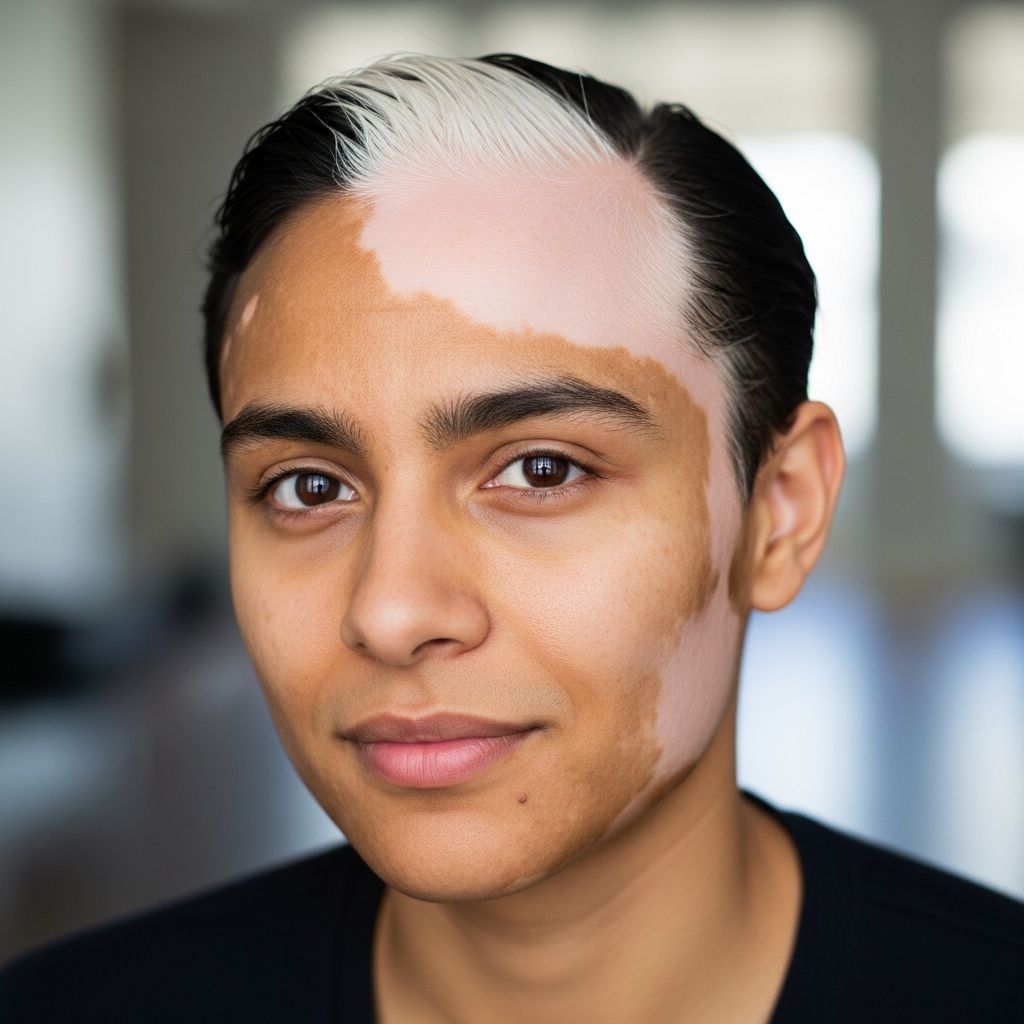
Piebaldism is a rare congenital autosomal dominant disorder of melanocyte migration and development, resulting in stable, symmetrical patches of leukoderma (white skin) and poliosis (white forelock or hair) present at birth. These depigmented areas lack functional melanocytes, leading to characteristic white patches on the forehead, trunk, and limbs, often with a prominent white forelock at the frontal scalp.
What is piebaldism?
Piebaldism represents a congenital form of partial albinism due to defective melanocyte survival and migration during embryogenesis. Unlike vitiligo, which involves autoimmune destruction of melanocytes postnatally, piebaldism features a complete absence of melanocytes in affected areas from birth, with no progression over time. The condition spares the distal extremities and is typically isolated to the skin and hair, though syndromic associations exist.
The hallmark is a triangular or diamond-shaped depigmented patch on the central forehead, accompanied by a white forelock (poliosis) in the anterior scalp hairline. Additional symmetrical hypopigmented or depigmented macules appear on the chest, abdomen, arms, and legs, often in a ventral midline distribution. Hyperpigmented borders may surround these lesions, creating a ‘cockade’ appearance in some cases.
Who gets piebaldism?
Piebaldism affects males and females equally, with an estimated incidence of less than 1 in 20,000 individuals worldwide, showing no racial or geographic predilection. As an autosomal dominant trait with incomplete penetrance and variable expressivity, it manifests in successive generations, though de novo mutations occur. Family history is key, but mild cases may go undiagnosed.
- Prevalence: Rare (<1:20,000)
- Inheritance: Autosomal dominant (50% risk to offspring)
- Penetrance: Incomplete; some carriers asymptomatic
- Expressivity: Variable; mild (isolated forelock) to extensive leukoderma
What causes piebaldism?
Piebaldism arises from mutations disrupting melanocyte development from neural crest progenitors. The primary genetic locus is the KIT proto-oncogene on chromosome 4q12, encoding a tyrosine kinase receptor essential for melanoblast survival, proliferation, and migration along dermatomes during embryogenesis.
Ligand binding (KITL/SCF) normally signals melanocytes to populate the ventral midline; mutations impair this, causing focal absence in characteristic sites. Over 50 KIT mutations are reported, with severity correlating to mutation site—missense mutations cause milder phenotypes, while nonsense or frameshift variants lead to extensive depigmentation.
Rarer causes include mutations in SNAI2 (slug gene, 8q11), affecting neural crest transcription factors. Pathophysiology involves neurocristopathy, where neural crest defects impact melanocytes selectively.
Clinical features of piebaldism
Symptoms are evident at birth and remain stable lifelong, without repigmentation or progression. Key features include:
- White forelock (poliosis): Broad white hair patch at frontal scalp midline (80-90% cases)
- Forehead leukoderma: Triangular/diamond-shaped white patch (midline, 1-3 cm)
- Body macules: Symmetrical depigmented patches on chest, abdomen, flanks, upper arms/legs
- Facial involvement: Hypopigmented eyebrows/eyelashes occasionally
- Hyper/hypopigmented borders: ‘Cockade’ or irregular edges in 20-30%
Lesions are asymptomatic but increase UV sensitivity and skin cancer risk in depigmented areas. No ocular, auditory, or systemic involvement in isolated piebaldism.
Related Stories



| Severity | Features | Frequency |
|---|---|---|
| Mild | Isolated forelock ± small forehead patch | ~30% |
| Moderate | Forelock + forehead + trunk macules | ~50% |
| Severe | Extensive limb/trunk involvement | ~20% |
Diagnosis of piebaldism
Diagnosis is clinical, based on characteristic congenital, stable midline leukoderma and poliosis with family history. No lab tests required for typical cases.
- Wood lamp: Highlights depigmented areas (bright white fluorescence)
- Skin biopsy: Confirms absent melanocytes/melanin in epidermis and follicles (H&E, Fontana-Masson stains)
- Genetic testing: KIT/SNAI2 sequencing for confirmation, family counseling
Differentiate from post-inflammatory hypopigmentation, chemical leukoderma, or progressive vitiligo via onset and stability.
Differential diagnosis
Waardenburg syndrome: Piebald-like pigmentation + sensorineural deafness, dystopia canthorum, heterochromia (PAX3, MITF, SOX10 genes).
Ziprski/Piebaldism-Hirschsprung: KIT mutations + aganglionic megacolon.
Others: Vitiligo (acquired, progressive), tuberous sclerosis (ash-leaf spots), Alezzandrini syndrome (unilateral, with vitiligo/deafness).
- NVNS: Neonatal-onset, no family history
- MCM: Midline, congenital, stable
- WS: + hearing loss, wide nasal bridge
Syndromic piebaldism
~10-15% associate with neural crest disorders:
- Waardenburg-Shah: Piebaldism + Hirschsprung disease (SOX10)
- PCWH: Pigmentary + neurological + gut issues
Screen with audiology, ophthalmology, abdominal imaging if extra-cutaneous signs.
Treatment of piebaldism
No cure; management is cosmetic and supportive. Sun protection critical (SPF50+, clothing).
- Camouflage: Makeup, self-tanners (Dihydroxyacetone)
- Hair dye: For poliosis
- Surgical: Melanocyte-keratinocyte transplants, skin grafting (small areas)
- Phototherapy: Limited efficacy (UVB risks cancer)
- Emerging: Autologous melanocyte transplantation
Counseling addresses psychosocial impact; support groups aid coping.
What is the outcome for piebaldism?
Benign, non-progressive; normal lifespan. Increased sunburn/skin cancer risk in patches mandates vigilance. Cosmetic interventions improve quality of life.
Prevention of piebaldism
Genetic counseling for families; preimplantation diagnosis possible but rare due to benign nature.
FAQs
Q: Is piebaldism the same as vitiligo?
A: No. Piebaldism is congenital and stable; vitiligo is acquired and progressive due to autoimmunity.
Q: Can piebaldism be cured?
A: No cure, but cosmetic options available.
Q: Does piebaldism affect eyes or hearing?
A: Isolated piebaldism—no. Syndromic forms may.
Q: Is piebaldism hereditary?
A: Yes, autosomal dominant; 50% offspring risk.
Q: How to protect piebald skin?
A: Broad-spectrum sunscreen, protective clothing.
References
- Piebaldism – Wikipedia — Wikimedia Foundation. 2023-10-15. https://en.wikipedia.org/wiki/Piebaldism
- Piebaldism — National Organization for Rare Disorders (rarediseases.org). 2024-01-12. https://rarediseases.org/mondo-disease/piebaldism/
- Piebaldism – StatPearls — NCBI Bookshelf, NIH. 2023-07-17. https://www.ncbi.nlm.nih.gov/books/NBK544238/
- Piebaldism: Symptoms, treatment, and outlook — Medical News Today. 2023-05-22. https://www.medicalnewstoday.com/articles/320561
- Piebaldism – DermNet — DermNet NZ. 2024-02-10. https://dermnetnz.org/topics/piebaldism
Similar Articles








Read full bio of Sneha Tete