Piezogenic Papules: Causes, Diagnosis, and Treatment
Complete guide to understanding piezogenic papules: symptoms, diagnosis, and effective management strategies.
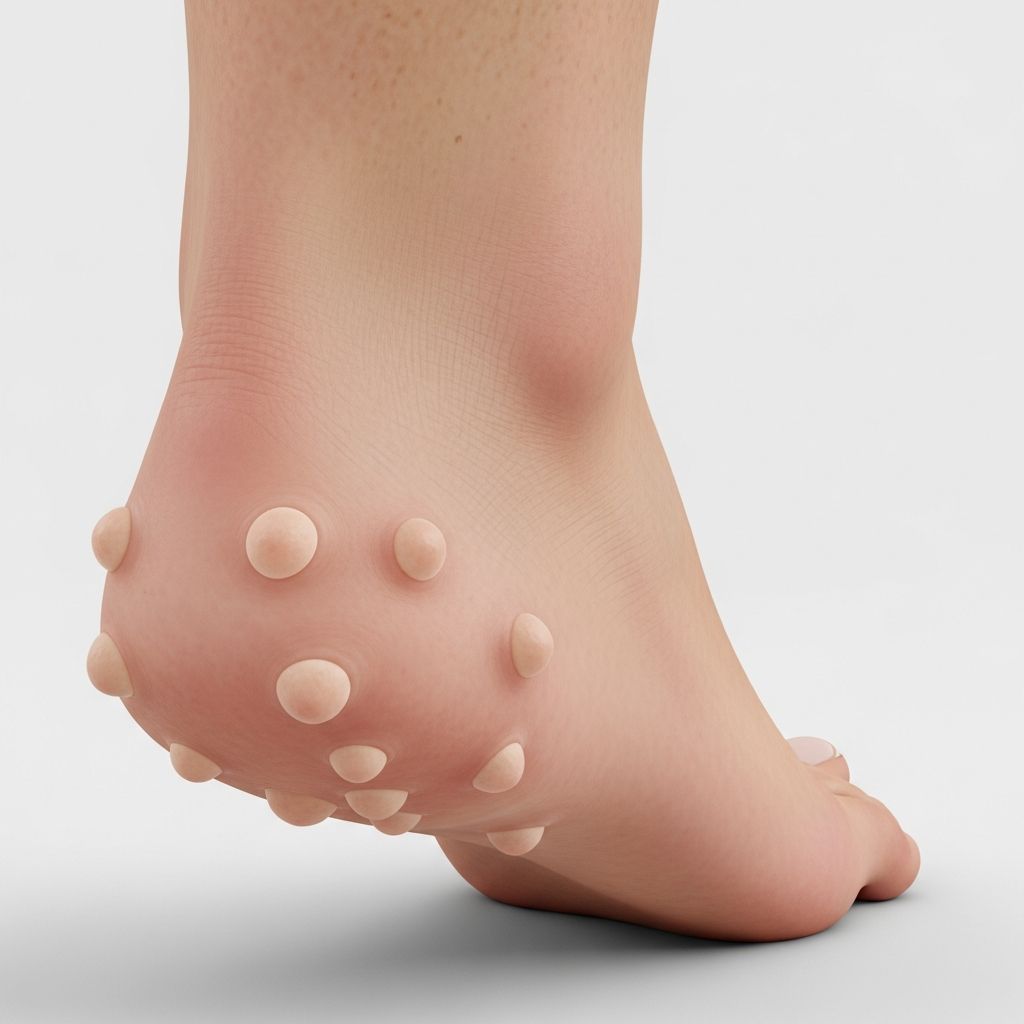
What Are Piezogenic Papules?
Piezogenic papules are soft, compressible, flesh-colored bumps that form within the subcutaneous tissue of the skin. These lesions consist of protrusions of fat that develop beneath the skin’s surface and are typically found on the heels or wrists. The term “piezogenic” comes from the Greek word “piezo,” meaning pressure, as these papules characteristically appear and become firm when weight-bearing pressure is applied.
The condition is predominantly found on the medial aspect of the heel, though papules on the posterior and lateral heel are not uncommon. These lesions usually appear as multiple small bumps, with most cases presenting 2-4 papules, though up to 18 papules have been observed on a single foot. The papules typically range in size from 0.2 to 1 cm in diameter and display a yellowish to skin-colored appearance.
Characteristics and Physical Appearance
Piezogenic papules have several distinctive features that make them recognizable:
- Soft and compressible texture that firms up under pressure
- Bilateral presentation, appearing on both sides of the body symmetrically
- Multiple papules rather than isolated lesions
- Flesh-colored to yellowish appearance
- Disappearance when weight-bearing pressure is relieved
- Most commonly located on the medial heel region
The characteristic feature that distinguishes piezogenic papules from other skin conditions is their appearance during standing and weight-bearing activities. When a patient stands, the papules become visible and firm, but they flatten and disappear when the patient sits or removes pressure from the affected area.
Prevalence and Epidemiology
Piezogenic papules are relatively common skin findings, particularly among certain populations. The condition occurs bilaterally in most cases, meaning patients typically develop papules on both heels or both wrists. While they can occur in individuals of any age, they are more commonly noted in adults. The papules may be present for years without the patient noticing them, as they are often asymptomatic and only become apparent during physical examination or when the patient bears weight.
Causes and Associated Factors
Piezogenic papules are believed to result from a structural defect in the connective tissue, either inherited or acquired. The exact mechanism of formation involves weakness in the skin’s connective tissue structure, which allows subcutaneous fat to protrude through small openings or weak points in the dermis and fascia.
In some cases, piezogenic papules may be associated with underlying connective tissue disorders. Notably, Ehlers-Danlos syndrome is an important systemic condition that may present with painful piezogenic papules as one of the earliest clinical signs. Ehlers-Danlos syndrome is characterized by skin hyperextensibility, joint hypermobility, tissue fragility, poor wound healing, and distinctive “cigarette paper scars.”
The condition may also be less commonly associated with genetic disorders such as Prader-Willi syndrome, a rare disease characterized by severe muscle hypotonia and growth disorder. Understanding potential systemic associations is crucial, as piezogenic papules may indicate an underlying connective tissue condition requiring further evaluation and genetic counseling.
Related Stories



Clinical Presentation and Symptoms
Piezogenic papules are mostly asymptomatic and are often noticed incidentally during routine examination or when the patient becomes aware of small bumps on their feet or wrists. The majority of patients with piezogenic papules experience no pain or discomfort.
However, when symptoms do occur, they typically manifest as:
- Pain or tenderness in the affected area
- Discomfort during standing or walking
- Increased sensitivity when pressure is applied to the lesions
- Pain that resolves once pressure is relieved from the area
Occasionally, piezogenic papules may be painful, particularly in individuals with underlying connective tissue disorders. Patients experiencing pain may have difficulty with prolonged weight-bearing activities or may notice symptoms worsen with increased activity levels. The pain is typically mechanical in nature, arising from pressure applied to the protrusions during standing or walking.
Diagnosis of Piezogenic Papules
Piezogenic papules are usually diagnosed clinically based on their characteristic appearance and behavior during physical examination. The diagnostic process is straightforward and typically does not require extensive testing.
Clinical Examination: Diagnosis relies on distinctive features observed during physical examination, including the appearance of soft, compressible papules that become firm when weight-bearing pressure is applied. The characteristic bilateral presentation and location on the heels or wrists further support the diagnosis.
Weight-Bearing Test: A key diagnostic feature is having the patient stand to observe the papules’ appearance and behavior. This simple test allows the healthcare provider to confirm the presence of lesions and their response to pressure, which is pathognomonic for piezogenic papules.
Imaging Studies: While ultrasound may occasionally be used to confirm diagnosis in cases with unusual symptoms or unclear presentation, imaging is not routinely necessary. When performed, ultrasound can help visualize the protrusions of fat and confirm the diagnosis.
Distinguishing Piezogenic Papules from Other Conditions
Several features help distinguish piezogenic papules from other dermatological conditions:
- Unlike warts, piezogenic papules are compressible and painless in most cases
- Unlike lipomas, they are small and multiple rather than large and solitary
- Unlike other heel bumps, they specifically appear with weight-bearing and disappear with pressure relief
- They have no central punctum or keratin plug characteristic of epidermoid cysts
Treatment Options for Piezogenic Papules
No treatment is required in the absence of symptoms. Since most piezogenic papules are asymptomatic, many patients require no intervention and only need reassurance about the benign nature of the condition.
For painful lesions, conservative management may include several approaches:
Conservative Management Approaches
- Restriction of weight-bearing exercise to reduce pressure on affected areas
- Weight loss to decrease overall pressure on the feet
- Compression stockings to provide support and reduce symptoms
- Foam rubber foot pads or foam-cushioned insoles to distribute pressure evenly
- Orthotic devices and fitted heel cups to provide customized support
- Tape support to stabilize the affected area
- Footwear modifications with cushioned insoles to reduce pressure on lesions
- Avoidance of prolonged standing or walking to minimize mechanical stress
These conservative measures are typically the first line of treatment and often provide adequate symptom relief without the risks associated with more invasive procedures.
Corticosteroid Injections
Intralesional corticosteroid injections have been documented to provide relief for patients with painful piezogenic papules. These injections, sometimes combined with local anesthetics, work by reducing discomfort through decreased levels of pro-inflammatory cytokines. Specifically, an injection of 1-2mL of a 1:1 betamethasone and bupivacaine mixture has resulted in a 50% reduction in pain after a single injection, with pain scores decreasing to 20% after a second injection at one month.
Corticosteroid injections have been particularly beneficial for individuals whose papules cause chronic pain, and they have shown efficacy in patients with underlying Ehlers-Danlos syndrome. However, corticosteroid injections are contraindicated for patients suffering from diabetes, bone disorders such as osteoporosis, or healing problems, as corticosteroids can disrupt tissue regeneration.
Electro-acupuncture
Electro-acupuncture represents an alternative therapeutic option that has been documented in the literature as a potential treatment approach for symptomatic piezogenic papules.
Low-Intensity Laser Therapy
Low-intensity laser therapy has shown encouraging results in treating painful piezogenic papules. In a study with two volunteers suffering from painful piezogenic papules, ten sessions of low-intensity laser therapy spread over fifteen days resulted in complete disappearance of the patients’ papules. The low-intensity laser works by increasing local blood circulation, which reduces edema, while also stimulating tissue repair processes in cells and decreasing pain. Although the small number of study participants calls for caution, these results are nonetheless encouraging and suggest potential for this therapeutic approach.
Surgical Excision
Surgical excision may be helpful if symptoms persist despite conservative management, but this approach is rarely necessary. If surgical intervention is considered, surgical excision involves removing the overgrowth of adipose tissue by excising the affected area under local anesthesia. Although relatively minimally invasive, surgical excision can result in scarring, hyperpigmentation, or post-operative local sensitivity.
A deep punch biopsy with subsequent closure of the fascial defect is preferred over extensive excisional surgery. The success of surgical treatment largely depends on the location of the piezogenic papules and the patient’s healing capacity, which can be more delicate in the heel region.
Surgery should be avoided in patients with impaired wound healing secondary to Ehlers-Danlos syndrome if possible, as this patient population faces higher risks of complications. For otherwise healthy patients, surgical intervention remains the treatment of last resort after all conservative measures have been exhausted.
Systemic Implications and Complications
Although piezogenic papules are a relatively benign condition, it is important to recognize that they may be the first clinical sign of a latent connective tissue disease, particularly Ehlers-Danlos syndrome. A thorough history and physical examination searching for evidence of systemic connective tissue disorders is imperative when piezogenic papules are identified.
Red flags suggesting an underlying connective tissue disorder include:
- Skin hyperextensibility (unusually stretchy skin)
- Joint hypermobility and excessive dislocations
- Tissue fragility and poor wound healing
- Wide atrophic scars with a “cigarette paper” appearance
- Easy bruising
- Family history of connective tissue disorders
If any of these signs or symptoms are present, the patient should be referred to a geneticist for diagnostic confirmation, subtype determination, and appropriate genetic counseling.
Prognosis and Long-term Outlook
Painless piezogenic papules are common, asymptomatic, and without risk of complication. The long-term outlook for patients with piezogenic papules is generally excellent, as the condition does not progress or pose significant health risks.
For patients with painful piezogenic papules, conservative management frequently provides adequate symptom relief and improved quality of life. Most patients can manage their symptoms effectively through lifestyle modifications and supportive measures without requiring surgical intervention.
Frequently Asked Questions
Q: Are piezogenic papules dangerous or cancerous?
A: No, piezogenic papules are benign skin lesions and pose no risk of malignancy or serious health complications. They are harmless protrusions of fat tissue and do not require treatment unless symptomatic.
Q: Can piezogenic papules be permanently removed?
A: While surgical excision can remove piezogenic papules, recurrence is possible depending on the underlying connective tissue defect. Conservative management is typically the preferred first-line approach, with surgery reserved for cases that fail other treatments.
Q: Do piezogenic papules indicate a serious underlying condition?
A: In most cases, piezogenic papules are isolated findings requiring no further investigation. However, they may occasionally indicate an underlying connective tissue disorder such as Ehlers-Danlos syndrome, particularly if accompanied by other clinical signs. A thorough evaluation is recommended.
Q: What is the best treatment for painful piezogenic papules?
A: Conservative measures such as compression stockings, orthotic devices, and foam pads are typically effective first-line treatments. If conservative management fails, corticosteroid injections offer documented pain relief in approximately 50% of patients after a single injection.
Q: Can piezogenic papules develop on other body areas besides the feet?
A: While piezogenic papules most commonly occur on the heels, they can also develop on the wrists and other areas subject to pressure or mechanical stress. The name reflects their characteristic pressure-dependent appearance and disappearance.
Q: How long does treatment for piezogenic papules take?
A: Treatment duration varies depending on the approach. Conservative measures may require several weeks to months to demonstrate effectiveness. Corticosteroid injections provide relief within days to weeks, while surgical excision provides immediate removal, though healing takes several weeks.
References
- What are the treatments for piezogenic papules? — Typology. 2025. https://us.typology.com/library/how-to-treat-piezogenic-papules
- Piezogenic papules — DermNet. 2025. https://dermnetnz.org/topics/piezogenic-papules
- Piezogenic Pedal Papules (Painful Piezogenic Pedal Papules; Piezogenic Wrist Papules) — Dermatology Advisor. 2025. https://www.dermatologyadvisor.com/home/decision-support-in-medicine/dermatology/piezogenic-pedal-papules-painful-piezogenic-pedal-papules-piezogenic-wrist-papules/
- Piezogenic Pedal Papule — MD Searchlight. 2025. https://mdsearchlight.com/skin-problems-and-treatments/piezogenic-pedal-papule/
- Bilateral Piezogenic Papules of the Heel — Cedar Falls Foot & Ankle. 2025. https://cefootandankle.com/blog/pedal-papules/
- Piezogenic papules — Wikipedia. 2025. https://en.wikipedia.org/wiki/Piezogenic_papules
Similar Articles








Read full bio of Sneha Tete