Pigmented Follicular Cyst Pathology: Clinical And Histology
Detailed histopathological analysis of pigmented follicular cysts, a rare benign cutaneous lesion with distinctive pigmented hair shafts.
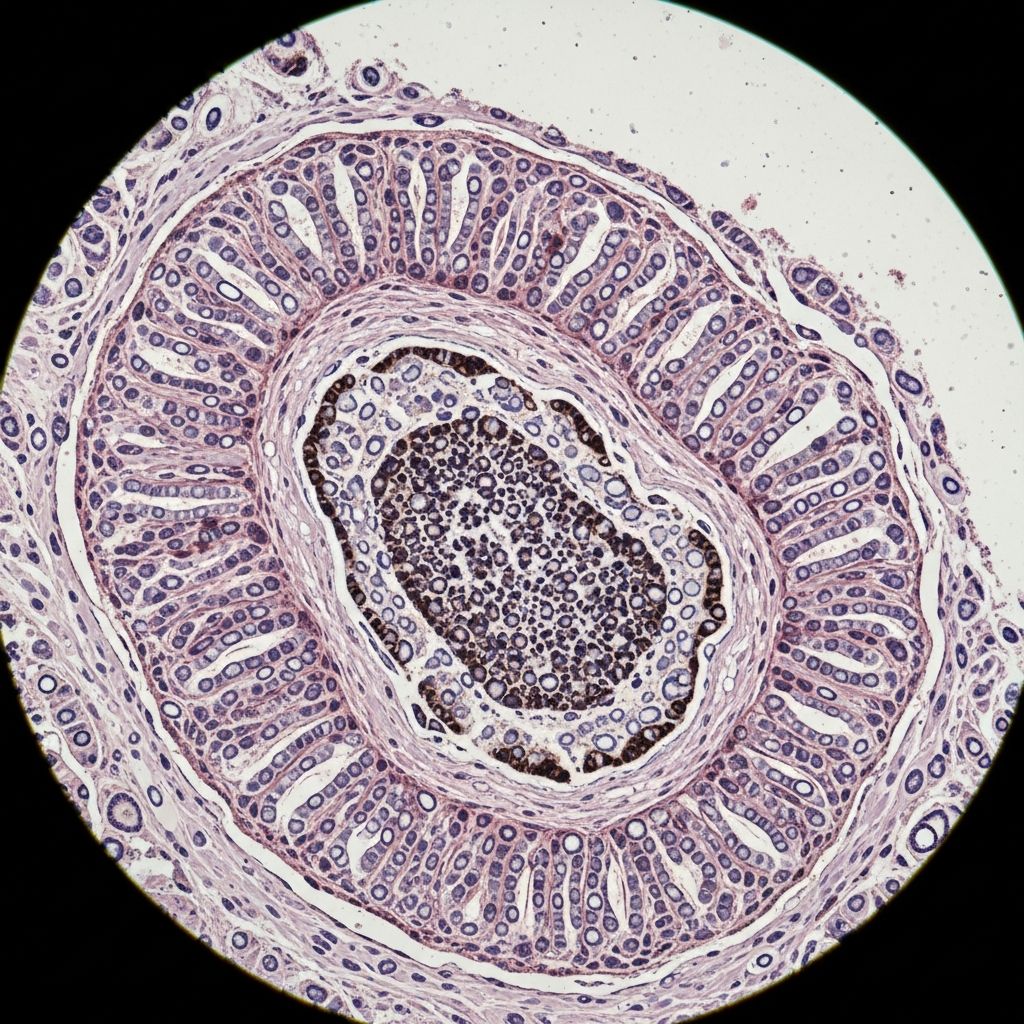
This benign lesion is grouped within the cutaneous cysts. Pigmented follicular cysts represent a rare subtype of epithelial cysts characterized by the presence of pigmented, terminally differentiated hair shafts within the cyst cavity. First described in the literature over three decades ago, these cysts typically manifest as solitary pigmented papules, predominantly on the head and neck in adult males, though multiple variants have been reported on the trunk.
Author Information
Dr Ben Tallon, Dermatologist/Dermatopathologist, Tauranga, New Zealand, 2011 (updated with recent insights).
Clinical Features
Pigmented follicular cysts usually present as small, dome-shaped papules measuring 2-5 mm in diameter, with a characteristic blue-brown pigmentation due to the melanin content in the entrapped hair shafts. They are most commonly located on the face, scalp, or neck, though axillary and truncal sites have been documented. The overlying skin is typically smooth and intact, without inflammation or ulceration unless secondarily irritated. In rare cases, patients develop multiple lesions, as seen in a 22-year-old male with numerous brown-blue papules on the chest and abdomen persisting for 10 years. These multiple forms may represent a distinct subtype within pilosebaceous cystic disorders, featuring hybrid cysts with both trichilemmal and epidermoid keratinization, occasionally incorporating sebaceous glands.
Clinically, these cysts are asymptomatic but may be excised for cosmetic reasons or diagnostic confirmation. Dermoscopic examination might reveal a pigmented structure with a central pore, though specific patterns are not well-defined in the literature. The benign nature is confirmed histologically, distinguishing them from malignant mimics.
Histopathology
Low Power (Scanning Power View)
At low magnification, pigmented follicular cyst appears as a well-circumscribed, unilocular cystic structure embedded within the dermis (Figure 1, conceptual low-power view). The cyst is typically superficial, lying just beneath the epidermis, with a thin fibrous wall. No connection to the overlying epidermis is usually evident, though subtle infundibular origins may be inferred. The overall architecture is simple, lacking the lobulation or proliferation seen in more aggressive lesions.
High Power
Higher magnification reveals critical diagnostic features. The cyst is lined by a thin epithelial layer, often 2-3 cells thick, exhibiting a prominent retained granular layer—a key feature distinguishing it from trichilemmal cysts (Figures 2 and 3). This granular layer consists of keratohyalin granules, indicative of infundibular differentiation.
The cyst cavity contains laminated, loose keratin fragments interspersed with numerous pigmented terminal hair shafts. These hairs are mature, terminally differentiated structures with thick shafts richly laden with melanin, imparting the clinical pigmentation. The hair shafts are irregularly fragmented and orthokeratinized, without nucleation or calcification. In hybrid cases, the epithelium may show abrupt keratinization akin to trichilemmal type, blending eosinophilic keratin with the more basket-weave pattern of epidermoid cysts. Sebaceous elements may rarely be embedded in the cyst wall, supporting pilosebaceous origins.
Special stains such as Fontana-Masson can highlight melanin in the hair shafts, while trichrome stains emphasize the stromal collagen. No atypia, mitoses, or inflammatory infiltrates are present in benign cases, though secondary inflammation may occur with rupture.
Differential Diagnosis
Pigmented follicular cysts must be differentiated from other cystic lesions containing hair or pigmented material. Key distinctions are summarized in the table below:
| Lesion | Key Histological Features | Distinguishing from Pigmented Follicular Cyst |
|---|---|---|
| Vellus Hair Cyst | Cyst cavity with small, unpigmented vellus hairs; thin granular layer present. | Lacks pigmentation; hairs are fine vellus type, not terminal pigmented shafts. |
| Epidermal Inclusion Cyst | Laminated orthokeratin; granular layer; no hair fragments. | Absence of hair shafts entirely. |
| Trichilemmal Cyst | Abrupt keratinization without granular layer; pale eosinophilic keratin. | No retained granular layer; lacks pigmented hairs. |
| Steatocystoma Multiplex | Sebaceous gland-associated; undulating wall; no hairs. | Predominantly sebaceous content; rare hairs if present are not pigmented. |
| Proliferating Trichilemmal Cyst | Proliferative epithelium; may have trichilemmal keratinization. | Shows epithelial proliferation and atypia; larger size. |
Related Stories



Vellus hair cysts, in particular, closely mimic pigmented follicular cysts but contain small, non-pigmented vellus hairs rather than mature terminal ones. Epidermal inclusion cysts lack any hair components, filled solely with keratin debris.
Pathogenesis
The etiology involves cystic dilatation of the follicular infundibulum with retention of pigmented terminal hairs. This may arise from developmental anomalies or follicular occlusion, trapping hairs during downward growth. In multiple cases, genetic factors akin to keratin mutations in vellus hair cysts (e.g., K17) may play a role, though specific genes for pigmented variants remain unidentified. Trauma or inflammation could provoke cyst formation from preexisting follicles.
Management and Prognosis
These cysts are entirely benign with no malignant potential. Simple excision is curative for solitary lesions, providing both diagnosis and therapy. Multiple lesions may require serial excisions or observation if asymptomatic. Recurrence is rare post-complete removal. No systemic associations are known, unlike some pilosebaceous disorders.
Frequently Asked Questions (FAQs)
- Q: What causes pigmented follicular cysts?
A: Likely due to occlusion and retention of pigmented terminal hairs within a follicular cyst, possibly developmental or traumatic in origin.
- Q: Are pigmented follicular cysts cancerous?
A: No, they are benign with no reported malignant transformation.
- Q: How is the diagnosis confirmed?
A: By histopathology showing thin epithelial lining with granular layer and pigmented terminal hair shafts in the cavity.
- Q: What is the difference from vellus hair cysts?
A: Vellus hair cysts contain small, unpigmented vellus hairs; pigmented follicular cysts have large, melanin-rich terminal hairs.
- Q: Do they require treatment?
A: Only if symptomatic or for cosmetics; excision is straightforward and curative.
Related Topics
- Eruptive vellus hair cysts
- Trichilemmal cyst
- Epidermoid cyst
- Steatocystoma multiplex
- Cutaneous cysts overview
References
- Multiple pigmented follicular cysts: a subtype of multiple pilosebaceous cysts — PubMed/Nakayama H et al. 1996-01-01. https://pubmed.ncbi.nlm.nih.gov/8733387/
- Pigmented follicular cyst pathology — DermNet NZ/Dr Ben Tallon. 2011 (Accessed 2026). https://dermnetnz.org/topics/pigmented-follicular-cyst-pathology
- Pigmented follicular cyst — PubMed/Mehregan AH et al. 1994-01-01. https://pubmed.ncbi.nlm.nih.gov/8043405/
- Eruptive vellus hair cysts — DermNet NZ. 2023 (Accessed 2026). https://dermnetnz.org/topics/eruptive-vellus-hair-cysts
- Proliferating trichilemmal cyst — DermNet NZ. 2023 (Accessed 2026). https://dermnetnz.org/topics/proliferating-trichilemmal-cyst
Similar Articles








Read full bio of medha deb