Pilar Sheath Acanthoma: Essential Guide To Diagnosis & Treatment
Uncommon benign hair follicle tumour presenting as a small papule with central pore on the upper lip.
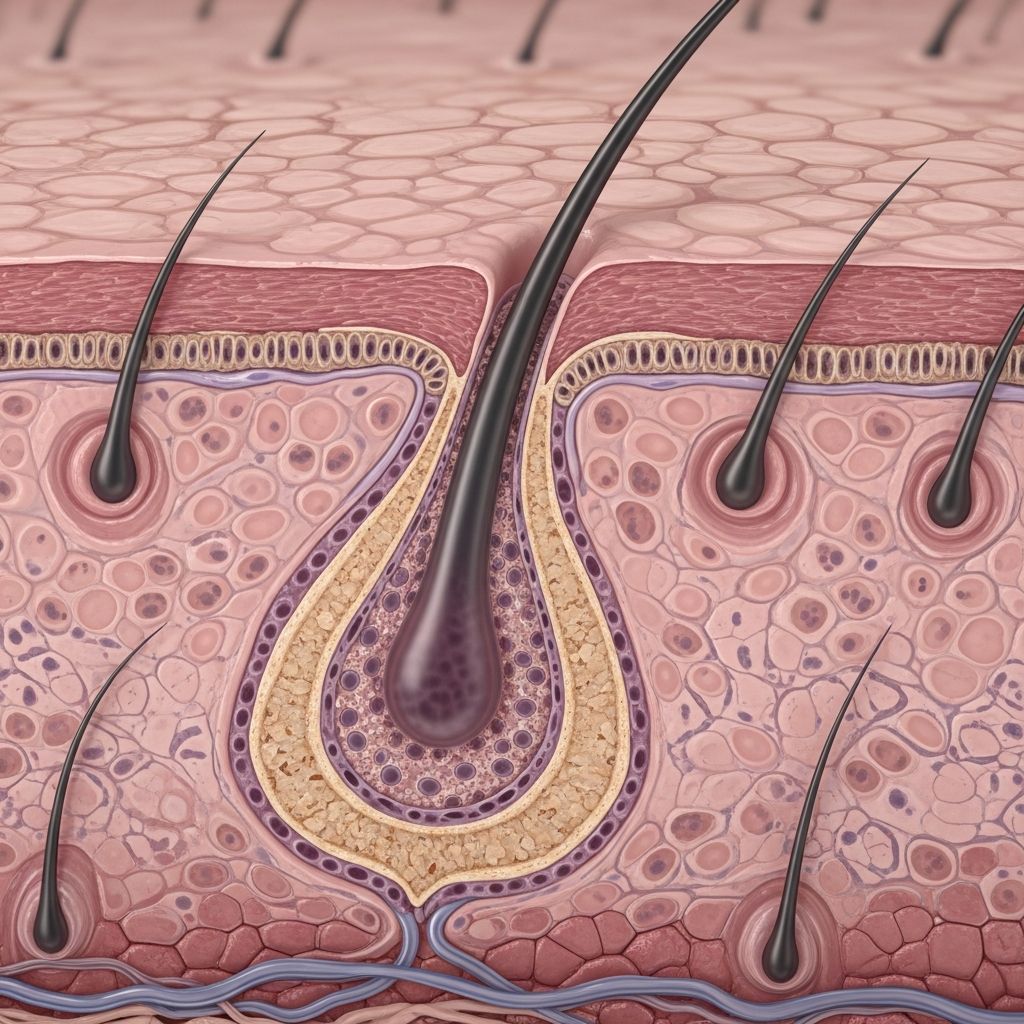
Pilar sheath acanthoma is an uncommon benign tumour originating from the outer root sheath of the hair follicle. It typically presents as a small, solitary, skin-coloured papule, most often located on the upper lip of middle-aged to elderly adults.
What is pilar sheath acanthoma?
**Pilar sheath acanthoma** is a rare, benign adnexal tumour derived from the follicular epithelium, specifically showing differentiation towards the outer root sheath of the hair follicle. First described by Mehregan and Brownstein in 1978, it manifests as a small cutaneous nodule with distinctive histopathological features. This lesion is not associated with any systemic disorders and remains asymptomatic unless irritated.
Clinically, it appears as a solitary papule or nodule measuring 3–10 mm in diameter, often with a central pore or depression filled with keratinous material. No hair emerges from the lesion, and gentle pressure may express whitish, cheesy material. While the classic site is the skin above the upper lip, rare cases have been reported on the cheeks, lower lip, eyebrows, and other head and neck areas.
The tumour arises from hamartomatous proliferation of pilar sheath cells, forming lobular extensions into the dermis from a central dilated follicular infundibulum. It affects adults predominantly, with no gender predilection noted in most series.
Who gets pilar sheath acanthoma?
Pilar sheath acanthoma primarily affects middle-aged and elderly individuals, typically over 40 years of age. It is uncommon in younger patients and has no strong racial or gender preference. The lesion is solitary in the vast majority of cases, with no reports of multiplicity or syndromic associations.
Anecdotal cases suggest a slight predominance in fair-skinned individuals, but data is limited due to its rarity. Genetic factors are not implicated, and it is considered a sporadic acquired neoplasm rather than hereditary.
What causes pilar sheath acanthoma?
The precise aetiology of pilar sheath acanthoma remains unknown. It is regarded as a benign follicular hamartoma resulting from abnormal differentiation or proliferation of outer root sheath keratinocytes. Unlike malignant tumours, no oncogenic mutations or viral associations have been identified.
Some authors propose it represents a late-stage or variant form of trichofolliculoma or dilated pore of Winer, but histopathological distinctions support its classification as a unique entity. Trauma, chronic irritation, or ultraviolet exposure may play minor roles in initiation at predilection sites like the upper lip, though evidence is circumstantial.
What are the clinical features of pilar sheath acanthoma?
The hallmark presentation is a small, asymptomatic, skin-coloured papule or nodule, usually 3–5 mm in diameter (up to 10 mm), with a central 1–2 mm pore-like opening. The surface is smooth or slightly umbilicated, and the lesion elevates minimally above the surrounding skin.
- Location: Almost exclusively on the face, particularly the upper lip philtrum; rarely cheeks, eyebrows, nose, or chin
- Appearance: Flesh-coloured to yellowish, firm, non-tender
- Central pore: Often plugged with keratin, expressible as whitish debris
- Symptoms: None; may become irritated if manipulated
- Evolution: Slow-growing over months to years, stable size
Lesions are often incidental findings during skin examinations. In one reported case, an eyebrow lesion lacked a visible pore but showed classic histology post-excision. Dermoscopically, a central comedo-like structure with surrounding whitish lobules may be visible.
Related Stories



Diagnosis
Clinical suspicion arises from the characteristic upper lip location and central pore. However, definitive diagnosis requires histopathological confirmation via biopsy. Differential diagnoses include dilated pore of Winer, trichofolliculoma, basal cell carcinoma, and epidermoid cyst.
Shave biopsy, punch biopsy, or excisional biopsy reveals a dilated central cystic cavity connected to the surface, filled with keratin. Broad lobules of bland squamous epithelium radiate peripherally into the dermis, connected to the cyst wall.
Pathology
Histopathology shows a vertically oriented, dilated follicular infundibulum opening to the epidermis, containing laminated keratin. From its wall, 4–12 bulbous lobules of squamous epithelium extend into the dermis, forming a ‘garland’ or ‘rosette’ pattern.
- Lobules composed of uniform keratinocytes with peripheral palisading
- Granular layer present (infundibular-type keratinisation)
- Clear/glycogen-rich cells in outer layers indicating outer root sheath differentiation
- Eosinophilic hyaline basement membrane around lobules
- No atypia, mitoses, or stromal fibrosis
Immunohistochemistry (if performed) shows CK5/6 positivity in basal cells and variable involucrin expression.
Differential diagnosis of pilar sheath acanthoma pathology
| Feature | Pilar Sheath Acanthoma | Dilated Pore (Winer) | Trichofolliculoma |
|---|---|---|---|
| Cystic space | Small, central, with radiating thick lobules | Large, with thin radiating epithelial strands | Central, with immature hair germs |
| Lobule arrangement | Broad, bulbous, rosette-like | Slender, finger-like projections | Follicular bulbs with stroma |
| Stroma | Absent | Minimal | Well-formed fibrovascular |
| Keratinisation | Infundibular ± trichilemmal | Infundibular | Variable |
Treatment of pilar sheath acanthoma
As a benign neoplasm, pilar sheath acanthoma requires no treatment unless for cosmetic concerns or diagnostic uncertainty. Options include:
- Observation: Preferred for asymptomatic lesions
- Surgical excision: Complete removal via elliptical excision or punch biopsy; curative and diagnostic
- Curettage and electrodessication: For small lesions, minimal scarring
- Shave excision: Superficial removal if no deep extension
Recurrence is rare post-excision. Malignancy potential is negligible.
Frequently Asked Questions (FAQs)
Q: Is pilar sheath acanthoma cancerous?
A: No, it is a completely benign tumour with no malignant potential. Biopsy shows bland cells without atypia.
Q: Can pilar sheath acanthoma appear anywhere besides the upper lip?
A: Yes, though rare; reported on eyebrows, cheeks, nose, and chin. Head and neck predominate.
Q: How is pilar sheath acanthoma diagnosed?
A: Primarily by biopsy showing characteristic lobular proliferation from a central dilated pore. Clinical features guide suspicion.
Q: Does pilar sheath acanthoma need to be removed?
A: Not medically necessary; excision is optional for cosmetics or confirmation.
Q: What does pilar sheath acanthoma look like under dermoscopy?
A: Central comedo-like plug with white homogeneous lobular structures around the pore.
References
- Pilar sheath acanthoma — Wikipedia. 2023. https://en.wikipedia.org/wiki/Pilar_sheath_acanthoma
- Pilar sheath acanthoma pathology — DermNet NZ. 2023. https://dermnetnz.org/topics/pilar-sheath-acanthoma-pathology
- An Unusual Location of a Pilar Sheath Acanthoma — PMC (Indian Dermatol Online J). 2016-01-15. https://pmc.ncbi.nlm.nih.gov/articles/PMC4738487/
- Pilar Sheath Acanthoma — MalaCards. 2023. https://www.malacards.org/card/pilar_sheath_acanthoma
- Pilar Sheath Acanthoma — Perri Dermatology. 2011-06-26. https://perridermatology.com/dr-perris-blog/hair-follicle-neoplasms-pilar-sheath-acanthoma/
- Pilar sheath acanthoma — VisualDx. 2023. https://www.visualdx.com/visualdx/diagnosis/pilar+sheath+acanthoma?diagnosisId=54715&moduleId=101
- Pilar sheath acanthoma — DermNet NZ. 2013. https://dermnetnz.org/topics/pilar-sheath-acanthoma
Similar Articles








Read full bio of Sneha Tete