Pilomatricoma Pathology: Guide To Histology, Variants & Diagnosis
Comprehensive histological analysis of pilomatricoma, a benign hair matrix tumour with characteristic shadow cells and calcification.
Pilomatricoma (also known as pilomatrixoma or calcifying epithelioma of Malherbe) is a benign cutaneous tumour originating from hair matrix cells. This common adnexal neoplasm typically presents as a firm, subcutaneous nodule, most frequently in children and young adults, with a predilection for the head and neck region.
Histology of pilomatricoma
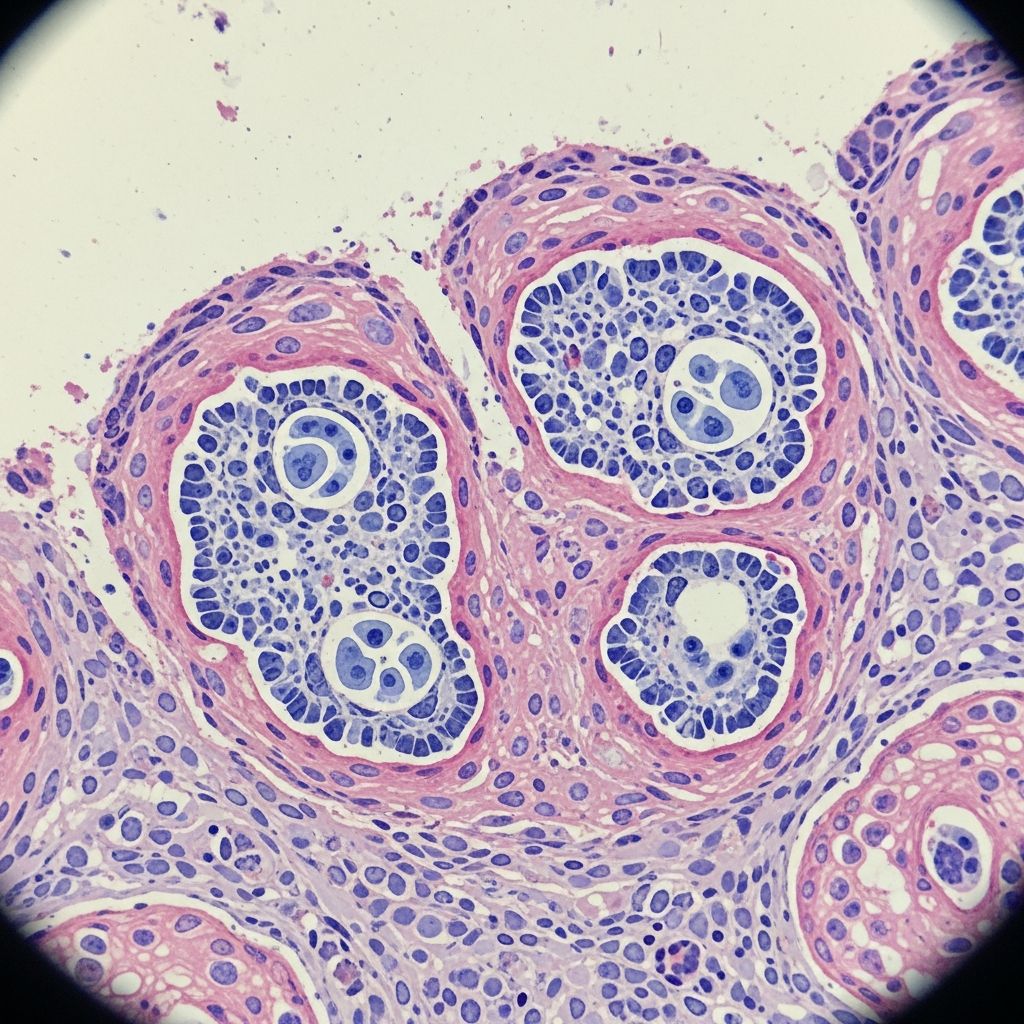
At low magnification, pilomatricoma appears as a well-circumscribed nodulocystic tumour predominantly located in the lower dermis, often extending into the subcutaneous fat (Figure 1). The tumour architecture is lobulated, surrounded by a fibrous pseudocapsule in most cases, though poorly demarcated variants exist.
The hallmark histological feature is a biphasic cellular pattern: an outer layer of
basaloid cells
resembling primitive hair matrix cells transitions centrally intoshadow cells
(anucleate, eosinophilic cells with a pale halo representing the lost nucleus). Shadow cells signify differentiation toward the hair cortex, the rigid outer layer of the hair shaft.- Basaloid cells: Small, uniform cells with high nuclear-to-cytoplasmic ratio, basophilic nuclei, and scant cytoplasm arranged in nests or islands at the tumour periphery.
- Shadow cells: Large, plump, eosinophilic cells lacking nuclei, forming expansive central zones that dominate mature lesions.
- Transition zone: Gradual dyskeratosis where basaloid cells lose nuclei and acquire eosinophilic cytoplasm.
Calcification occurs in 70-85% of cases, typically within shadow cell regions, appearing as basophilic deposits that may progress to ossification. Calcified foci contribute to the tumour’s characteristic bony hardness on palpation.
Inflammatory responses are common, particularly at sites of cyst rupture. A foreign body-type reaction features histiocytes, multinucleated giant cells, and lymphocytes surrounding spilled shadow cells. Chronic inflammation may lead to fibrosis and scarring.
Pilomatricoma maturation stages
Pilomatricomas evolve through distinct histological phases:
| Stage | Key Features |
|---|---|
| Early | Small cystic lesions with predominant basaloid cells |
| Fully developed | Large cystic tumour with balanced basaloid and shadow cells |
| Early regressive | Shadow cells predominate; lymphocytic infiltrate, multinucleated giant cells, calcification |
| Late regressive | Numerous calcified shadow cells; absent basaloid cells and inflammation; ossification common |
Special stains in pilomatricoma
Diagnosis typically relies on routine haematoxylin and eosin (H&E) staining; special stains are rarely required. However,
Von Kossa stain
highlights calcium deposits as black precipitates, confirming dystrophic calcification in ambiguous cases.Immunohistochemistry may aid differential diagnosis:
- Basaloid cells: Positive for cytokeratins (CK1/5/10/14), p63, β-catenin (nuclear in mutated cases)
- Shadow cells: Negative for pancytokeratin, EMA; retain hair cortex markers
- Stromal fibroblasts: Vimentin-positive
Pilomatricoma variants
Pigmented pilomatricoma
Occurring in up to 11% of cases, this variant features prominent
melanin deposition
ormelanocytic hyperplasia
within the basaloid islands. Melanocytes are normal hair matrix residents, but hyperplasia may result from UV stimulation or cytokine release. Histologically, dendritic melanocytes with melanin granules intermingle with basaloid cells, imparting a pigmented appearance that may mimic melanoma clinically.Ossifying pilomatricoma
Advanced calcification progresses to mature bone formation with osteoid and trabeculae, often in late regressive lesions. This metaplastic ossification is reactive, not neoplastic.
Related Stories



Anetodermic pilomatricoma
Rare variant with overlying dermal atrophy and herniation of tumour through elastotic skin, histologically identical to conventional pilomatricoma.
Multiple pilomatricomas
Familial or syndromic (myotonic dystrophy, Gardner syndrome) cases show identical histology but increased β-catenin mutations.
Differential diagnosis
Pilomatricoma’s distinctive shadow cells are diagnostic, but early lesions or crushed biopsies pose challenges. Key differentials include:
| Entity | Distinguishing Features |
|---|---|
| Epidermoid cyst | Lacks shadow cells; laminated keratin, no basaloid proliferation |
| Dermoid cyst | Adnexal structures in stratified squamous lining; no shadow cells |
| Basal cell carcinoma | Peripheral palisading, retraction artifact, mucin; no shadow cells |
| Craniopharyngioma (ectopic) | Similar wet keratin, but adamantinomatous pattern with palisading |
| Pilomatrix carcinoma | Atypia, necrosis, infiltration, high mitotic rate; rare |
Cytology shows basaloid clusters with naked shadow cells in a bloody background, but ghost cells may mimic calcification in other tumours.
Pathogenesis
Pilomatricomas arise from somatic CTNNB1 gene mutations (β-catenin) in hair matrix stem cells, activating Wnt signalling and suppressing apoptosis via BCL-2 overexpression. This leads to uncontrolled basaloid proliferation and dysregulated differentiation to shadow cells. Mutations are detectable in 70-90% of cases via nuclear β-catenin IHC.
Clinical correlation
Histology explains clinical features: calcification causes bony hardness; inflammation from rupture produces tenderness and ‘tent sign’ (angulated skin surface); head/neck location reflects hair follicle density. Size ranges 0.5-3 cm; female predominance (2:1); peak incidence <20 years.
Management implications
Complete surgical excision is curative, with <3% recurrence if margins clear. Histological confirmation prevents misdiagnosis as cyst or malignancy. Pilomatrix carcinoma (rare) shows infiltrative growth, atypia, and recurrence risk, requiring wide excision ± Mohs surgery.
Frequently Asked Questions
What are the hallmark histological features of pilomatricoma?
Basaloid cells transitioning to shadow cells, calcification, and foreign body giant cell reaction.
Is special staining required for diagnosis?
No, H&E is diagnostic; Von Kossa confirms calcification if needed.
Can pilomatricoma become malignant?
Very rarely (<1%); suspect pilomatrix carcinoma with atypia, rapid growth, or recurrence.
What is the most common location?
Head and neck (50-70% of cases).
Does pilomatricoma regress spontaneously?
No; surgical excision is standard treatment.
References
- Pilomatricoma pathology — DermNet NZ. 2023. https://dermnetnz.org/topics/pilomatricoma-pathology
- Pilomatricoma pathology image — DermNet NZ. 2023. https://dermnetnz.org/imagedetail/18248-pilomatricoma-pathology
- PILOMATRICOMA AS A DIAGNOSTIC PITFALL IN CLINICAL PRACTICE — PMC (NCBI). 2010-11-15. https://pmc.ncbi.nlm.nih.gov/articles/PMC3051306/
- Pilomatricoma — DermNet NZ. 2023. https://dermnetnz.org/topics/pilomatricoma
- Pilomatrix carcinoma — DermNet NZ. 2023. https://dermnetnz.org/topics/pilomatrix-carcinoma
Similar Articles








Read full bio of medha deb