Pilomatricoma: Signs, Diagnosis, And Treatment Guide
Pilomatricoma: Benign hair follicle tumour, common in children, presenting as hard subcutaneous nodules on head and neck.
Pilomatricoma, also known as pilomatrixoma or calcifying epithelioma of Malherbe, is a benign tumour originating from hair follicle matrix cells. It typically presents as a hard subcutaneous nodule, most commonly on the head and neck in children and young adults.
What is pilomatricoma?
Pilomatricoma is a slow-growing, non-cancerous skin tumour derived from the hair bulb matrix, the site of hair shaft production. It consists of tightly packed, keratinised ‘ghost’ or ‘shadow’ cells resembling hair cortices, often with calcification. These tumours are superficial, firm, and mobile under the skin.
Despite being benign, pilomatricomas can mimic malignant lesions due to their hard consistency and occasional inflammation. They account for approximately 0.12% of all skin tumours and 20% of childhood hair follicle tumours.
Who gets pilomatricoma?
Pilomatricoma affects individuals of all ages but peaks in children and young adults. Approximately 40% occur before age 10, and 60% before age 20. Females are affected twice as often as males.
- Children under 10: Most common age group (40% of cases)
- Young adults under 20: Additional 20% of cases
- Female:male ratio: 2:1
Risk increases with certain genetic conditions including:
- Myotonic dystrophy
- Steinert disease
- Familiial Sotos syndrome
- Gardner syndrome
- Turner syndrome
Multiple pilomatricomas (>2 lesions) occur in 2-10% of cases and warrant investigation for associated syndromes.
What causes pilomatricoma?
Pilomatricomas result from mutations in the CTNNB1 gene (beta-catenin), activating the Wnt signalling pathway and causing uncontrolled proliferation of hair matrix cells. These mutations are somatic and occur after conception.
Associated conditions include:
| Condition | Gene | Inheritance |
|---|---|---|
| Myotonic dystrophy | DMPK | Autosomal dominant |
| Sotos syndrome | NSD1 | Autosomal dominant |
| Gardner syndrome | APC | Autosomal dominant |
Trauma may trigger development in predisposed individuals.
What does pilomatricoma look like?
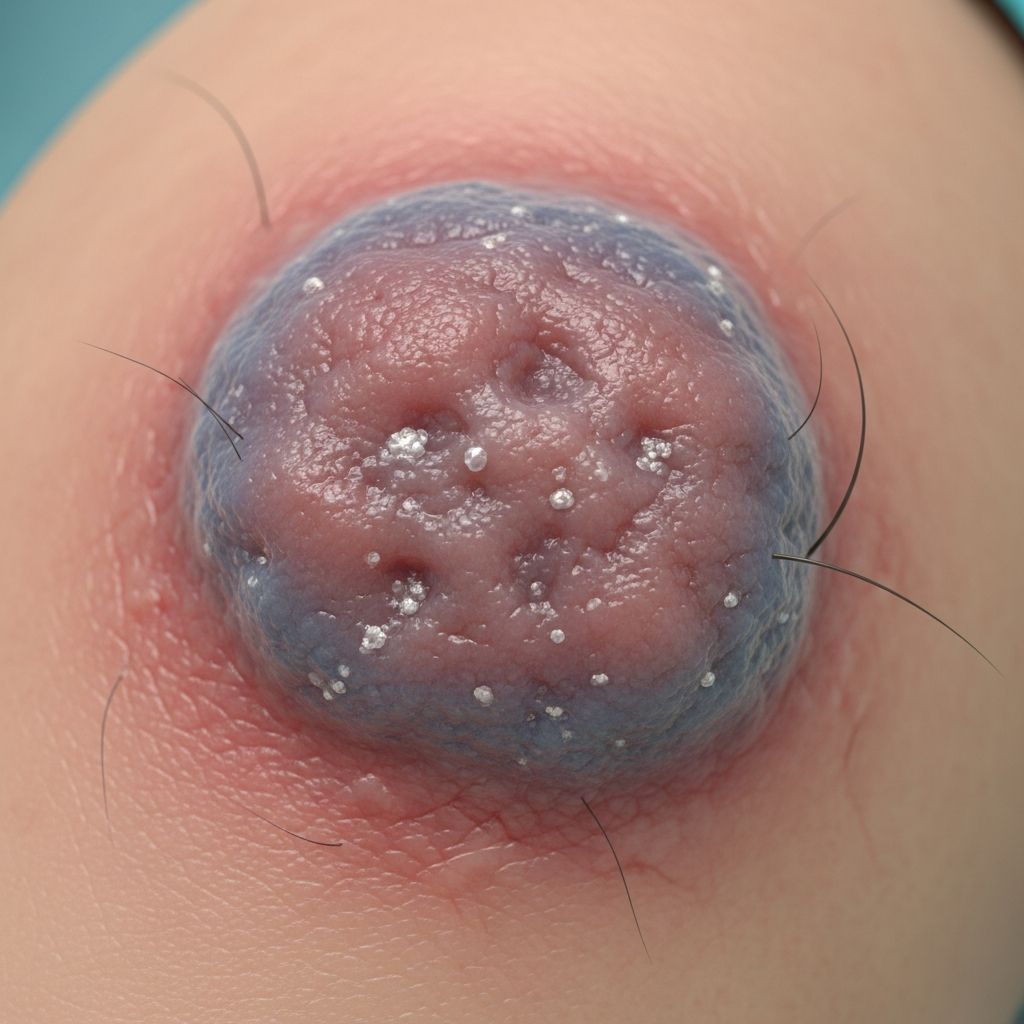
Pilomatricomas present as solitary, slowly enlarging, hard dermal or subcutaneous nodules, typically 3-30 mm in diameter. Common locations include:
- Head and neck: 75% of cases (cheek, pre/post-auricular, brow)
- Upper extremities: 15%
- Trunk: 10%
Skin characteristics:
- Skin-coloured, pink-red, blue-black, or purple
- Firm to hard (‘pebble-like’)
- Freely mobile over deeper structures
- Tenting sign: Irregular facets when stretched
- Teeter-totter sign: Opposite side elevates on pressure
Clinical stages:
- Early: Reddish, inflammatory, tender
- Fully developed: Hard, skin-coloured nodule
- Regressing: Calcified, extruded keratin
Rare giant forms exceed 5 cm.
How is pilomatricoma diagnosed?
Diagnosis combines clinical features, dermoscopy, and histopathology:
Clinical diagnosis
Suspicious features: Hard subcutaneous nodule on child’s head/neck with tenting/teeter-totter signs.
Dermoscopy
Characteristic findings:
- Central white/gray-blue structureless area (calcification/shadow cells)
- Peri-follicular pigment ring
- Reddish rim with telangiectasia
Imaging
- Ultrasound: Well-defined, hyperechoic mass ± calcification/acoustic shadowing
- X-ray: Dense calcification
Histopathology (definitive)
Classic triad:
- Basophilic cells (small, dark, mitotically active)
- Shadow/ghost cells (anucleate, eosinophilic, cornified)
- Calcification (80% of cases)
Tumour may be encapsulated or infiltrative.
What are the complications of pilomatricoma?
Complications are uncommon but include:
- Inflammation: 25% become red, tender, mimicking infection
- Giant growth: >5 cm diameter
- Recurrence: 1-5% after incomplete excision
- Pilomatrix carcinoma: Very rare (<1%), rapid growth, local invasion
Related Stories



Multiple lesions suggest syndromic association.
What is the treatment for pilomatricoma?
Surgical excision is curative, removing the entire lesion with a margin of normal tissue. Performed under local/general anaesthesia as day surgery.
Alternative approaches (less common):
- Incision and curettage: Smaller lesions
- Laser ablation: Experimental
Observation may be appropriate for small, asymptomatic lesions in children, but most are excised for diagnosis and cosmesis.
Frequently asked questions
Is pilomatricoma cancerous?
No, pilomatricoma is benign. Pilomatrix carcinoma is extremely rare (<100 cases reported).
Will pilomatricoma go away on its own?
No, they persist and slowly enlarge. Surgical removal is recommended.
Can pilomatricoma recur?
Recurrence rate is 1-5% with incomplete excision. Complete removal prevents recurrence.
Should all pilomatricomas be removed?
Yes, for definitive diagnosis and to prevent growth/cosmetic issues, especially in visible areas.
Are multiple pilomatricomas dangerous?
Multiple lesions (2+) occur in 2-10% and may indicate genetic syndromes requiring screening.
Clinical images
(Image descriptions based on typical presentations: Hard subcutaneous nodule on cheek with normal overlying skin; blue-black lesion behind ear showing tenting sign; calcified mass with extruded keratin)
References
- Pediatric Pilomatrixoma – Conditions and Treatments — Children’s National Hospital. 2023. https://www.childrensnational.org/get-care/health-library/pilomatrixoma
- Pilomatrixoma — Children’s Hospital of Philadelphia. 2024. https://www.chop.edu/conditions-diseases/pilomatrixoma
- Pilomatricoma: An Unusual Dermatologic Neoplasm — PMC (National Library of Medicine). 2012-10-01. https://pmc.ncbi.nlm.nih.gov/articles/PMC3484971/
- Pilomatricoma: Symptoms, Causes, Risks, and Treatment — Healthline. 2023. https://www.healthline.com/health/pilomatricoma
- Pilomatrixoma — St. Louis Children’s Hospital. 2024. https://www.stlouischildrens.org/conditions-treatments/pilomatrixoma
- Pilomatricoma: Signs, Causes, and Treatment — Healthgrades. 2023. https://resources.healthgrades.com/right-care/skin-hair-and-nails/pilomatricoma
- Pilomatricoma — DermNet NZ (Authoritative dermatology reference). 2024. https://dermnetnz.org/topics/pilomatricoma
Similar Articles








Read full bio of Sneha Tete