Pilomatrix Carcinoma: Diagnosis, Treatment, and Prognosis
Comprehensive guide to pilomatrix carcinoma: understanding this rare malignant skin tumor.
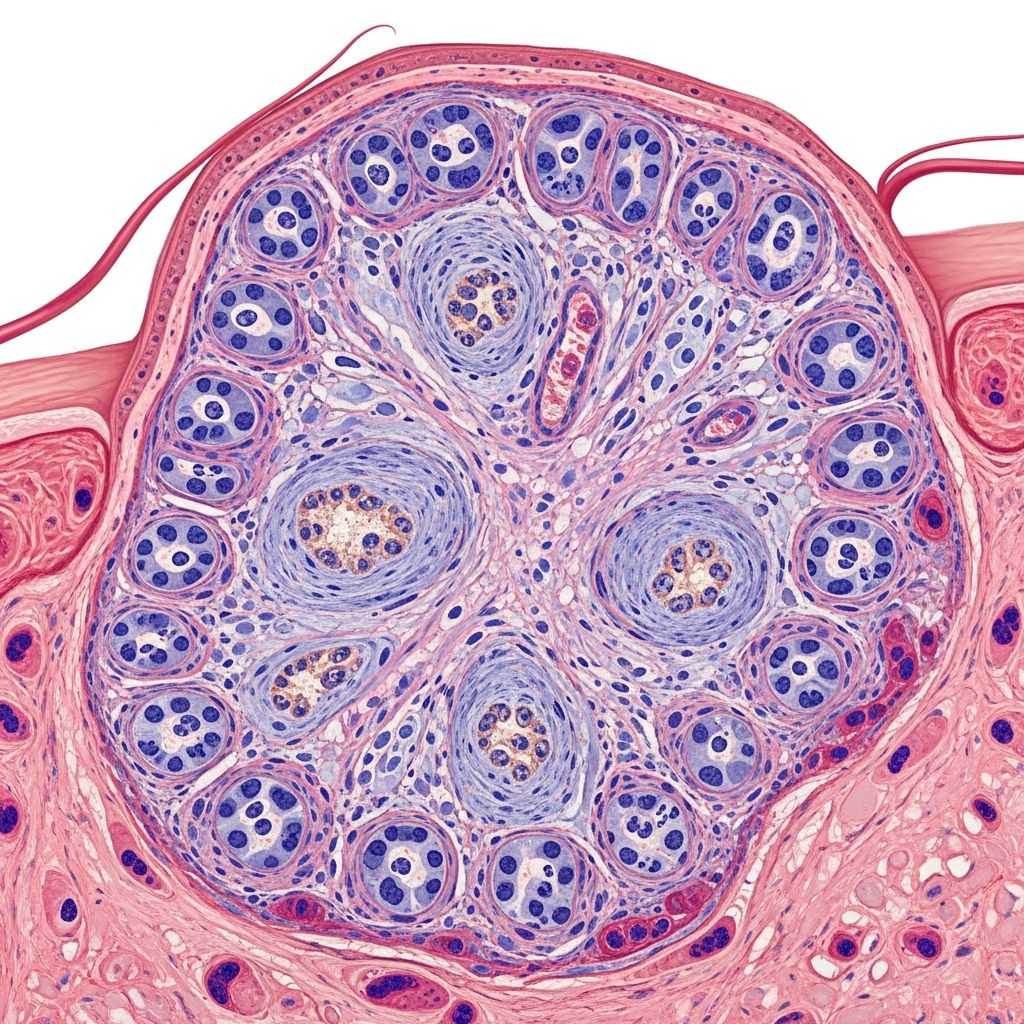
Pilomatrix Carcinoma: Overview and Definition
Pilomatrix carcinoma is a rare malignant neoplasm composed of cells that resemble the matrix of hair follicles. Despite its rarity, this aggressive tumor presents significant clinical challenges due to its high propensity for local recurrence and potential for distant metastasis. Understanding the pathology, clinical presentation, and management strategies is essential for dermatologists and surgical oncologists involved in treating this condition.
The tumor arises from the hair follicle matrix and is characterized by infiltrative growth patterns and malignant histological features. While pilomatrix carcinoma shares some histological features with the benign pilomatricoma, the malignant variant demonstrates distinct characteristics that differentiate it diagnostically. The biological behavior of pilomatrix carcinoma is more aggressive than initially recognized, with higher rates of recurrence and metastasis than previously documented in early clinical observations.
Clinical Presentation
Pilomatrix carcinoma frequently presents as a single asymptomatic dermal or subcutaneous mass that is firm, painless, and mobile. Patients typically report a slow-growing lesion that has been present for an extended period before seeking medical attention. The tumor commonly appears as a hard lump beneath the skin surface, often with a violaceous discoloration of the overlying skin.
Notable clinical features include:
- Solitary subcutaneous or dermal nodule
- Firm consistency and mobile character
- Asymptomatic presentation in most cases
- Slow growth rate over months to years
- Possible violaceous discoloration of overlying skin
- Surface ulceration in some cases, considered one of the notable signs of malignancy
- Most common location in the head and neck region, particularly in the preauricular area, scalp, posterior neck, and upper back
The demographic profile most frequently affected includes males above the sixth decade of age, though the condition can occur across different age groups. Most reported lesions range between 0.5 and 7 centimeters in size, with a mean size of approximately 4 centimeters among documented cases.
Histopathological Features and Diagnosis
The diagnosis of pilomatrix carcinoma is based on histological examination of a skin biopsy specimen obtained through surgical excision or needle biopsy. Distinguishing this malignant tumor from its benign counterpart requires careful microscopic analysis of specific diagnostic criteria.
Key histopathological features diagnostic of pilomatrix carcinoma include:
- Irregularly shaped nests of large anaplastic, hyperchromatic basaloid cells
- Prominent nucleoli and nuclear pleomorphism
- Abundant mitotic figures, ranging from 8-62 per high-power field
- Atypical mitotic figures indicating malignant transformation
- Central areas with necrotic debris and shadow cells
- Infiltrative growth pattern into surrounding tissues
- Invasion of blood and lymphatic vessels in some cases
- Surface ulceration
- Clear cytoplasmic cells and transition to squamous cells
- Desmoplastic stroma surrounding tumor nests
Immunohistochemical analysis provides supportive evidence for diagnosis, with typical markers including cytoplasmic staining with pan-cytokeratin CK14, positivity with the monoclonal antibody Ber-Ep4, and nuclear positivity with p63. Focal cytoplasmic staining with carcinoembryonic antigen may also be present, while the tumor is typically negative for CK20, S-100, and CD56.
Differential Diagnosis
Clinical differential diagnosis of pilomatrix carcinoma includes several other skin conditions, which may lead to initial misdiagnosis:
- Benign pilomatricoma (the non-malignant counterpart)
- Epidermal cyst
- Basal cell carcinoma
- Squamous cell carcinoma
- Malignant melanoma
- Vascular lesions
- Cutaneous sarcomas (particularly for large lesions)
The clinical presentation as a firm, asymptomatic nodule often leads to initial treatment as a benign tumor, with the malignant diagnosis typically made only after histopathological examination of the excised specimen.
Related Stories



Staging and Imaging Evaluation
Complete staging and assessment of local spread are critical components of pilomatrix carcinoma management. A magnetic resonance imaging (MRI) scan of the lesion may be required to determine the local spread of the tumor and assess involvement of adjacent structures. This imaging modality provides excellent soft tissue contrast and helps define tumor margins and relationship to surrounding anatomical structures.
Additional imaging and physical examination procedures include:
- Palpation of regional lymph nodes to detect clinical evidence of nodal involvement
- Computed tomography (CT) scan to search for lung and liver metastases
- Chest imaging to evaluate for pulmonary involvement, the most frequent site of distant metastases
- Cross-sectional imaging of the primary site to assess depth and local extent
Due to the potential for metastasis to various sites including regional lymph nodes, lungs, bones, and other organs, comprehensive staging is warranted at the time of initial diagnosis and during follow-up evaluations.
Treatment and Management
Surgical Treatment
Complete surgical excision with wide margins is the recommended and principal treatment modality for pilomatrix carcinoma. Wide local excision with safe margins, typically ranging from 2-3 centimeters, is essential to reduce the risk of local recurrence. Incomplete resections have led to local recurrences in a significant proportion of cases, emphasizing the importance of adequate surgical margins.
Mohs micrographic surgery may be used to ensure better margin control and tissue preservation, particularly in anatomically sensitive areas. This technique allows for real-time microscopic assessment of surgical margins and systematic removal of tumor tissue while maximizing preservation of normal tissue.
Regional lymph node dissection is recommended when metastasis is suspected based on clinical examination or imaging findings. The decision for prophylactic lymph node dissection versus observation remains controversial, though some authorities advocate for consideration of nodal dissection in high-risk cases.
Adjuvant Radiotherapy
Adjuvant radiotherapy has been used in the management of pilomatrix carcinoma, though the potential benefits are not completely well defined. Radiotherapy has demonstrated utility in several clinical scenarios:
- Providing adequate local tumor control following incomplete excision
- Treating lymph node metastases as an alternative to formal surgical dissection
- Providing palliative treatment of systemic metastases
- Serving as an alternative in patients for whom adequate surgical excision is not possible due to anatomical or medical constraints
Chemotherapy
Systemic chemotherapy has not demonstrated effectiveness in pilomatrix carcinoma. Currently, no chemotherapy regimen has shown efficacy in local control or in preventing metastatic spread. Systemic disease is associated with poor prognosis and remains resistant to chemical therapy approaches.
Prognosis and Outcomes
The prognosis of pilomatrix carcinoma varies depending on the stage at presentation and completeness of treatment. Mortality rates range from 7 to 9 percent in published case series, with most deaths occurring in patients with advanced disease or metastatic involvement.
Recurrence statistics reveal several important prognostic considerations:
- Local recurrence occurs in approximately 23 percent of cases treated with wide excision
- Simple excision without adequate margins results in recurrence rates as high as 83 percent
- Metastases to regional lymph nodes, lungs, bones, and other organs occur in approximately 13 percent of cases
- Local tumor recurrence is the only significant risk factor for development of metastases
- Recurrence-free intervals following resection range from 5-17 months in published series
- Lung metastases have been described and may occur years after initial diagnosis
Prognosis is significantly better for localized disease treated with adequate wide excision compared to incomplete resections. Patients with nodal or systemic metastases at presentation have substantially worse outcomes.
Follow-up and Surveillance
Comprehensive follow-up examinations are warranted following initial treatment of pilomatrix carcinoma, despite the currently inadequate treatment options for advanced disease. Regular clinical assessment of the primary site and regional lymph nodes should be performed at defined intervals. Long-term surveillance is recommended given the potential for late recurrence and the possibility of metastatic disease presenting years after initial treatment.
Imaging surveillance may be considered in selected patients at higher risk for recurrence or metastasis, particularly those with aggressive histological features or incomplete initial resection. However, the optimal surveillance protocol remains undefined.
Origin and Pathogenesis
It remains unknown whether pilomatrix carcinomas arise de novo or through malignant transformation of benign pilomatricomas. Similarities exist between the benign lesion and its malignant counterpart in terms of activating mutations in signaling pathways, suggesting a potential evolutionary relationship. However, the exact mechanism of malignant transformation has not been fully elucidated.
Frequently Asked Questions
Q: How is pilomatrix carcinoma different from benign pilomatricoma?
A: While both tumors originate from hair follicle matrix cells, pilomatrix carcinoma demonstrates malignant histological features including increased mitotic activity, nuclear pleomorphism, atypical mitotic figures, and infiltrative growth patterns. Benign pilomatricomas lack these malignant characteristics and do not have metastatic potential.
Q: What is the recurrence rate for pilomatrix carcinoma?
A: Local recurrence occurs in approximately 23 percent of cases treated with adequate wide excision. However, simple excision without proper margins results in recurrence rates as high as 83 percent, emphasizing the critical importance of surgical technique and margin adequacy.
Q: Can pilomatrix carcinoma metastasize?
A: Yes, metastases occur in approximately 13 percent of cases, most commonly to regional lymph nodes and lungs. Lung metastases may occur years after initial diagnosis. Local tumor recurrence is the most significant risk factor for development of metastatic disease.
Q: What is the mortality rate for pilomatrix carcinoma?
A: Mortality rates range from 7 to 9 percent in published series, with most deaths occurring in patients with advanced or metastatic disease at presentation.
Q: Is chemotherapy effective for pilomatrix carcinoma?
A: No, systemic chemotherapy has not demonstrated effectiveness in treating pilomatrix carcinoma. No chemotherapy regimen has shown efficacy in local control or prevention of metastatic spread, making systemic disease associated with poor prognosis.
Q: What are the most common locations for pilomatrix carcinoma?
A: The majority of lesions are located in the head and neck region, particularly in the preauricular area, scalp, posterior neck, and upper back. Very few cases have been reported arising from other locations such as the parotid region.
Conclusion
Pilomatrix carcinoma represents a rare but aggressive malignant skin tumor requiring prompt diagnosis and appropriate surgical management. The combination of wide local excision with adequate margins and careful histopathological examination provides the best opportunity for successful treatment and disease control. Although adjuvant radiotherapy may provide additional benefit in selected cases, chemotherapy remains ineffective for systemic disease. Long-term follow-up is essential given the potential for late recurrence and metastatic spread. Future studies are needed to establish more defined treatment standards and to evaluate the role of additional therapeutic modalities in improving outcomes for patients with this challenging malignancy.
References
- Pilomatrix carcinoma — DermNet New Zealand. Accessed January 2026. https://dermnetnz.org/topics/pilomatrix-carcinoma
- Pilomatrix carcinoma of the skin and soft tissue — University of Pittsburgh Medical Center, Department of Pathology. Accessed January 2026. https://path.upmc.edu/cases/case857/dx.html
- Pilomatrix carcinoma: More malignant biological behavior than was previously recognized — Spandidos Publications. 2017. https://www.spandidos-publications.com/10.3892/mco.2017.1148
- Pilomatrix carcinoma: 12-year experience and review of the literature — Journal of Cutaneous Pathology. 2017. https://onlinelibrary.wiley.com/doi/10.1111/cup.13046
- Not Your Average Skin Cancer: A Rare Case of Pilomatrix Carcinoma — National Center for Biotechnology Information. https://pmc.ncbi.nlm.nih.gov/articles/PMC7442310/
- Pilomatrix carcinoma — National Organization for Rare Disorders. https://rarediseases.org/mondo-disease/skin-pilomatrix-carcinoma/
- Pilomatrix carcinoma — Orphanet, European Organization for Rare Diseases. https://www.orpha.net/en/disease/detail/499182
Similar Articles








Read full bio of Sneha Tete