Pityriasis Lichenoides Et Varioliformis Acuta: Pathology Guide
Detailed histopathology of pityriasis lichenoides et varioliformis acuta (PLEVA), including clinical features, microscopic findings, and differential diagnosis.
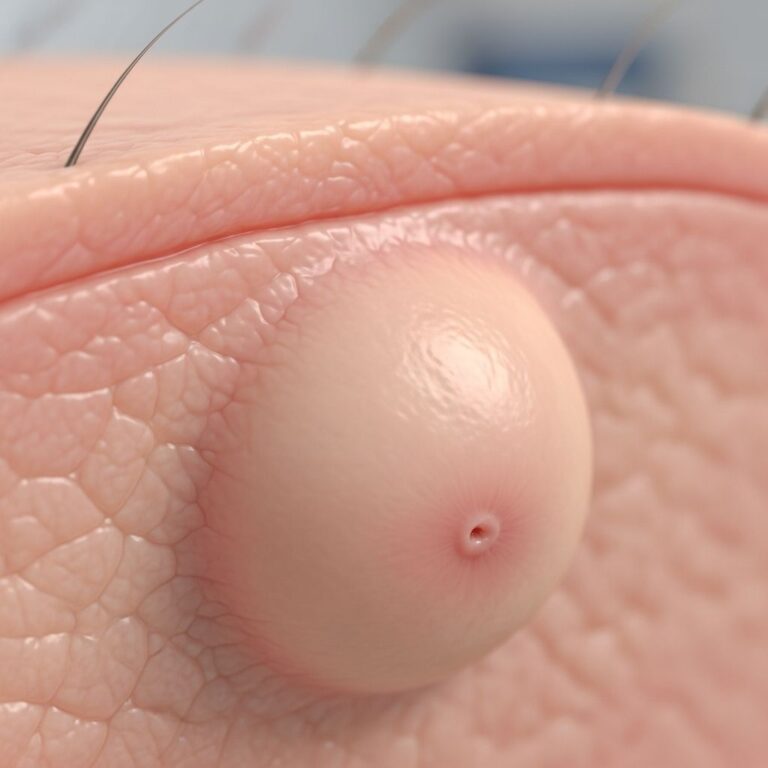
Pityriasis lichenoides et varioliformis acuta (PLEVA), also known as Mucha-Habermann disease, is an acute, self-limiting inflammatory skin disorder characterized by crops of haemorrhagic papules that evolve into necrotic lesions and resolve with varioliform (pox-like) scars. It predominantly affects children and young adults, presenting as a polymorphic eruption on the trunk and extremities.
Clinical features
PLEVA manifests as recurrent crops of small, erythematous papules that rapidly develop central haemorrhagic crusts or vesicles, often accompanied by pruritus or burning sensation. Lesions are typically 2–10 mm in diameter, polymorphic in nature, and favour the trunk, buttocks, and flexor aspects of the limbs. Constitutional symptoms such as fever, malaise, or arthralgia may occur in severe cases, distinguishing it from the chronic variant, pityriasis lichenoides chronica (PLC).
- Acute onset: Crops appear over days to weeks, resolving in 2–3 weeks per lesion but recurring for months.
- Morphology: Papules progress to haemorrhagic necrosis, ulceration, and post-inflammatory hypopigmentation or atrophic scars.
- Distribution: Centralized on trunk; spares face, palms, and soles in most cases.
- Associations: Rare links to infections (e.g., HHV-7, adenovirus) or hypersensitivity reactions; T-cell mediated immune response implicated.
Diagnosis relies on clinicopathological correlation, as histology alone lacks absolute specificity, with mimics including pityriasis rosea, arthropod bites, and guttate psoriasis.
Histopathology
The hallmark of PLEVA is a wedge-shaped, dense lymphocytic infiltrate centred on the superficial vascular plexus, extending into the deep dermis. This pattern reflects the vasculopathic and interface nature of the process.
Low power view
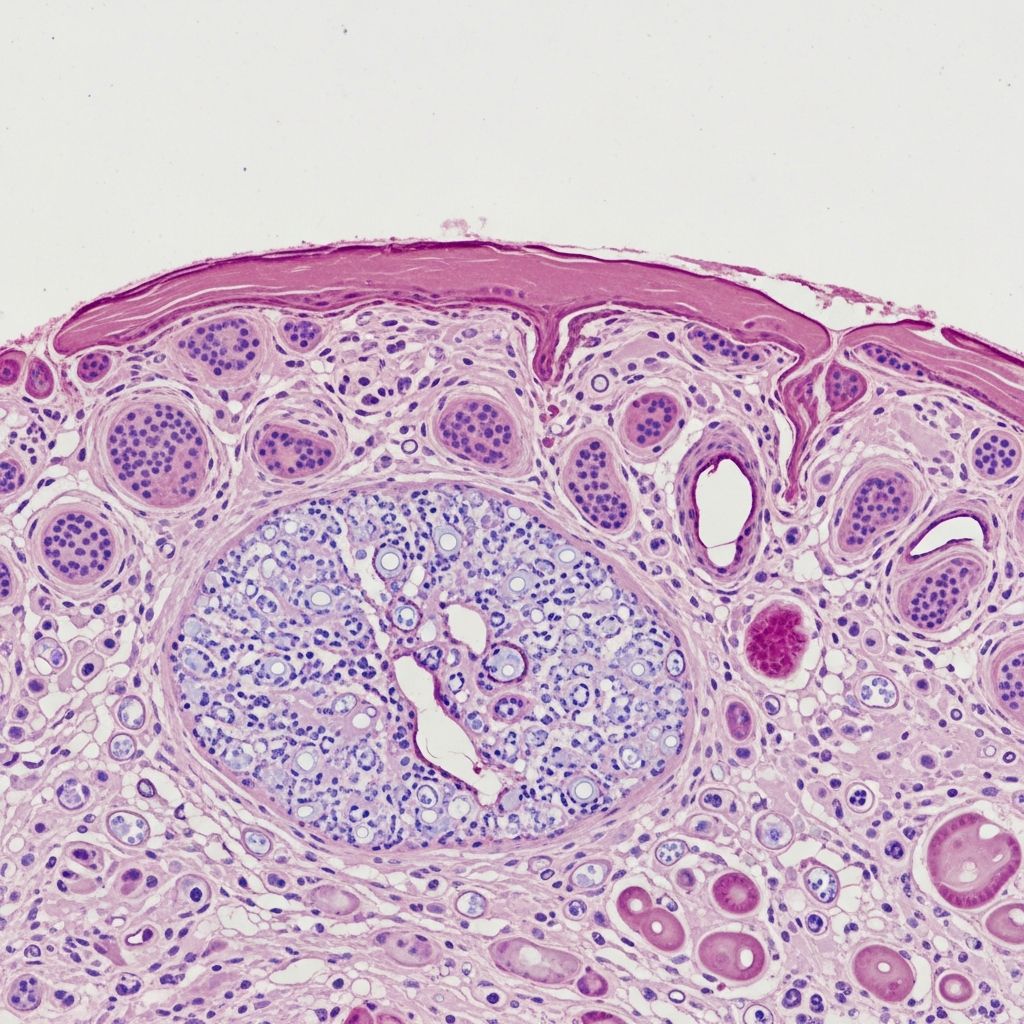
At scanning magnification, PLEVA exhibits a sharply demarcated, moderately dense perivascular and lichenoid infiltrate forming a wedge from the dermal papillae to the mid-reticular dermis (figure 1). Epidermal changes include parakeratosis, spongiosis, and focal necrosis, with scattered extravasated erythrocytes imparting a haemorrhagic appearance.
High power view
Interface dermatitis is prominent, with vacuolar degeneration of the basal layer, dyskeratotic keratinocytes, and colloid bodies. Exocytosis of mature lymphocytes into the epidermis is conspicuous, often with satellite cell necrosis. Parakeratosis overlies areas of epidermal injury, sometimes with Dunn-Smith microabscesses (neutrophilic collections). Dermal papillae show erythrocyte extravasation, endothelial swelling, and perivascular lymphocytes without true fibrinoid necrosis—distinguishing it from leukocytoclastic vasculitis.
- Epidermis: Hydropic degeneration, keratinocyte apoptosis, lymphocytic exocytosis, confluent parakeratosis ± neutrophils.
- Dermis (superficial): Band-like lichenoid infiltrate, erythrocyte extravasation, pigment incontinence.
- Vascular changes: Lymphocytic vasculitis (endothelial swelling, perivascular lymphocytes) without fibrin deposition or leukocytoclasia.
- Deep dermis: Extension of wedge-shaped infiltrate, sparse perivascular lymphocytes.
| Feature | PLEVA | Pityriasis Rosea | Arthropod Bite |
|---|---|---|---|
| Infiltrate pattern | Wedge-shaped lichenoid | Patchy lichenoid | Superficial perivascular |
| Exocytosis | Prominent | Mild | Variable |
| Parakeratosis | Confluent ± neutrophils | Focal | Absent |
| Vasculitis | Lymphocytic (no fibrin) | Absent | Absent |
| Necrosis | Foci of keratinocytes | Mild | Eosinophils common |
Studies confirm basal vacuolation and perivascular infiltrates in all cases, with exocytosis in ~45%; PLEVA shows more intense changes than PLC.
Related Stories



Immunohistochemistry
CD4+ T-cells predominate the infiltrate, with CD8+ cells at the interface; CD30 expression in atypical lymphocytes suggests a lymphoproliferative spectrum in some cases. HHV-7 DNA detected via PCR in lesional skin supports infectious trigger hypotheses.
Electron microscopy
Basal lamina disruption, cytoplasmic vacuolization of keratinocytes, and lymphocytic invasion of epidermal cells; tuboreticular inclusions occasionally noted, hinting at interferon response.
Pathogenesis
The aetiology remains elusive, positioned as a hypersensitivity reaction to infections (adenovirus, parvovirus, HHV-7), drugs, or vaccines, manifesting as T-cell mediated cytotoxicity against keratinocytes. Evidence includes clonal T-cell populations in some, blurring lines with cutaneous T-cell lymphoma, though most self-resolve.
- Infectious: HHV-7 DNA in skin biopsies of cases resolving with antibiotics.
- Immune: Oligoclonal T-cells, cytokine storm akin to lymphomatoid papulosis.
- Genetic: Rare familial clusters; HLA associations unconfirmed.
Differential diagnosis
Clinicopathological overlap challenges diagnosis:
- Lymphomatoid papulosis: CD30+ cells, larger lesions, chronicity.
- Guttate psoriasis: Regular acanthosis, Munro microabscesses.
- Viral exanthems: Sparse infiltrate, no wedge shape.
- PLC: Less necrosis, more chronic interface changes.
- Secondary syphilis: Plasma cells, endothelial proliferation.
Histologic specificity is moderate; only 38% of “PLEVA-like” biopsies confirm clinically.
Febrile ulceronecrotic Mucha-Habermann disease
A rare, severe variant with high fever, coalescent ulcerations, and systemic involvement (hepatitis, pneumonitis); mortality up to 25% pre-immunosuppressants. Histology mirrors PLEVA but more extensive necrosis and angioinvasion.
Fluorescence microscopy
IgM and C3 deposits at dermoepidermal junction in ~30%, supporting immune complex role; direct immunofluorescence aids in excluding lupus or bullous diseases.
Management overview
Self-limited (months to years); symptomatic with emollients, potent topicals. Antibiotics (erythromycin, tetracycline), phototherapy (NB-UVB, PUVA) effective; severe cases require methotrexate or cyclosporine.
Frequently Asked Questions
What causes PLEVA?
Unknown; likely post-infectious hypersensitivity with T-cell activation.
Is PLEVA contagious?
No, not communicable despite infectious associations.
Does PLEVA scar?
Yes, varioliform atrophic scars in 25–50% of lesions.
Can PLEVA turn into cancer?
Rare progression to lymphoma; monitor atypical cases.
How is PLEVA diagnosed?
Skin biopsy showing wedge infiltrate, exocytosis, and necrosis.
References
- Pityriasis lichenoides et varioliformis acuta pathology — DermNet NZ. 2023. https://dermnetnz.org/topics/pityriasis-lichenoides-et-varioliformis-acuta-pathology
- Histopathologic diagnosis of pityriasis lichenoides et varioliformis acuta — Hood AF, et al. Arch Dermatol. 1982. https://pubmed.ncbi.nlm.nih.gov/7092272/
- Pityriasis lichenoides et varioliformis acuta associated with HHV-7 — Acta Dermosifiliogr. 2018. https://www.actasdermo.org/en-pityriasis-lichenoides-et-varioliformis-acuta-articulo-S1578219018301859
- Histopathologic Diagnosis of PLEVA — JAMA Dermatol. 1982. https://jamanetwork.com/journals/jamadermatology/fullarticle/543326
- Clinical and histopathological study of pityriasis lichenoides — Nair PS. Indian J Dermatol Venereol Leprol. 2007. https://ijdvl.com/a-clinical-and-histolopathological-study-of-pityriasis-lichenoides/
- Pityriasis lichenoides et varioliformis acuta: a disease spectrum — Fernandes NF, et al. Int J Dermatol. 2010. https://onlinelibrary.wiley.com/doi/abs/10.1111/j.1365-4632.2008.03915.x
- Pityriasis Lichenoides Et Varioliformis Acuta (PLEVA) — Teklehaimanot F, et al. StatPearls NCBI. 2023. https://www.ncbi.nlm.nih.gov/books/NBK585135/
Similar Articles








Read full bio of medha deb