Pityriasis Versicolor Pathology: Key Histology & Diagnosis
Detailed histopathological analysis of pityriasis versicolor, highlighting Malassezia yeast distribution and skin changes.
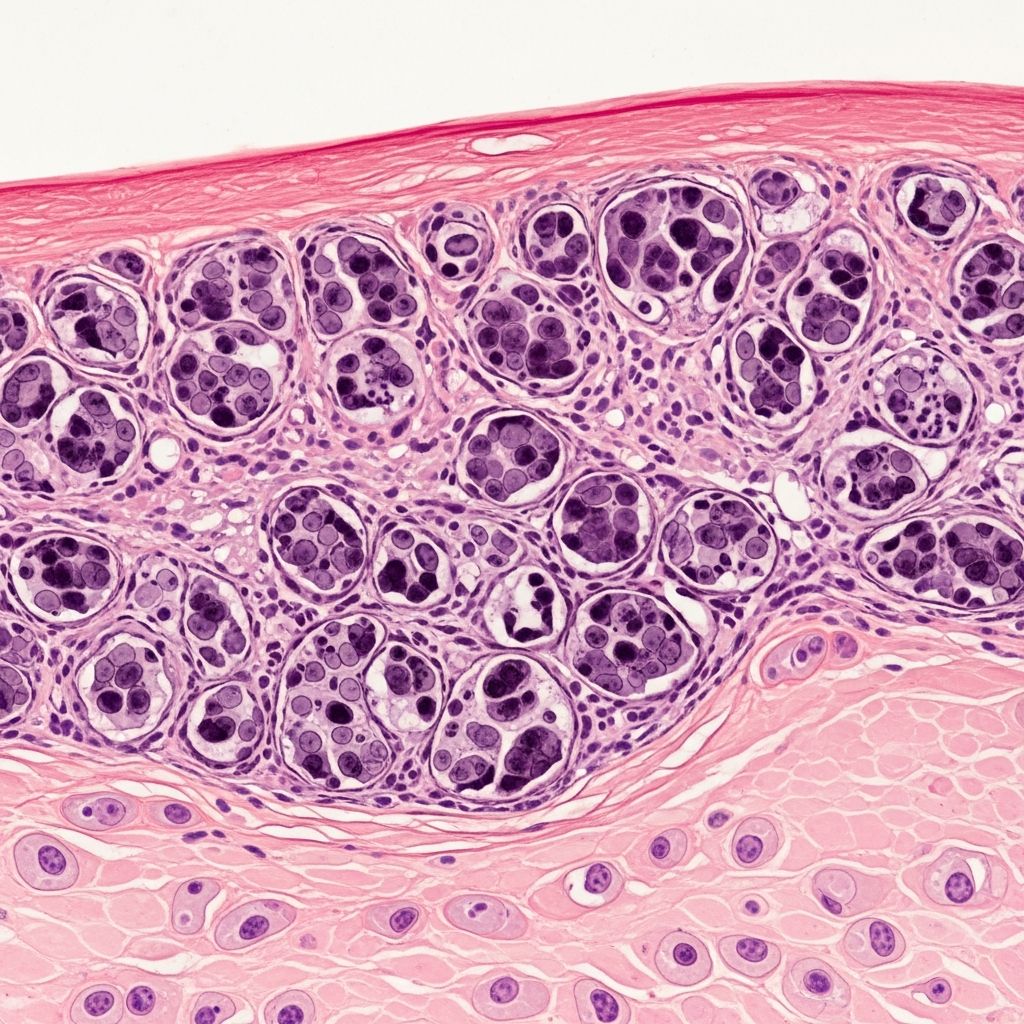
Pityriasis versicolor, also known as tinea versicolor, is a common superficial fungal infection of the skin caused by lipophilic yeasts of the Malassezia genus, primarily Malassezia furfur. This condition manifests as discoloured patches on the skin due to abnormal melanin production influenced by the fungus. Pathologically, it is characterized by organisms residing almost exclusively in the stratum corneum, with distinctive histological features visible on routine stains.
Authoritative Facts
- Pityriasis versicolor involves Malassezia species, normal skin flora that overgrow under certain conditions, leading to hypopigmented, hyperpigmented, or pink scaly patches mainly on the trunk.
- Histologically, low-power views show mild superficial perivascular inflammation, with yeasts and hyphae confined to the horny layer.
- Diagnosis relies on microscopy revealing ‘spaghetti and meatballs’ appearance: round spores and short hyphae.
Clinical Introduction
Pityriasis versicolor presents as discrete or confluent macules and patches with fine surface scale, commonly on the upper trunk, neck, and arms. In lighter skin, patches appear pink or coppery brown; in darker skin, they are often hypopigmented (pityriasis versicolor alba). The infection is usually asymptomatic but can be mildly pruritic. It thrives in warm, humid environments, affecting adolescents and young adults predominantly.
The pathogenesis involves Malassezia yeasts producing substances like azelaic acid, which inhibit melanocyte function, leading to pigmentary changes. Hyperpigmented lesions show enlarged melanosomes, while hypopigmented ones result from impaired tyrosinase activity. Rarely, an atrophying variant occurs with epidermal thinning and wrinkled appearance, sometimes linked to corticosteroid use.
Histopathology
The hallmark of pityriasis versicolor pathology is the presence of fungal elements within the stratum corneum. On low-power microscopy, a mild superficial perivascular lymphocytic infiltrate is observed, suggesting subtle inflammation (Figure 1, low-power view).
The epidermis often exhibits mild
hyperkeratosis
(thickened stratum corneum) andacanthosis
(epidermal thickening), with occasional elongation of rete ridges and increased basal layer pigmentation resembling acanthosis nigricans. These changes correlate with the fine scale seen clinically.Key Microscopic Features
| Feature | Description | Stain Visibility |
|---|---|---|
| Yeast Spores | Round, 3-8 μm ‘meatballs’ | H&E, PAS (prominent) |
| Hyphae | Short, straight ‘cigar-butt’ or ‘spaghetti’ | H&E, GMS |
| Location | Exclusively stratum corneum | All stains |
| Inflammation | Mild perivascular lymphocytes, occasional plasma cells | H&E |
Fungal organisms are readily identified on haematoxylin and eosin (H&E) sections without special stains. The classic ‘spaghetti and meatballs’ pattern—curved hyphae amidst clusters of spores—is pathognomonic (Figures 2-4). Periodic acid-Schiff (PAS) or Gomori methenamine silver (GMS) stains highlight the fungi more vividly, especially in subtle cases.
In hypopigmented lesions, basket-weave hyperkeratosis is prominent, with sparse inflammation. Hyperpigmented variants show more pronounced acanthosis and pigment incontinence. Rarely, deeper invasion occurs in immunocompromised patients, but this is atypical.
Dermoscopic Correlation
Dermoscopy aids non-invasive diagnosis. Hypopigmented patches show diffuse white structureless areas, faint pigment networks, and patchy fine scales, sometimes forming a ‘wire-fence’ pattern along skin lines. Hyperpigmented lesions display perifollicular white scale and brownish networks.
Related Stories



These findings correlate histologically: white scale reflects hyperkeratosis, while retained faint networks indicate mild basal hyperpigmentation in elongated rete ridges. Stretching the skin reveals ‘double-edged’ scale, confirming superficial fungal colonization.
Differential Diagnosis
Pathologically, pityriasis versicolor must be distinguished from other superficial dermatoses:
- Pityriasis alba: Fine scale without fungi; reduced melanin but no organisms.
- Vitiligo: Complete melanocyte loss, no scale or inflammation.
- Progressive macular hypomelanosis: Faint reticular pigment, minimal scale, negative microscopy.
- Tinea corporis: Deeper hyphae in stratum spinosum/malassezia; PAS-positive but different morphology.
- Seborrhoeic dermatitis: Spongiosis, parakeratosis; Malassezia present but not dominant.
Skin scrapings in 10-20% KOH confirm diagnosis by revealing hyphae and spores, absent in mimics.
Special Stains and Variants
PAS stains yeast cell walls magenta, aiding detection in cornflakes-like parakeratosis. Fontana-Masson highlights melanin distribution: increased in brown lesions, decreased in white ones.
An uncommon
atrophying tinea versicolor
shows epidermal atrophy, vascular ectasia, and reduced dermal collagen/elastic fibers on biopsy. It presents as wrinkled, reddish-ivory lesions, often in corticosteroid users but also spontaneously.Pathogenesis Insights
Malassezia furfur (formerly Pityrosporum ovale/orbiculare) is lipophilic, requiring free fatty acids from sebum. Proliferation leads to dicarboxylic acids (e.g., azelaic acid) that:
- Inhibit tyrosinase, causing hypopigmentation.
- Induce mild dermatitis in pink variants.
- Enlarge melanosomes in hyperpigmented types.
Host factors like humidity, occlusion, immunosuppression, and hyperhidrosis promote overgrowth.
Frequently Asked Questions (FAQs)
Q: What does pityriasis versicolor look like under the microscope?
A: Characteristic ‘spaghetti and meatballs’—short hyphae and round yeast spores in the stratum corneum on H&E or PAS stains.
Q: Is pityriasis versicolor contagious?
A: No, as Malassezia is normal skin flora; it’s not person-to-person transmissible.
Q: Why does it cause pigment changes?
A: Fungal metabolites like azelaic acid impair melanocytes, leading to hypo- or hyperpigmentation.
Q: Can pathology confirm the diagnosis?
A: Yes, biopsy shows superficial fungi with minimal inflammation, distinguishing from other hypomelanoses.
Q: What is atrophying pityriasis versicolor?
A: Rare variant with epidermal atrophy and wrinkled lesions, visible on histopathology.
Diagnostic Approach
Clinical suspicion prompts KOH prep: hyphae/spores in 80-90% cases. Biopsy reserved for atypical/diagnostic uncertainty. Wood’s lamp shows yellow-green fluorescence in some. Dermoscopy enhances specificity pre-biopsy.
Post-treatment, persistent pigment normalizes slowly (1-3 months); scale clearance indicates mycologic cure.
References
- Pityriasis versicolor pathology — DermNet NZ. 2023. https://dermnetnz.org/topics/pityriasis-versicolor-pathology
- Dermoscopy of pityriasis versicolor — DermNet NZ. 2023. https://dermnetnz.org/topics/dermoscopy-of-pityriasis-versicolor
- Tinea Versicolor — StatPearls, NCBI Bookshelf. 2023-10-01. https://www.ncbi.nlm.nih.gov/books/NBK482500/
- Pityriasis versicolor — DermNet NZ. 2023. https://dermnetnz.org/topics/pityriasis-versicolor
- Pityriasis versicolor – Fungal skin infections — DermNet NZ. 2023. https://dermnetnz.org/cme/fungal-infections/pityriasis-versicolor
- Tinea Versicolor | Treatment & Management — StatPearls. 2023. https://www.statpearls.com/point-of-care/30211
Similar Articles








Read full bio of Sneha Tete