Plasmacytoma: Comprehensive Guide To Diagnosis And Treatment
Rare plasma cell tumour affecting skin or bone, with critical diagnostic and prognostic implications.
A
plasmacytoma
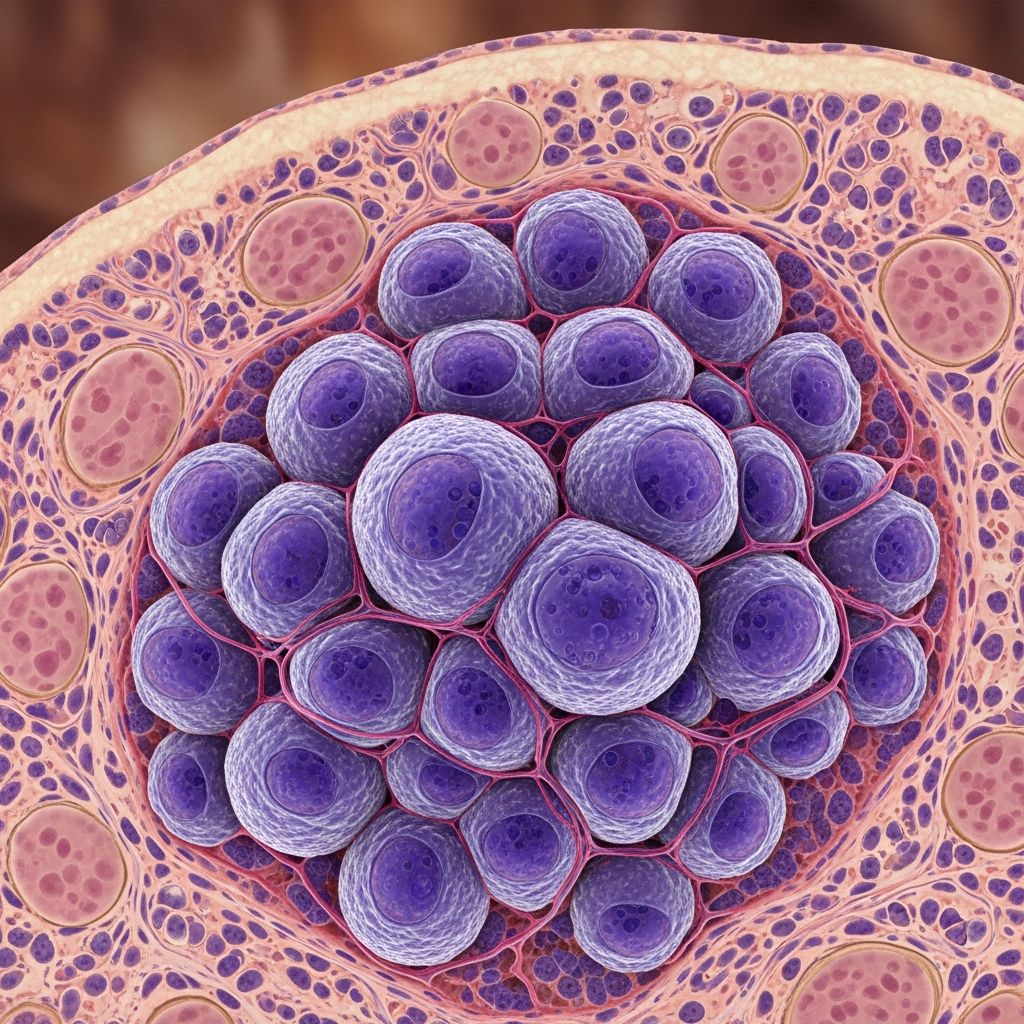
is a tumour composed of abnormal plasma cells, typically arising within bone but occasionally in extramedullary sites such as the skin. These neoplasms represent localized proliferations of monoclonal plasma cells without evidence of systemic multiple myeloma at initial presentation. Primary cutaneous plasmacytoma (PCP), a rare subtype, manifests solely in the skin without underlying bone marrow involvement or myeloma.What is plasmacytoma?
Plasmacytomas originate from mature B-lymphocytes differentiated into plasma cells, which normally comprise less than 5% of bone marrow cellularity and produce antibodies. Pathological uncontrolled proliferation leads to tumour formation. Two primary forms exist:
solitary plasmacytoma
(localized) and those associated withmultiple myeloma
(systemic). Extramedullary plasmacytomas (EMP) occur outside bone, with cutaneous involvement being exceptionally rare, comprising under 1% of plasma cell dyscrasias.Primary cutaneous plasmacytoma specifically denotes skin-limited disease, distinguished from secondary cutaneous lesions in known myeloma patients, which portend dismal prognosis. Solitary bone plasmacytoma (SBP) affects bone, while EMP may involve mucosa, soft tissues, or skin. Progression to multiple myeloma occurs in approximately 50% of SBP cases and 15% of EMP within years.
Who gets plasmacytoma?
Plasmacytomas predominantly affect adults over 50 years, with a male predominance (male-to-female ratio ~2:1). Cutaneous plasmacytomas are exceedingly rare, often in patients with IgA or IgD myeloma subtypes. Risk factors mirror multiple myeloma: age, male sex, African ancestry, obesity, and family history of plasma cell disorders. Primary cutaneous cases lack systemic associations initially but require vigilant monitoring.
- Age: Peak incidence 50–70 years.
- Sex: More common in males.
- Race: Higher in those of African descent.
- Associations: Rarely de novo; often progresses from solitary to multiple forms.
What causes plasmacytoma?
The precise aetiology remains unclear, involving genetic mutations in plasma cells (e.g., MYC translocations, TP53 inactivation) alongside microenvironmental factors promoting clonal expansion. Chronic antigenic stimulation or inflammation may contribute, particularly in extramedullary sites where stromal-derived factor-1 (SDF-1) attracts CXCR4-expressing myeloma cells post-trauma or surgery. No definitive environmental triggers identified; unlike myeloma, radiation exposure links are weaker.
What are the clinical features of plasmacytoma?
Cutaneous plasmacytoma
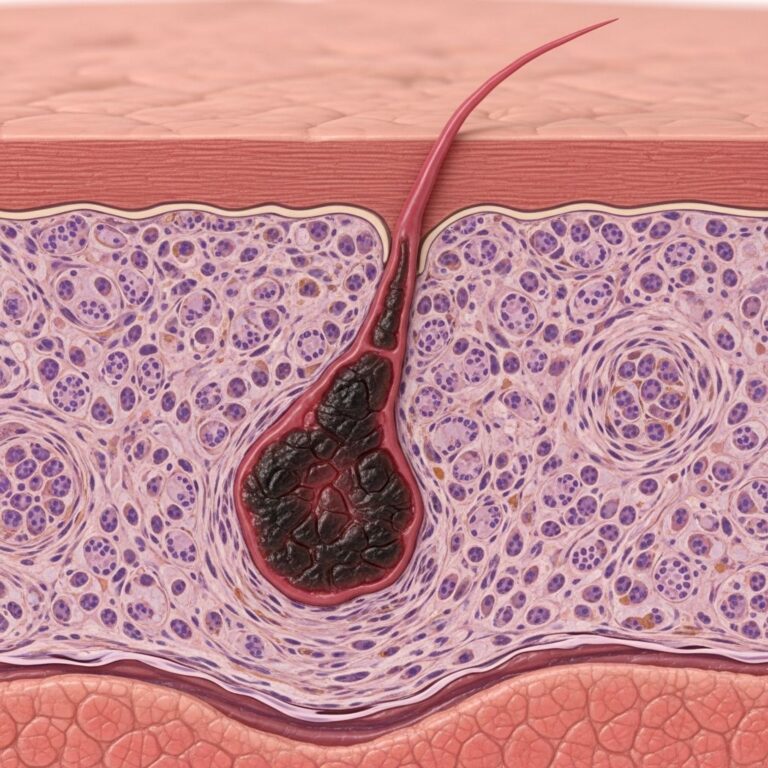
Skin lesions present as solitary or multiple
domed papules, nodules, or tumours
(0.5–10 cm), oftenerythematous-violaceous
, smooth-surfaced, and asymptomatic. Common sites: trunk, limbs; rarely face or mucosa. Secondary cutaneous myeloma lesions signal advanced disease with rapid progression.- Solitary primary cutaneous plasmacytoma: Single reddish-purple nodule without systemic symptoms.
- Multiple cutaneous plasmacytoma: Disseminated eruption, as in cases appearing years after initial EMP.
- Associated features: Rare ulceration, scaling; lymphadenopathy in 20–30%.
Other presentations
SBP causes
bone pain, pathological fractures
at vertebral, pelvic, or skull sites. EMP (non-cutaneous) involves upper respiratory tract (sinuses, nasopharynx), GI tract, or CNS, presenting with mass effect, obstruction, or bleeding. Systemic B-symptoms uncommon in solitary forms.Diagnosis of plasmacytoma
Diagnosis mandates
skin biopsy
for cutaneous lesions, revealingdense dermal/subcutaneous infiltrate
of monotonous plasma cells sparing epidermis/papillary dermis. Cells exhibit eccentric nuclei, clock-face chromatin, perinuclear hof.Histology
- Low-grade (Grade I): Mature plasma cells.
- Intermediate (Grade II): Pleomorphic with nucleoli.
- High-grade (Grade III): Anaplastic, plasmablastic morphology.
Related Stories



Immunohistochemistry
Monoclonality confirmed by
kappa/lambda restriction
; positive forCD138, CD79a, MUM1, BCL2
; negative for CD20, CD3, PAX5. Ki-67 proliferation index ~15% in low-grade cases.Investigations to exclude myeloma
| Test | Purpose |
|---|---|
| Serum/urine protein electrophoresis, immunofixation | Detect M-protein (absent/minimal in solitary plasmacytoma) |
| Free light chain assay | Assess clonality |
| Bone marrow biopsy | <10% plasma cells excludes MM |
| Skeletal survey, MRI/PET-CT | Rule out other lesions |
| Whole-body low-dose CT or PET-CT | Detect occult disease |
International Myeloma Working Group criteria: single lesion with clonal plasma cells, no M-protein or minimal, normal marrow, no end-organ damage.
Differential diagnosis
- Other cutaneous B-cell lymphomas: Marginal zone or follicle centre lymphoma (CD20+).
- Plasmablastic lymphoma: CD20-, EBV+.
- Metastatic carcinoma/melanoma: Cytokeratin/S100 positive.
- Benign plasma cell processes: Extramedullary haemopoiesis, inflammatory.
- Multiple myeloma skin infiltration: Systemic workup positive.
What is the treatment for plasmacytoma?
**Solitary plasmacytoma:** Local therapy with
surgery + radiotherapy
(45–50 Gy) yields 5-year local control >80%; however, 50–70% progress to MM.**Primary cutaneous plasmacytoma:** Excision or radiotherapy for solitary; systemic therapy (bortezomib, lenalidomide, dexamethasone) for multiple/disseminated.
**Secondary cutaneous lesions:** Treat as relapsed myeloma with novel agents (proteasome inhibitors, IMiDs), stem cell transplant if eligible.
Regimens effective: VAMP (bortezomib, adriamycin, melphalan, prednisone), TaCyDex, lenalidomide-dex.
What is the outcome for plasmacytoma?
Solitary bone plasmacytoma: 10-year OS ~60%, but high MM progression risk. EMP: Better prognosis, 15% MM progression. Primary cutaneous: Favourable if isolated, but multiple lesions warrant aggressive therapy. Secondary cutaneous myeloma: Median survival <12 months. Close surveillance mandatory; PET-CT for relapse detection.
Plasmacytoma pathology
(Cross-reference to detailed pathology section mirroring DermNet style: dense infiltrate of monoclonal plasma cells with grading.)
Frequently Asked Questions
Is plasmacytoma the same as multiple myeloma?
No. Plasmacytoma is localized; multiple myeloma is systemic with >10% marrow plasma cells, CRAB criteria.
Can plasmacytoma be cured?
Local therapy cures ~20–30% solitary cases; most progress to myeloma requiring lifelong monitoring.
Does cutaneous plasmacytoma always mean myeloma?
No. Primary cutaneous plasmacytoma is skin-confined without marrow/serum abnormalities.
What is the best treatment for skin plasmacytoma?
Radiotherapy or excision for solitary; systemic novel agents for multiple.
References
- Multiple primary cutaneous plasmacytoma a decade after a nasal plasmacytoma — Wiley/Clin Case Rep. 2016-10-01. https://pmc.ncbi.nlm.nih.gov/articles/PMC5134131/
- Cutaneous plasmacytoma pathology — DermNet NZ. 2023. https://dermnetnz.org/topics/cutaneous-plasmacytoma-pathology
- Plasmacytoma — StatPearls/NCBI Bookshelf. 2023-08-08. https://www.ncbi.nlm.nih.gov/books/NBK573076/
- Cutaneous plasmacytoma — VisualDx. 2023. https://www.visualdx.com/visualdx/diagnosis/?moduleId=101&diagnosisId=55871
- Plasmacytoma — DermNet NZ. 2023. https://dermnetnz.org/topics/plasmacytoma
Similar Articles








Read full bio of Sneha Tete