Podoconiosis: Causes, Symptoms, Prevention, And Treatment Guide
Understanding podoconiosis: causes, symptoms, prevention, and management of nonfilarial elephantiasis from irritant soils.
Podoconiosis, also known as
nonfilarial elephantiasis
orendemic nonfilarial elephantiasis
, is a chronic lymphoedema affecting the lower limbs in individuals with prolonged barefoot exposure to irritant volcanic red clay soils.What is podoconiosis?
**Podoconiosis** is a neglected tropical disease classified as a form of geochemical elephantiasis. It develops in genetically susceptible people who walk barefoot on irritant soils derived from volcanic rock, particularly red clay soils rich in minerals like aluminium, silica, and iron oxides. Unlike infectious causes of lymphoedema such as lymphatic filariasis, podoconiosis is non-infectious and results from an abnormal immune response to soil particles that penetrate the skin of the feet.
The disease primarily impacts subsistence farmers and rural workers in highland areas of tropical Africa, Latin America, and North-West India, where irritant soils are prevalent. Globally, an estimated 4 million people are affected across 32 potentially endemic countries, with Ethiopia bearing the highest burden at around 1 million cases. Women and girls are disproportionately affected due to cultural practices and greater soil exposure during daily chores.
Who gets podoconiosis?
Podoconiosis affects individuals with a genetic predisposition who experience cumulative barefoot exposure to irritant soils over years or decades. Key risk factors include:
- Genetic susceptibility, linked to variants in HLA genes (HLA-DQA1, HLA-DRB1, HLA-DQB1) involved in T-cell mediated inflammation.
- Prolonged barefoot walking on volcanic red clay soils, common in altitudes of 1,200–2,800 meters above sea level.
- Socioeconomic poverty, limiting access to footwear, especially in rural farming communities.
- Familial clustering, with heritability estimates up to 63%, indicating strong genetic components.
Prevalence can reach 5–10% in endemic villages without intervention. Children starting barefoot farming from age 6–10 are at high risk if susceptible.
What causes podoconiosis?
The pathogenesis involves a combination of environmental and genetic factors. Mineral particles (e.g., silica, aluminium oxides) from irritant soils enter the skin through micro-abrasions on bare feet. In genetically susceptible individuals, these particles trigger chronic inflammation in lymphatic vessels, leading to fibrosis, vessel occlusion, and impaired lymph drainage.
Key elements implicated include smectite clays and trace metals like zirconium, beryllium, and aluminium. Particles smaller than 10 microns lodge in macrophages within lymphatics, provoking an exaggerated helper T-cell response and cytokine release. Over time (10–20 years of exposure), this results in lymphoedema, primarily below the knees.
What are the signs and symptoms of podoconiosis?
Podoconiosis progresses through stages, starting with a reversible
prodromal phase
and advancing to irreversibleelephantiasis
.Prodromal phase (early, reversible)
- Itching and burning sensation on the forefoot and toes.
- Tingling, plantar oedema, and lymph ooze after walking.
- Forefoot widening (splaying) and increased skin markings.
Established phase
- Bilateral but asymmetrical swelling of feet and lower legs, pitting initially then becoming firm and fibrotic.
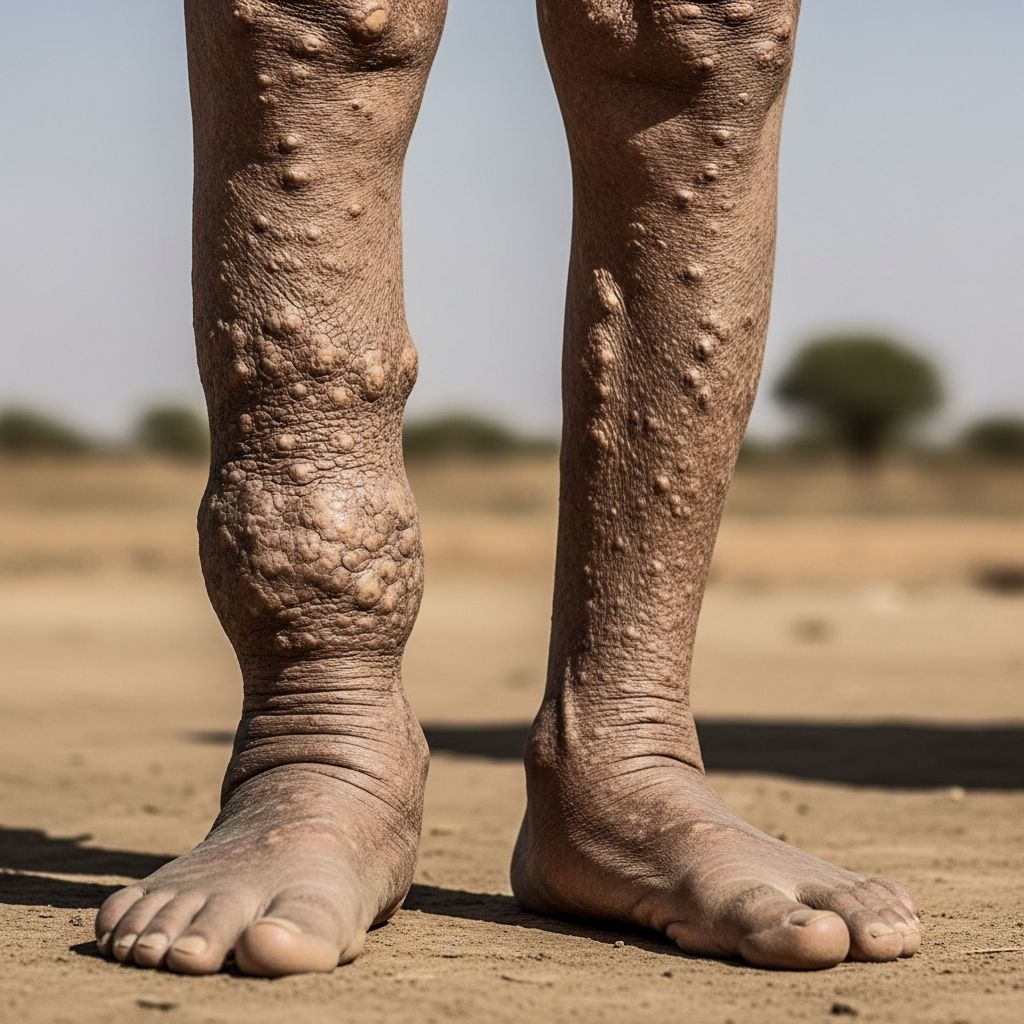
- Mossy papillomata (hyperkeratotic nodules) on sides of feet and heels, giving the ‘mossy foot’ appearance.
- Rigid toes, skin thickening, maceration between toes.
Advanced phase
- Hard nodules, ulceration, and secondary bacterial infections.
- Acute adenolymphangitis (ADL) attacks: fever, limb pain, warmth, redness lasting 3–15 days, occurring 5 times/year on average.
Related Stories



Psychosocial impacts include stigma, depression, reduced quality of life, and economic loss from disability (up to 153 days/year lost).
Diagnosis
Diagnosis is clinical, based on history of barefoot exposure in endemic areas and characteristic bilateral asymmetrical lymphoedema below the knees with mossy changes. Key differentials include:
| Condition | Distinguishing Features |
|---|---|
| Lymphatic filariasis | Infectious (Wuchereria bancrofti), groin lymphatics involved, positive filarial antigen test. |
| Chronic venous insufficiency | Unilateral, haemosiderin staining, venous Doppler abnormalities. |
| Hereditary lymphoedema | Onset in childhood, family history, upper limb involvement possible. |
| Trauma/obesity-related | No soil exposure history, symmetrical. |
Lymphoscintigraphy shows lymphatic stasis; histopathology reveals dilated lymphatics with PAS-positive particles. No specific biomarker exists.
Treatment of podoconiosis
Treatment focuses on lymphoedema management to reduce swelling, prevent infections, and improve mobility. No cure exists for advanced fibrosis, but early intervention is highly effective.
Primary prevention
- Consistent shoe-wearing from childhood to block soil contact.[10]
- Floor coverings in homes and improved sanitation.
Management after onset (lymphoedema package)
- Daily foot hygiene: Wash with soap/antiseptic, dry thoroughly, moisturize to prevent fissuring.
- Compression: Bandaging or stockings to reduce oedema; Complete Decongestive Therapy (CDT) as gold standard.
- Exercises and elevation: Ankle pumps, leg raising to promote drainage.
- Infection control: Antibiotics for ADL (e.g., penicillin), antifungals for intertrigo.
- Surgery: Nodulectomy for painful nodules; debulking in severe cases with good healing rates.
Holistic care includes psychosocial support. Programs show 50–70% reduction in swelling and ADL episodes.
What is the outcome for podoconiosis?
Untreated, podoconiosis causes chronic pain, recurrent infections, disability, and social exclusion, trapping families in poverty. With management, patients achieve pain relief, reduced swelling (up to 50%), fewer ADL attacks, and improved quality of life. Early prodromal cases can fully reverse with prevention. Globally, control efforts aim for elimination as a public health problem by 2030 via mapping, shoe distribution, and hygiene.
Prevention of podoconiosis
Prevention is simple and cost-effective:
- Shoes for all: Provide well-fitting footwear via WASH programs; averts 100% of cases.[10]
- Education: Community awareness on risks of barefoot walking.
- Soil mapping: Identify high-risk areas for targeted interventions.
- Socioeconomic development: Reduce poverty to enable shoe access.
Ethiopia’s national program integrates podoconiosis into NTD control, distributing millions of shoes.[10]
Frequently Asked Questions (FAQs)
Is podoconiosis contagious?
No, podoconiosis is non-infectious and not caused by parasites, bacteria, or viruses. It results from soil exposure in genetically susceptible people.
Can podoconiosis be cured?
Early stages are reversible with prevention and hygiene. Advanced fibrosis is managed but not cured; consistent care prevents progression.
How do you prevent podoconiosis?
Wear shoes consistently from childhood, wash feet daily, and avoid barefoot soil contact. Community programs provide free footwear.[10]
Where is podoconiosis found?
Mainly highland Ethiopia, Rwanda, Uganda, Tanzania; also Latin America and India. Affects ~4 million globally.
What does podoconiosis look like?
Bilateral leg swelling with mossy nodules on feet, rigid toes, and skin thickening; asymmetrical and below knees.
References
- Podoconiosis – Wikipedia — Wikipedia. 2024. https://en.wikipedia.org/wiki/Podoconiosis
- Podoconiosis: a comprehensive clinical review and strategies for… — Oxford Academic (Clinical and Experimental Dermatology). 2024-10-01. https://academic.oup.com/ced/advance-article/doi/10.1093/ced/llaf397/8246398
- Podoconiosis: endemic non-filarial elephantiasis — World Health Organization. 2023. https://www.who.int/teams/control-of-neglected-tropical-diseases/lymphatic-filariasis/podoconiosis-endemic-non-filarial-elephantiasis
- Podoconiosis (non-filarial lymphoedema) — World Health Organization. 2024-04-25. https://www.who.int/news-room/fact-sheets/detail/podoconiosis-(non-filarial-lymphoedema)
- Podoconiosis – DermNet — DermNet NZ. 2024. https://dermnetnz.org/topics/podoconiosis
- Podoconiosis today: challenges and opportunities — PMC (Transactions of the Royal Society of Tropical Medicine and Hygiene). 2018. https://pmc.ncbi.nlm.nih.gov/articles/PMC6214421/
Similar Articles








Read full bio of medha deb