Porokeratosis: 6 Variants, Diagnosis, Risks & Treatment
Comprehensive guide to porokeratosis: causes, types, diagnosis, management, and malignant potential of this distinctive skin disorder.
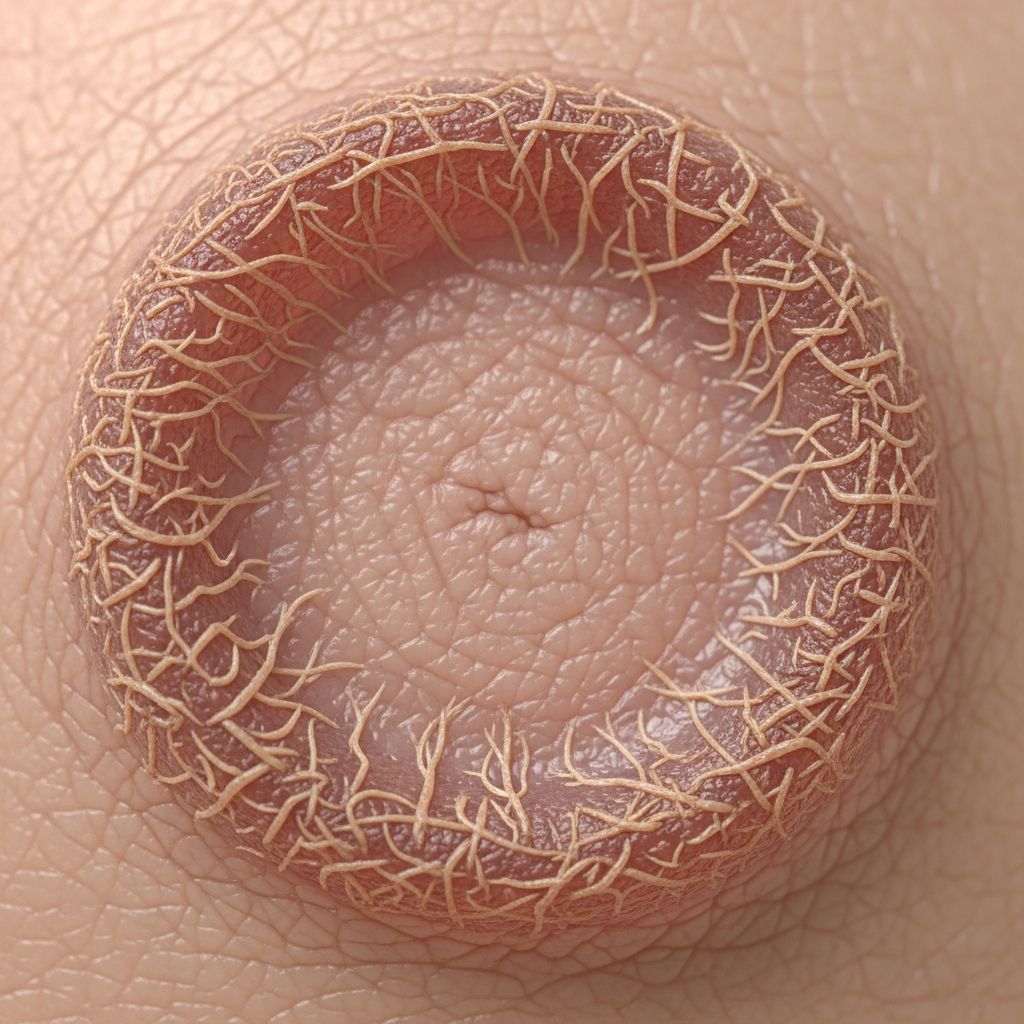
Porokeratosis encompasses a group of rare skin disorders characterized by annular or linear keratotic lesions with a distinctive raised, thread-like border known as the cornoid lamella. These lesions arise from abnormal keratinocyte proliferation, often presenting as slowly expanding plaques on sun-exposed or occluded skin areas. While typically benign, certain variants carry a risk of malignant transformation into squamous cell carcinoma (SCC), necessitating regular dermatologic surveillance.
What is porokeratosis?
Porokeratosis refers to a spectrum of cutaneous disorders marked by incomplete keratinization of keratinocytes, resulting in the pathognomonic cornoid lamella—a histopathologic hallmark visible clinically as a fine, ridged perimeter surrounding central atrophic or hyperkeratotic skin. The condition may manifest sporadically, genetically, or in association with immunosuppression, affecting individuals across all ages but peaking in adulthood. Lesions are often asymptomatic but can itch, burn, or become painful due to friction, particularly on palms and soles.
The etiology involves clonal expansion of abnormal keratinocytes, potentially linked to defects in mevalonate metabolism or UV-induced genetic mutations. Sun exposure exacerbates actinic variants, while genetic predisposition underlies familial forms. Immunosuppression, such as post-transplantation or HIV, triggers eruptive disseminated types.
Who gets porokeratosis?
Porokeratosis affects individuals of all ethnicities, with a slight male predominance in some variants like disseminated superficial actinic porokeratosis (DSAP). Incidence rises with age, particularly for sun-related subtypes in fair-skinned populations. Genetic forms appear in childhood, while sporadic cases emerge later. Risk factors include:
- Chronic UV exposure (DSAP)
- Immunosuppression (organ transplant, chemotherapy)
- Genetic mutations (e.g., MVK gene in some families)
- Family history (autosomal dominant inheritance in 25-50% of cases)
Prevalence is estimated at 1 in 1,000 for DSAP in sun-exposed adults over 40.
What causes porokeratosis?
The precise pathogenesis remains incompletely understood but centers on aberrant keratinocyte cloning. Key theories include:
- Genetic mutations: Somatic or germline alterations in mevalonate kinase pathway genes (e.g., MVK, PMVK) impair cholesterol synthesis, leading to keratinocyte escape from apoptosis.
- UV radiation: Induces p53 mutations in actinic forms.
- Immunosuppression: Loss of immune surveillance allows clonal proliferation.
- Triggering factors: Trauma, friction, or radiotherapy in localized variants.
Recent research highlights mevalonate pathway dysregulation as a unifying mechanism, opening avenues for targeted therapies.
What are the clinical features of porokeratosis?
Lesions typically begin as small papules expanding centrifugally, developing a thin, raised keratotic rim. The center may be atrophic, hyperpigmented, or anhidrotic. Common features include:
- Annular plaques 2-20 mm in diameter
- Single or multiple lesions
- Preference for extremities, trunk, or genitals
- Asymptomatic or pruritic/painful
Symptoms vary by subtype and site; palmar-plantar forms cause dyshidrosis-like discomfort.
Types of porokeratosis
Six principal variants exist, classified by morphology, distribution, and etiology:
- Porokeratosis of Mibelli (classic): Few large (up to 10 cm), annular plaques on limbs; childhood onset, genetic.
- Linear porokeratosis: Blaschko-linear arrangement along limbs; high SCC risk (up to 7.5%).
- Disseminated superficial actinic porokeratosis (DSAP): Multiple small brown-red papules on sun-exposed sites (legs, arms); adults 30-50 years.
- Disseminated superficial porokeratosis (DSP): Widespread tiny lesions on trunk/extremities; immunosuppression-associated.
- Porokeratosis palmaris et plantaris disseminata (PPPD): Symmetrical punctate keratoses on palms/soles; familial.
- Punctate porokeratosis: Minute hyperkeratotic papules on palms/soles; often coexists with others.
Related Stories



Rare forms include giant, eruptive disseminated (EDP), and genitocrural types.
Diagnosis of porokeratosis
Diagnosis is primarily clinical, supported by dermoscopy revealing the “white track,” “double-track,” or “diamond necklace” sign at the border. Biopsy confirms cornoid lamella: a column of parakeratosis with absent granular layer beneath.
Dermoscopic features:
- Peripheral white/yellow-brown rim
- Central brown dots, scarring, or vessels
- Ink test enhances cornoid lamella
Histology: Epidermal invagination with coronoid lamella, dyskeratotic cells. Rule out SCC via biopsy if atypical.
Treatment of porokeratosis
No curative therapy exists; management focuses on symptom relief, cosmesis, and malignancy prevention. Options include:
| Category | Treatments | Efficacy/Notes |
|---|---|---|
| Topical | 5-FU, imiquimod, retinoids, diclofenac, vitamin D | 30-50% response; irritation common |
| Systemic | Acitretin/isotretinoin (0.25-1.5 mg/kg/day) | For widespread disease; teratogenic |
| Procedural | Cryotherapy, CO2/Erbium laser, PDT, dermabrasion | Good for localized; recurrence high |
| Other | Sun protection, emollients | Preventive essential |
Watch-and-wait suits asymptomatic cases, with annual monitoring for high-risk variants (linear, giant).
Malignant transformation in porokeratosis
SCC arises in 7-11% of cases, especially linear (19%), Mibelli (9%), and giant forms. Risk factors: large lesions, immunosuppression. Biopsy suspicious changes (ulceration, nodularity). Prognosis favorable if early.
Frequently Asked Questions (FAQs)
Q: Is porokeratosis contagious?
A: No, it is not infectious; it results from intrinsic keratinocyte abnormalities.
Q: Can porokeratosis be cured?
A: No cure exists, but treatments control lesions effectively in many patients.
Q: What is the best treatment for DSAP?
A: Topical 5-FU, PDT, or laser; sun avoidance critical.
Q: Does porokeratosis turn into cancer?
A: Rarely (up to 11% in some types); regular check-ups advised.
Q: Is porokeratosis painful?
A: Usually not, but palmar/plantar sites may cause discomfort from friction.
References
- Understanding Porokeratosis: Causes, Symptoms & Effective Treatments — MDCS Dermatology. 2023-06-15. https://www.mdcsnyc.com/post/understanding-porokeratosis-causes-symptoms-effective-treatments
- Porokeratosis: Types, causes, treatments, and pictures — Medical News Today. 2024-02-10. https://www.medicalnewstoday.com/articles/porokeratosis
- Porokeratosis: An enigma beginning to unravel — Indian Journal of Dermatology, Venereology and Leprology. 2012-01-01. https://ijdvl.com/porokeratosis-an-enigma-beginning-to-unravel/
- Porokeratosis: A Review of its Pathophysiology, Clinical… — Actas Dermo-Sifiliográficas. 2020-11-01. http://www.actasdermo.org/en-porokeratosis-a-review-its-pathophysiology-articulo-S1578219020302055
- Porokeratosis – DermNet — DermNet NZ. 2024-05-20. https://dermnetnz.org/topics/porokeratosis
- Porokeratosis: What Is It And How Does It Impact My Health? — WebMD. 2023-09-12. https://www.webmd.com/skin-problems-and-treatments/what-is-porokeratosis
- Porokeratosis – StatPearls — NCBI Bookshelf (NIH). 2023-07-17. https://www.ncbi.nlm.nih.gov/books/NBK532290/
Similar Articles








Read full bio of medha deb