Porokeratotic Eccrine Ostial and Dermal Duct Naevus
Rare congenital skin disorder featuring linear keratotic papules on palms, soles, and extremities along Blaschko's lines.
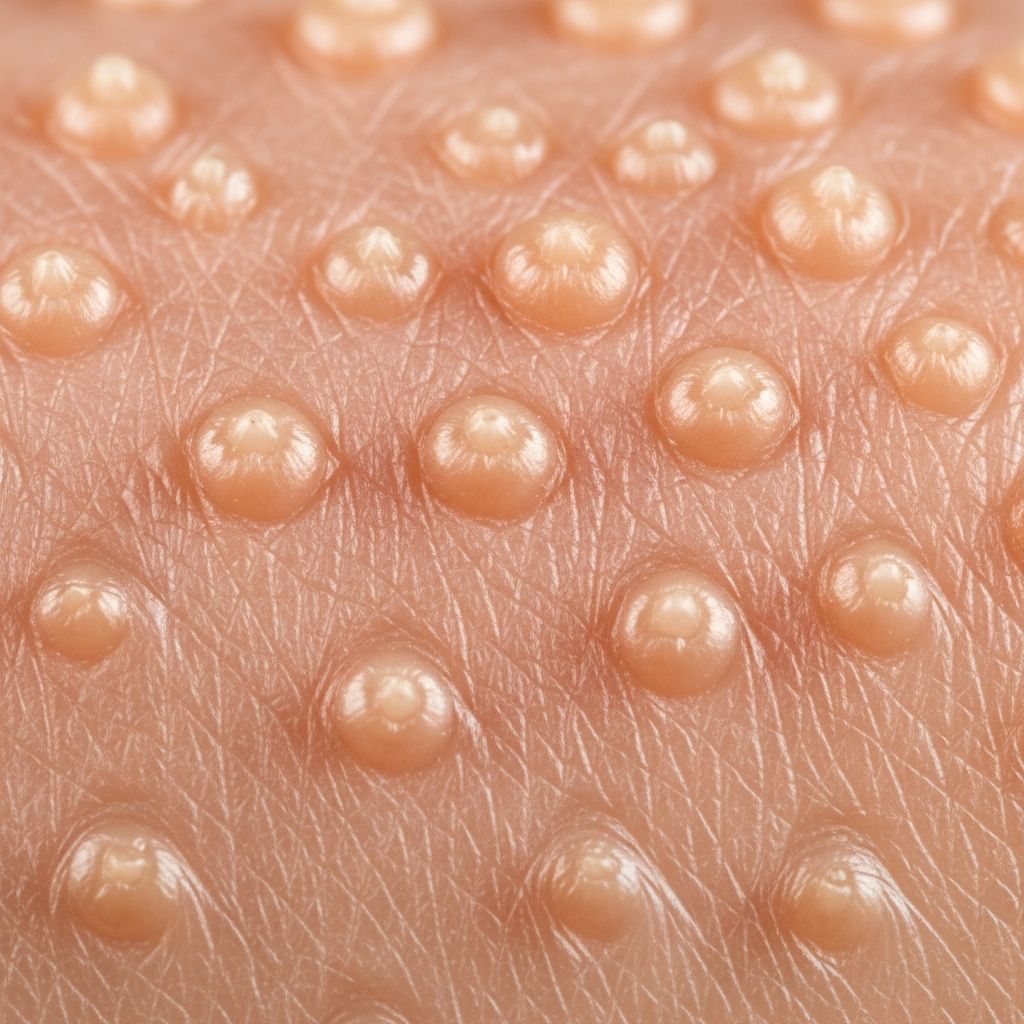
Porokeratotic eccrine ostial and dermal duct naevus (PEODDN) is a rare, benign dermatological condition classified as an eccrine hamartoma, characterised by the development of small, discrete, scaly keratotic papules arranged linearly, predominantly on the palms, soles, fingers, and toes.
What is porokeratotic eccrine ostial and dermal duct naevus?
PEODDN represents a hamartomatous proliferation of eccrine duct structures, first described in 1980 by Abell and Read. It manifests as grouped keratotic papules or plaques with punctate pits in a linear distribution, typically following Blaschko’s lines—patterns of skin development visible in mosaic genetic conditions. Unlike typical nevi, PEODDN occurs in acral areas devoid of pilosebaceous units, such as palms and soles, distinguishing it from comedonal nevi.
The condition arises from clonal keratinocyte proliferation leading to obstruction of eccrine ostia and ducts, resulting in the formation of cornoid lamellae—hallmark histopathological features involving parakeratotic columns overlying dilated acrosyringia. While primarily congenital, onset can occur later in childhood or adulthood, with equal prevalence across genders.
Who gets porokeratotic eccrine ostial and dermal duct naevus?
PEODDN typically presents at birth or during early infancy, though cases with later onset have been documented. It affects individuals without predilection for age, sex, or ethnicity, though its rarity limits comprehensive epidemiological data. Genetic mosaicism is implicated, explaining the linear distribution along Blaschko’s lines, potentially via paradominant inheritance.
- Congenital presentation: Most common, with lesions evident from birth.
- Childhood onset: Papules emerging in early years, progressing to plaques.
- Rare adult onset: As seen in cases with pruritic papules developing over a decade.
What causes porokeratotic eccrine ostial and dermal duct naevus?
The precise aetiology remains unclear, but PEODDN is considered a developmental anomaly of eccrine glands due to genetic mosaicism. Postzygotic mutations lead to localised clonal proliferation of eccrine ductal keratinocytes, obstructing ducts and forming characteristic lesions. No specific genetic loci have been consistently identified, though paradominant transmission—where heterozygous mutations manifest in mosaic patterns—has been proposed.
Unlike disseminated porokeratosis linked to immunosuppression, PEODDN shows no such association and persists lifelong without malignant potential.
What are the clinical features of porokeratotic eccrine ostial and dermal duct naevus?
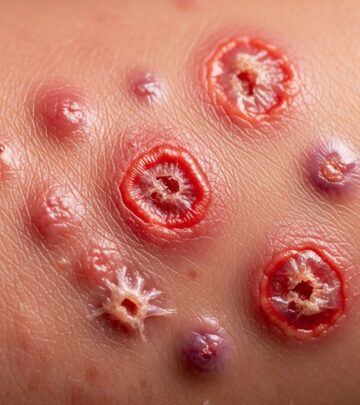
Lesions appear as multiple punctate keratotic papules or pits, often linear or grouped, coalescing into plaques over time. Primary sites include:
- Palms and soles: Discrete scaly papules or warty plaques.
- Fingers and toes: Linear arrangements extending dorsally.
- Extremities: Following Blaschko’s lines proximally.
- Rarely: Trunk, face, helix (ear), or widespread involvement.
Progression yields a verrucous, hyperkeratotic appearance, with central keratin plugs resembling comedones. Most cases are asymptomatic, but mild pruritus, hyperhidrosis, or anhidrosis may occur.
| Site | Features | Frequency |
|---|---|---|
| Palms/Soles | Linear scaly papules, pits | Most common |
| Distal Extremities | Keratotic plaques along Blaschko lines | Common |
| Proximal Limbs/Trunk | Scattered verrucous papules | Rare |
| Face/Ears | Hyperkeratotic papules | Very rare |
Diagnosis of porokeratotic eccrine ostial and dermal duct naevus
Clinical suspicion arises from the characteristic linear acral papules, confirmed by histopathology, which is pathognomonic. Key features include:
- Cornoid lamellae: Thin parakeratotic columns with absent granular layer, overlying dilated eccrine acrosyringia.
- Epidermal invaginations containing eccrine duct hyperplasia.
- Dilated dermal ducts and ostia.
Dermoscopy reveals comedo-like keratin plugs, scaly rims, and white dots. Differential diagnoses include:
- Porokeratosis variants (plantaris discreta, Mibelli, punctate).
- Nevus comedonicus, linear verrucous epidermal nevus.
- Linear psoriasis, spiny keratoderma.
Treatment of porokeratotic eccrine ostial and dermal duct naevus
No curative treatment exists; management is palliative, targeting hyperkeratosis. Options include:
- Topical therapies: Corticosteroids, calcipotriol, 5-fluorouracil, retinoids—partially effective in reducing thickness.
- Destructive methods: Cryotherapy, CO2 laser ablation, dermabrasion, excision—for localised lesions, with variable success and recurrence risk.
Lesions persist despite intervention, often becoming more warty. Extensive cases may require multimodal approaches, with long-term monitoring.
Frequently Asked Questions (FAQs)
Q: Is PEODDN cancerous?
A: No, PEODDN is a benign hamartoma with no reported malignant transformation.
Q: Does PEODDN affect sweating?
A: Occasionally associated with hyperhidrosis or anhidrosis in affected areas due to eccrine involvement.
Q: Can PEODDN be prevented?
A: As a congenital mosaic disorder, prevention is not possible; genetic counselling may apply in familial patterns.
Q: Is treatment always needed?
A: No, if asymptomatic; cosmetic or symptomatic relief guides intervention.
Q: Does PEODDN resolve spontaneously?
A: Rarely; it typically persists lifelong, progressing in appearance.
References
- Porokeratotic eccrine ostial and dermal duct nevus — Wikipedia. 2023-10-15. https://en.wikipedia.org/wiki/Porokeratotic_eccrine_ostial_and_dermal_duct_nevus
- Porokeratotic eccrine ostial and dermal duct naevus — DermNet NZ. 2024-05-20. https://dermnetnz.org/topics/porokeratotic-eccrine-ostial-and-dermal-duct-naevus
- Porokeratotic Eccrine Ostial and Dermal Duct Nevus Showing… — PMC (PubMed Central). 2012-02-29. https://pmc.ncbi.nlm.nih.gov/articles/PMC3276787/
- Porokeratotic eccrine ostial and dermal duct nevus — PMC (PubMed Central). 2017-04-25. https://pmc.ncbi.nlm.nih.gov/articles/PMC5412763/
- Porokeratotic eccrine ostial and dermal duct nevus — Cosmoderma. 2023-08-10. https://cosmoderma.org/porokeratotic-eccrine-ostial-and-dermal-duct-nevus/
Similar Articles





Read full bio of Sneha Tete