Potassium-Sparing Diuretics: 5 Key Uses And Safety Tips
Understanding potassium-sparing diuretics: their uses, how they work, side effects, and key considerations for safe use.
Potassium-sparing diuretics are medications that promote urine production while minimizing potassium loss, making them valuable in treating conditions like heart failure and hypertension when combined with other diuretics.
What are potassium-sparing diuretics?
Diuretics are medicines that increase urine output to remove excess fluid from the body.
Potassium-sparing diuretics
represent one category, characterized as weak diuretics often prescribed alongside stronger types like loop or thiazide diuretics. They enhance fluid excretion without causing significant potassium depletion, which is crucial since other diuretics can lead to hypokalaemia (low blood potassium levels).These drugs are not potent enough for standalone use in most cases but excel in combination therapy. By blocking potassium loss, they maintain electrolyte balance, preventing complications from low potassium such as muscle weakness, irregular heart rhythms, or fatigue.
How do potassium-sparing diuretics work?
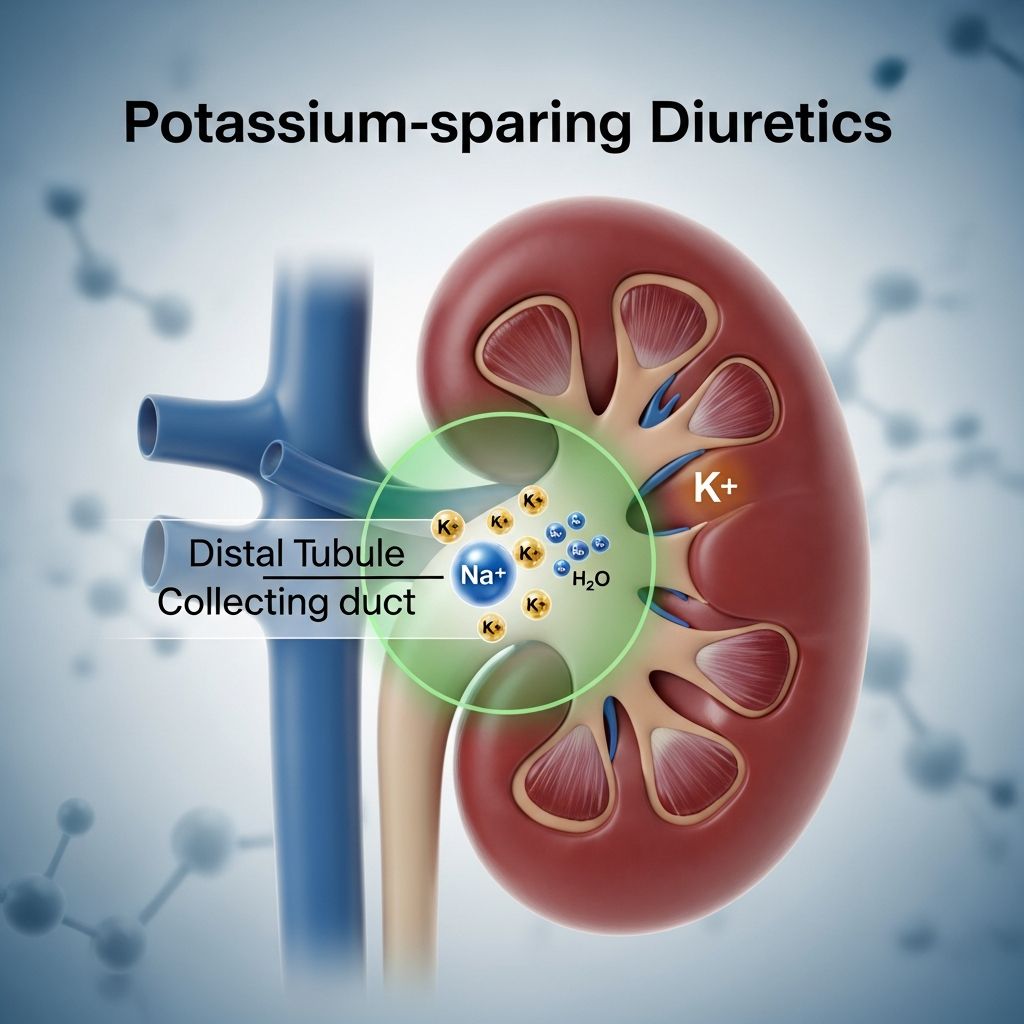
Potassium-sparing diuretics target the late distal tubules and collecting ducts of the nephron, where final sodium and water reabsorption occurs. Normally, sodium reabsorption via epithelial sodium channels (ENaCs) creates a lumen-negative potential that drives potassium secretion into urine. These diuretics interrupt this process.
There are two main subclasses:
- Sodium channel blockers (amiloride and triamterene): These directly inhibit ENaCs on principal cells, reducing sodium entry. This diminishes the electrochemical gradient for potassium secretion, retaining potassium while promoting sodium and water excretion.
- Aldosterone antagonists (spironolactone, eplerenone, finerenone): Aldosterone, part of the renin-angiotensin-aldosterone system (RAAS), binds mineralocorticoid receptors to upregulate ENaCs and Na-K-ATPase pumps, enhancing sodium reabsorption and potassium loss. These drugs competitively block these receptors, countering aldosterone’s effects.
In practice, their diuretic effect is mild, with onset delayed up to 3 days, but they effectively counteract potassium-wasting from loop (e.g., furosemide) or thiazide (e.g., bendroflumethiazide) diuretics.
Types of potassium-sparing diuretic
Common potassium-sparing diuretics include:
- Amiloride: A direct ENaC blocker, often combined with thiazides (e.g., co-amilozide).
- Triamterene: Similar to amiloride, used in combinations like co-triamterzide, though less common due to potential triamterene stones.
- Spironolactone: Aldosterone antagonist with anti-androgenic effects, useful in heart failure and resistant hypertension.
- Eplerenone: Selective aldosterone antagonist with fewer hormonal side effects than spironolactone.
- Finerenone: Newer non-steroidal antagonist for chronic kidney disease in diabetes.
| Drug | Class | Common Combinations | Key Notes |
|---|---|---|---|
| Amiloride | ENaC blocker | Co-amilozide (with bendroflumethiazide) | Minimal hormonal effects |
| Triamterene | ENaC blocker | Co-triamterzide (with chlortalidone) | Risk of kidney stones |
| Spironolactone | Aldosterone antagonist | Co-flumactone (with hydroflumethiazide) | Gynecomastia risk |
| Eplerenone | Aldosterone antagonist | Usually monotherapy | Better tolerated hormonally |
Main uses of potassium-sparing diuretics
These diuretics serve several key roles:
- Preventing hypokalaemia: Primary use when prescribing loop or thiazide diuretics for heart failure, hypertension, or oedema, maintaining serum potassium.
- Heart failure: Reduce fluid overload; spironolactone and eplerenone improve survival in severe cases per RALES and EPHESUS trials.
- Resistant hypertension: Enhance blood pressure control in combinations.
- Primary hyperaldosteronism: Aldosterone antagonists like spironolactone treat excess aldosterone production.
- Other: Cirrhosis with ascites, nephrotic syndrome; spironolactone for PCOS-related hirsutism.
Dosages vary: e.g., spironolactone 25-50 mg daily for heart failure, up to 400 mg for hyperaldosteronism.
Who might be prescribed potassium-sparing diuretics?
Patients on potassium-wasting diuretics for:
Related Stories



- Heart failure (especially with reduced ejection fraction).
- Hypertension not controlled by single agents.
- Oedema from liver cirrhosis or nephrotic syndrome.
- Those at risk of hypokalaemia, like elderly or digoxin users.
Not first-line alone due to weak diuretic action; contraindicated in hyperkalaemia, severe renal impairment (e.g., eGFR <30 mL/min), or Addison’s disease.
How to take potassium-sparing diuretics
Typically oral tablets, once or twice daily with food to reduce GI upset. Combinations like co-amilozide simplify regimens. Do not adjust doses without medical advice; regular blood tests monitor potassium (aim 4.0-5.0 mmol/L).
Start low (e.g., spironolactone 25 mg) and titrate. Liquid forms available for swallowing difficulties.
Side-effects of potassium-sparing diuretics
Side effects are uncommon at low doses (e.g., 5-10 mg amiloride, 25 mg spironolactone). Most frequent:
- Hyperkalaemia: High potassium causing nausea, weakness, arrhythmias; risk highest in renal impairment or ACE inhibitor co-use. Monitor levels frequently.
- Gynaecomastia/breast tenderness: Spironolactone’s anti-androgenic effect (5-10% men); switch to eplerenone.
- Gastrointestinal: Nausea, vomiting, diarrhoea, cramps.
- Others: Dizziness, rash, headache; triamterene may cause blue urine or stones.
Rare: metabolic acidosis, acute kidney injury. Report symptoms like irregular heartbeat or severe fatigue immediately.
Precautions when taking potassium-sparing diuretics
- Monitoring: Blood tests for potassium, renal function before starting and 1-2 weeks after dose changes.
- Diet: Avoid high-potassium foods (bananas, oranges, potatoes) and supplements/lo-salt; risk hyperkalaemia.
- Drug interactions: Caution with ACE inhibitors, ARBs, NSAIDs, ciclosporin—increase hyperkalaemia risk. Avoid potassium supplements.
- Renal/hepatic impairment: Dose reduce or avoid in poor function.
- Pregnancy/breastfeeding: Use only if essential; spironolactone contraindicated in pregnancy (feminization of male fetus).
Information about potassium-sparing diuretic treatment
Treatment is long-term for chronic conditions. Effectiveness assessed by symptom relief, weight stability, blood pressure, and labs. If hyperkalaemia develops, hold diuretic, restrict potassium, consider alternatives like thiazides alone. In heart failure, they reduce hospitalization and mortality.
Patient education emphasizes adherence, diet, and reporting side effects. Nurses stress fluid/electrolyte balance education.
Frequently Asked Questions (FAQs)
Q: Are potassium-sparing diuretics safe for long-term use?
A: Yes, when monitored with regular blood tests to prevent hyperkalaemia, especially in combination therapy.
Q: Can I eat bananas while taking these diuretics?
A: Limit high-potassium foods; consult your doctor to avoid hyperkalaemia.
Q: What if I develop high potassium levels?
A: Stop the medication and seek urgent medical advice; symptoms include weakness and palpitations.
Q: Do they cause weight gain?
A: No, they promote fluid loss; any gain may indicate poor control or other issues.
Q: Can I drink alcohol on these medications?
A: Moderate alcohol is usually fine but may enhance dizziness; discuss with your doctor.
References
- Potassium-sparing diuretic – Wikipedia — Wikipedia. 2023-10-01. https://en.wikipedia.org/wiki/Potassium-sparing_diuretic
- 34.4 Potassium-Sparing Diuretics – Pharmacology for Nurses — OpenStax. 2023-08-15. https://openstax.org/books/pharmacology/pages/34-4-potassium-sparing-diuretics
- Potassium-sparing Diuretics: Uses and Side-Effects – Patient.info — Patient.info. 2024-05-20. https://patient.info/digestive-health/dietary-potassium/potassium-sparing-diuretics
- Potassium sparing diuretics — Osmosis.org. 2023-11-10. https://www.osmosis.org/video/Potassium_sparing_diuretics
- Potassium-sparing diuretics – PubMed — PubMed (NCBI). 1988-01-01. https://pubmed.ncbi.nlm.nih.gov/2455308/
Similar Articles








Read full bio of Sneha Tete