Prader-Willi Syndrome
Comprehensive guide to Prader-Willi syndrome: genetics, clinical features by age, skin manifestations, diagnosis, and management strategies.

Prader-Willi syndrome (PWS) is a rare genetic disorder caused by the loss of function of specific genes on chromosome 15q11.2-q13 due to paternal deletion, maternal uniparental disomy, or imprinting defects. It manifests with multisystem involvement, including severe neonatal hypotonia, failure to thrive in infancy, followed by hyperphagia leading to morbid obesity, mild to moderate intellectual disability, behavioral problems, and distinctive cutaneous features dominated by skin picking (excoriation disorder).
The syndrome affects approximately 1 in 10,000 to 30,000 live births and requires lifelong multidisciplinary management to address feeding difficulties, obesity, skin issues, endocrine abnormalities, and psychiatric concerns. Cutaneous manifestations, particularly skin picking, are hallmark features present across all ages and often lead to significant morbidity including infections, scarring, and milia formation.
What is Prader-Willi syndrome?
Prader-Willi syndrome results from lack of expression of paternally inherited genes in the imprinted region of chromosome 15q11.2-q13. The most common mechanism (70%) is a de novo interstitial deletion of the paternal chromosome 15q11.2-q13. Maternal uniparental disomy 15 (UPD; 25-30%) and imprinting defects (1-3%) account for remaining cases. Unlike the related Angelman syndrome, which arises from maternal deletion in the same region, PWS specifically involves paternal gene silencing.
Clinical features evolve with age: infants present with profound hypotonia and feeding difficulties requiring special feeding techniques or gastrostomy tubes. Around age 2-4 years, hyperphagia emerges due to hypothalamic dysfunction, driving insatiable hunger if unrestricted access to food is not controlled. Other core features include short stature, hypogonadism, sleep disturbances, scoliosis, and compulsive behaviors such as skin picking.
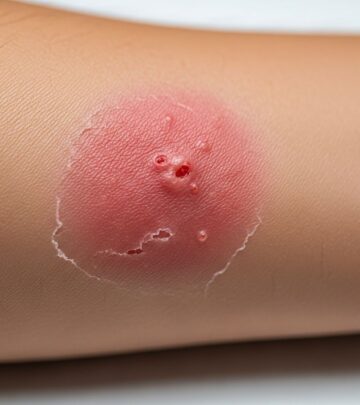
Skin involvement is prominent from early childhood, with excoriation (skin picking) affecting up to 80-100% of individuals. Lesions typically occur on accessible areas like hands, forearms, face, and legs, resulting from repetitive scratching, pinching, or digging.
Who gets Prader-Willi syndrome (Epidemiology)?
PWS has an estimated incidence of 1:10,000-1:30,000 live births worldwide, with equal male-female distribution. No ethnic predisposition is noted. Genetic mechanisms vary: paternal deletion (65-75%), maternal UPD (20-30%), imprinting center mutation (1-3%), and rare balanced translocations or point mutations. Prenatal diagnosis via microarray or methylation analysis is available for at-risk pregnancies.
Diagnosis often occurs in infancy due to hypotonia, but milder cases may be identified later through developmental delay or obesity. Early intervention improves outcomes, emphasizing the need for genetic counseling for families.
Clinical features of Prader-Willi syndrome
The clinical presentation of PWS varies by age, reflecting evolving hypothalamic, endocrine, and neurodevelopmental dysfunction.
Neonatal period (birth to 2 years)
- Marked hypotonia (‘floppy infant’), weak cry, and poor suck reflex leading to failure to thrive
- Feeding difficulties often necessitating nasogastric or gastrostomy tube support
- Hypogonadism: undescended testes in males, genital hypoplasia
- Dysmorphic features: narrow forehead/bifrontal diameter, almond-shaped eyes, thin upper lip, downturned mouth, small hands/feet (acromicria)
- Fair skin, hair, eyes (hypopigmentation due to OCA2 gene involvement in some deletion cases)
- Sleep apnea, temperature instability
Infants appear lethargic with poor head control and delayed milestones.[10]
Childhood (2-12 years)
- Hyperphagia onset around age 2-4, rapid weight gain if food access uncontrolled
- Short stature, relative macrocephaly
- Behavioral issues: temper tantrums, stubbornness, obsessive-compulsive traits
- Skin picking emerges, targeting face, arms, legs
- Hypogonadism persists; scoliosis develops in 10-20%
- Learning difficulties, speech delays, IQ 50-70
- Sleep disturbances, daytime somnolence
Strict food supervision is critical to prevent obesity.
Adolescence and adulthood
- Morbid obesity if unmanaged, leading to type 2 diabetes, cardiovascular disease
- Incomplete puberty, infertility
- Osteoporosis from hypogonadism
- Worsening skin picking, prone to secondary bacterial infections (cellulitis)
- Psychiatric disorders: psychosis (10-20% in early adulthood), anxiety
- Reduced lifespan (average 30-40 years) due to complications
Life expectancy has improved with growth hormone therapy and management.
Dermatological features
Skin picking (excoriation disorder) is the most characteristic and prevalent cutaneous manifestation, affecting nearly all individuals with PWS across lifespan. It manifests as compulsive scratching, pinching, biting, or excavating skin, often targeting bony prominences or visible areas.
- Typical lesions: Excoriations, hemorrhagic crusts, ulcers, bacterial superinfections, scarring, postinflammatory hyperpigmentation, secondary milia (especially dorsal hands/forearms)
- Common sites: backs of hands, forearms, face (perioral, cheeks), knees, legs, anal/perianal region
- Triggers: boredom, anxiety, self-soothing; perpetuated by pruritus from dry skin or eczema
Other skin findings include:
- Hypopigmentation: fair skin/hair/eyes in 50-80% (OCA2-related)
- Dry skin, eczema (9% per registry data)
- Cellulitis (9-20%, higher hospitalization risk due to wounds/obesity)
- Edema (7%)
- Rare: seborrheic dermatitis, urticaria pigmentosa, pseudo-Kaposi sarcoma
Skin picking intensity varies but can lead to chronic wounds and sepsis risk. Registry data shows dermatologist visits rise with age (28% by age 15, 45% by 21).
Diagnosis
Diagnosis combines clinical scoring and genetic testing. Holm clinical criteria provide a diagnostic framework:
| Major Criteria (1 point each) | Minor Criteria (1 point each) | Supportive Criteria |
|---|---|---|
| Hypotonia neonatal | Decreased fetal movement | Narrow hands/feet |
| Feeding problems <1yr | Hypogonadism | Temperature lability |
| Rapid weight gain 1-6yr | Hypopigmentation | Sleep disturbance |
| Hyperphagia | Short stature post-15yr | Speech problems |
| Developmental delay IQ<70 | Psychiatric illness | Thick viscous saliva |
Score ≥5 major or ≥8 total (major+minor) prompts testing: DNA methylation analysis (sensitive/specific), followed by microarray/FISH for deletion, UPD studies.
Management
Multidisciplinary lifelong care is essential:
- Growth hormone: Improves height, body composition, muscle tone (start age 2-12yr)
- Food control: Locked environments, 24/7 supervision, low-calorie diet
- Skin picking: Behavioral therapy (habit reversal), SSRIs/naltrexone (anecdotal), barriers (gloves, bandages), moisturizers, nail trimming, positive reinforcement
- Endocrine: Sex steroids for hypogonadism, treat sleep apnea (CPAP)
- Behavioral: Therapy for OCD traits, psychosis monitoring
- Dental/ortho: For decay, scoliosis
Skin management emphasizes prevention: daily emollients (Aloe vera-based), infection surveillance.
Excoriation (skin picking) disorder
Skin picking in PWS differs from typical excoriation disorder by earlier onset and resistance to standard treatments. It serves self-stimulation amid boredom/anxiety. Strategies include distraction, fidget toys, SSRIs, and topical antibiotics for infections. Aloe vera creams and self-applied moisturizers promote self-care.
Related topics
- Angelman syndrome
- Hypopigmentation
- Excoriation disorder
Frequently asked questions
What causes skin picking in Prader-Willi syndrome?
Skin picking arises from neurobehavioral dysregulation, often triggered by stress, boredom, or itch, and maintained compulsively.
Can skin picking be managed?
Yes, via behavioral interventions, medications, environmental modifications, and skincare routines.
Is Prader-Willi syndrome curable?
No, but symptoms are manageable with early, comprehensive care improving quality of life.
What is the prognosis?
With management, lifespan extends; obesity and complications remain key risks.
References
- Prader-Willi syndrome — DermNet NZ. 2023. https://dermnetnz.org/topics/prader-willi-syndrome
- Symptoms – Prader-Willi syndrome — NHS UK. 2021-01-28. https://www.nhs.uk/conditions/prader-willi-syndrome/symptoms/
- Cutaneous manifestations of Prader-Willi syndrome — PubMed (Bornhausen-Demarch E et al.). 2012. https://pubmed.ncbi.nlm.nih.gov/23094311/
- PWS Registry Data: Dermatology — Foundation for Prader-Willi Research. 2023. https://www.fpwr.org/blog/pws-registry-data-dermatology-infographic
- Skin Picking in People with Prader-Willi Syndrome — PWSA USA. 2016. https://www.pwsausa.org/wp-content/uploads/2016/01/Skin-Picking-in-People.pdf
- Prader-Willi syndrome – Symptoms and causes — Mayo Clinic. 2023. https://www.mayoclinic.org/diseases-conditions/prader-willi-syndrome/symptoms-causes/syc-20355997
Similar Articles


Read full bio of Sneha Tete