Presbyopia-Correcting IOLs: Complete Guide For 2025
Discover advanced intraocular lenses that restore clear vision at all distances, freeing you from glasses after cataract surgery or lens replacement.
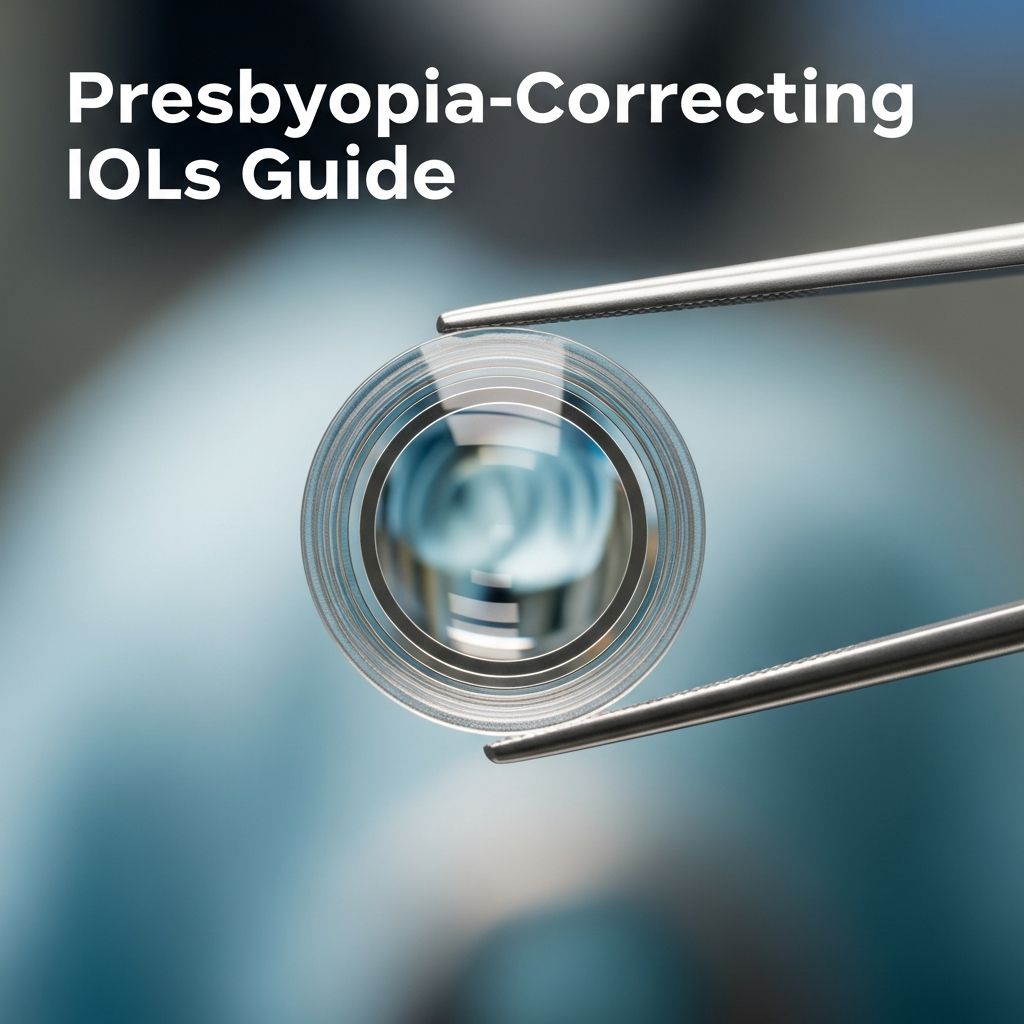
Presbyopia-correcting intraocular lenses (IOLs) represent a transformative advancement in ophthalmic surgery, enabling patients to achieve sharp vision across multiple distances without relying on glasses. These specialized lenses are implanted during cataract removal or refractive lens exchange (RLE), addressing the natural lens’s loss of flexibility that causes presbyopia in most people over age 40.
Understanding Presbyopia and Its Impact
Presbyopia occurs when the eye’s crystalline lens hardens, reducing its ability to focus on close objects. Affecting nearly 1.8 billion people worldwide, this condition intensifies with modern demands like smartphone use and prolonged computer work. Traditional solutions include reading glasses or bifocals, but many seek permanent fixes through surgery.
In lens replacement procedures, presbyopia-correcting IOLs substitute the natural lens, providing multifocal or extended focus capabilities. This approach not only treats cataracts but also prevents future lens clouding in RLE cases. Success rates have soared, with complication risks below 0.5% and over 85% of patients hitting precise refractive targets.
Types of Presbyopia-Correcting IOLs
Several IOL categories tackle presbyopia, each with distinct optical designs for varying visual needs.
Multifocal IOLs
These lenses feature multiple focal points, splitting light to deliver clear near, intermediate, and distance vision. Traditional bifocal or trifocal models excel in full correction but may cause halos or glare at night. Recent innovations like the Clareon PanOptix trifocal IOL yield 93% spectacle independence at 12 months, with 89% of patients opting for it again.
- Advantages: Comprehensive vision restoration; high patient satisfaction.
- Drawbacks: Potential photic phenomena; not ideal for all pupils sizes.
Extended Depth of Focus (EDOF) IOLs
EDOF lenses create a continuous focal range, prioritizing distance and intermediate vision with functional near sight. They minimize visual disturbances compared to multifocals. Examples include Vivity and OmniVu, maintaining 20/32 or better across ~4.7 diopters over 24 months without adverse events.
Suitable for patients valuing seamless intermediate tasks like dashboard viewing or cooking.
Other Innovative Designs
Segmented multifocals like ClearView 3 offer excellent all-distance vision, with 97% distance independence and low disturbances. Refractive lenses such as Precizon Presbyopic use continuous transitional focus for small pupils, outperforming some EDOFs. Autofocus Pro employs gradient refractive index technology for halo-free, high-contrast vision.
Surgical Techniques for Optimal Results
Implantation occurs via phacoemulsification, a precise ultrasound-based cataract extraction followed by IOL placement. Surgeons tailor choices to eye dominance, anatomy, and lifestyle.
Mix-and-Match Strategies
Combining IOL types enhances outcomes. Hybrid monovision pairs a monofocal in the dominant eye for sharp distance with a multifocal or EDOF in the non-dominant for near tasks. Premium monovision uses advanced lenses bilaterally for balanced performance.
Reversible Options
The duet procedure adds a sulcus-fixated supplementary multifocal IOL over a primary monofocal, allowing easy removal if side effects arise. This is safe over toric IOLs, preserving stability.
| Strategy | Dominant Eye IOL | Non-Dominant Eye IOL | Best For |
|---|---|---|---|
| Hybrid Monovision | Monofocal | Multifocal/EDOF | Distance priority with near support |
| Premium Monovision | EDOF | Trifocal | Balanced all-range vision |
| Duet Procedure | Monofocal + Supplementary | Same | Trial multifocality |
Related Stories



Candidate Selection and Preoperative Evaluation
Not everyone qualifies for premium IOLs. Ideal candidates have healthy retinas, stable prescriptions, and realistic expectations. Contraindications include macular degeneration, severe dry eye, or irregular astigmatism.
- Assess visual demands: Office workers favor intermediate focus; readers prefer strong near vision.
- Measure pupil size, corneal health, and eye dominance.
- Discuss trade-offs: Premium IOLs cost more out-of-pocket, with ~15-18% U.S. adoption.
For complex cases like post-LASIK eyes, IC-8 Apthera IOLs provide good outcomes with minimal disturbances.
Benefits of Presbyopia-Correcting IOLs
Primary gain is spectacle independence: 72-97% across distances. Patients report enhanced quality of life, freedom in activities, and future-proofing against cataracts via RLE.
Phakic IOLs offer less invasive alternatives for non-cataract patients, though RLE risks like retinal detachment persist in myopes.
Potential Risks and Side Effects
While safe, premium IOLs carry higher dysphotopsia risks (halos, glare) than monofocals. Posterior capsule opacification rates vary; some lenses like Softec HD require fewer Nd:YAG treatments.
- Common: Temporary adaptation (1-3 months); mild halos.
- Rare: Reduced contrast sensitivity; need for IOL exchange (<1%).
Strategies like mini-monovision mitigate issues. For endothelial issues, staged DMEK followed by IOL implantation optimizes results, despite long-term challenges.
Latest Research and Future Directions
2025 ASCRS data highlights ongoing refinements. OmniVu’s 24-month stability, ClearView 3’s satisfaction, and PanOptix efficacy signal growing adoption. Emerging lenses target complex corneas and small pupils.
Personalized approaches, leveraging AI biometry, promise even better precision.
Patient Experiences and Outcomes
Studies show 89-93% satisfaction, with low regret rates. One trial noted 100% intermediate independence for certain EDOFs. Long-term data (up to 48 months) confirms durability against PCO.
Cost Considerations and Insurance
Premium IOLs involve additional fees ($2,000-$4,000 per eye), rarely covered by insurance for non-cataract RLE. Weigh against lifelong glasses savings.
FAQs
Who is a good candidate for presbyopia-correcting IOLs?
Healthy eyes with cataracts or presbyopia, motivated for glasses-free vision, and willing to accept minor trade-offs.
How long do results last?
Lifetime, as IOLs don’t degrade like natural lenses; enhancements possible via laser.
Will I still need glasses?
Most achieve independence, but 5-10% may use them for very fine tasks.
What if I’m not happy post-surgery?
Reversible options like supplementary IOLs or exchanges are available.
Are these IOLs safe for high myopes?
Yes, with careful screening; phakic alternatives reduce RLE risks.
Making the Decision: Next Steps
Consult a cataract specialist for customized simulation and trials. Discuss lifestyle alignment to select the best IOL.
References
- Presbyopia Correction in Lens Replacement Surgery: A Review — PMC/NCBI. 2024. https://pmc.ncbi.nlm.nih.gov/articles/PMC12326228/
- Presbyopia-Correcting Intraocular Lens Research — Ophthalmology Advisor. 2025. https://www.ophthalmologyadvisor.com/features/presbyopia-correcting-intraocular-lens/
- Presbyopia-Correcting IOLs — EyeWiki (AAO). 2025. https://eyewiki.org/Presbyopia-Correcting_IOLs
Similar Articles








Read full bio of medha deb