Probenecid: 3 Uses, Dosing, Risks, And New Research
Discover how probenecid manages gout by lowering uric acid and explore its emerging roles in neurology and antibiotic enhancement for better health outcomes.
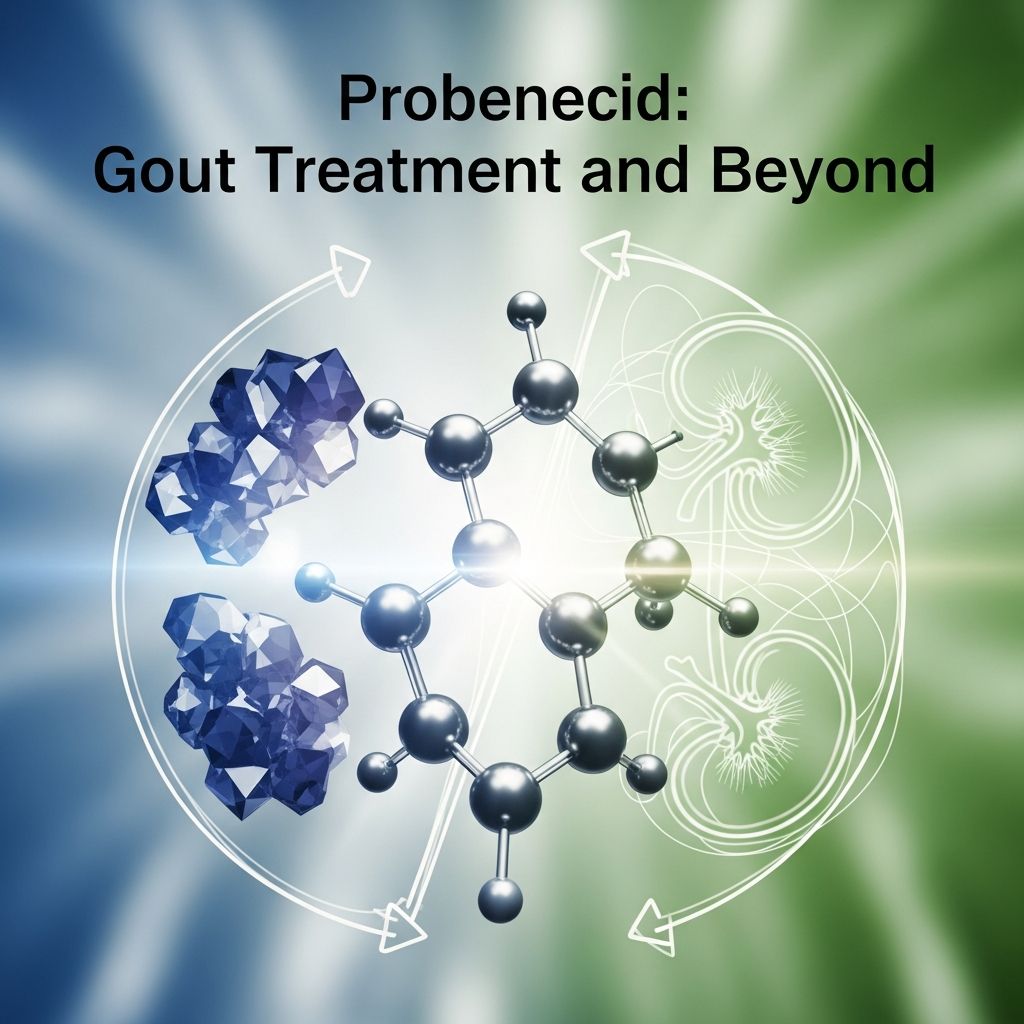
Probenecid serves as a key medication primarily for managing chronic gout by facilitating the kidneys’ removal of excess uric acid from the body. This uricosuric agent prevents painful gout attacks rather than treating acute episodes and can enhance certain antibiotics’ effectiveness by slowing their urinary excretion.
Understanding Gout and Probenecid’s Core Role
Gout is a form of inflammatory arthritis triggered by elevated uric acid levels in the blood, leading to crystal formation in joints. These crystals cause sudden, intense pain, swelling, and redness, often in the big toe. Probenecid addresses this by inhibiting uric acid reabsorption in the renal tubules, promoting its excretion in urine and thereby reducing serum levels over time.
Unlike pain relievers for acute flares, probenecid is preventive, requiring consistent use to maintain low uric acid. It belongs to the uricosuric class, distinct from xanthine oxidase inhibitors like allopurinol, offering an alternative for patients intolerant to those drugs.
Historical Development and Evolution of Use
Originally introduced in the 1940s as an adjunct to penicillin therapy, probenecid extended antibiotic duration by blocking their renal secretion. This was crucial during eras when antibiotics had short half-lives. Its uricosuric properties were discovered serendipitously, shifting focus to gout management by the 1950s.
Over decades, newer antibiotics reduced its primary use in infections, but gout treatment solidified its place. Recent preclinical research revives interest, highlighting effects on membrane channels like pannexin-1 (Panx1) hemichannels and transient receptor potential vanilloid 2 (TRPV2) channels, suggesting broader therapeutic potential.
Mechanism of Action in Detail
Probenecid primarily targets organic anion transporters (OATs) in the kidneys, preventing uric acid reuptake into the bloodstream. This increases urinary uric acid output, lowering hyperuricemia risks.
- Renal Effects: Blocks OAT1 and OAT3, elevating uric acid excretion while retaining beneficial substances.
- Antibiotic Synergy: Inhibits tubular secretion of penicillins and cephalosporins, prolonging plasma levels for better infection control.
- CNS Modulation: Inhibits Panx1 hemichannels to curb ATP release and neuroinflammation; activates TRPV2 for calcium signaling in neurons and glia.
These actions extend to retaining neurotransmitter metabolites like homovanillic acid (dopamine marker) in cerebrospinal fluid, historically aiding depression studies.
Approved Indications and Clinical Applications
| Indication | Purpose | Key Benefits |
|---|---|---|
| Chronic Gout/Gouty Arthritis | Prevent attacks | Reduces uric acid crystals in joints |
| Antibiotic Adjunct | Enhance penicillins/cephalosporins | Prolongs drug exposure, improves efficacy |
| Hyperuricemia | Lower serum uric acid | Protects kidneys from urate deposits |
Not for acute gout, as it may exacerbate flares initially; colchicine or NSAIDs are preferred then.
Dosing Guidelines and Administration
Typical adult dose for gout starts at 250 mg twice daily, increasing to 500 mg twice daily after one week, taken with food or antacids to minimize GI upset. Maximum is 2-3 grams daily, adjusted by uric acid monitoring.
Related Stories



With antibiotics, 500 mg four times daily. Hydration is essential to prevent uric acid stones; urine alkalinization with sodium bicarbonate may be advised.
- Children under 2 years: Contraindicated.
- Renal impairment: Dose reduction needed.
- Duration: Long-term for gout prevention.
Potential Side Effects and Risks
Most users tolerate probenecid well, but common issues include headache, nausea, vomiting, anorexia, and dizziness.
Serious effects demand immediate attention:
- Nephrolithiasis (uric acid stones) – mitigated by fluids.
- Hypersensitivity: Rash, fever, anaphylaxis.
- Hematologic: Anemia, leukopenia.
- Hepatic: Elevated enzymes, jaundice.
- GI: Severe pain, bloody stools.
Monitor for lower back pain, hematuria, or jaundice. Risk rises with dehydration or salicylate use.
Drug Interactions and Contraindications
Probenecid alters excretion of many drugs:
| Drug Class | Effect | Management |
|---|---|---|
| Salicylates (Aspirin) | Reduced uricosuric effect | Avoid low-dose aspirin |
| NSAIDs | Compete for secretion | Monitor levels |
| Antibiotics (Penicillins) | Increased levels | Beneficial synergy |
| Anticoagulants (Warfarin) | Potentiated | Adjust doses |
| Methotrexate | Toxicity risk | Contraindicated |
Contraindicated in uric acid stone history, severe renal failure, or hypersensitivity. Inform providers of all medications.
Emerging Research: Neuroprotective Potential
Beyond gout, probenecid shows promise in CNS disorders via Panx1 blockade, reducing neuroinflammation – a factor in epilepsy, ischemia, sepsis, Parkinson’s, Alzheimer’s, and multiple sclerosis models.
- Epilepsy: Suppresses seizures by limiting ATP release.
- Neurodegeneration: Mitigates inflammasome activation, cytokine storms.
- Sepsis-Induced Dysfunction: Improves cognition, reduces IL-1β/IL-18.
- MS Models (EAE): Lessens T-cell infiltration, preserves oligodendrocytes.
As an OAT inhibitor, it boosts CNS drug bioavailability, aiding therapies limited by blood-brain barrier efflux.
Patient Monitoring and Lifestyle Advice
Regular blood tests track uric acid (<6 mg/dL goal), renal/hepatic function. Urine output should exceed 2 liters daily.
Lifestyle complements therapy:
- Maintain hydration.
- Limit purine-rich foods (red meat, shellfish).
- Avoid alcohol, fructose.
- Exercise moderately, control weight.
Special Populations and Precautions
Pregnancy: Category B; use if benefits outweigh risks. Lactation: Excreted in milk; caution advised. Elderly: Dose carefully due to renal decline.
Not for acute flares or children <2 years. Those with peptic ulcers or diabetes require oversight.
Frequently Asked Questions (FAQs)
Can probenecid cure gout?
No, it prevents attacks by controlling uric acid but requires ongoing use.
Does it interact with aspirin?
Yes, low-dose aspirin counters its effects; use alternatives.
How soon does it work?
Uric acid drops in weeks; full prevention may take months.
Is it safe for kidneys?
Protects from urate but risks stones; hydrate well.
What about new brain health uses?
Preclinical data promising for inflammation-driven CNS issues, but not yet approved.
Conclusion
Probenecid remains a cornerstone for gout prevention and antibiotic optimization, with exciting research hinting at neuroprotective roles. Consult healthcare providers for personalized guidance, ensuring safe, effective use amid its multifaceted profile.
References
- Probenecid, an Old Drug with Potential New Uses for Central Nervous System Disorders — PMC/NCBI. 2023-07-01. https://pmc.ncbi.nlm.nih.gov/articles/PMC10295187/
- Probenecid — Associates for Women’s Medicine. Accessed 2026. https://www.afwomensmed.com/health-library/hw-view.php?DOCHWID=a682395
- Probenecid TAB 500mg – Dosage, Side Effects & Drug Information — CVS Health. Accessed 2026. https://www.cvs.com/drug-info/probenecid/500mg/tab/10135054101
- Probenecid: Uses & Side Effects — Cleveland Clinic. Accessed 2026. https://my.clevelandclinic.org/health/drugs/19121-probenecid-tablets
- Probenecid — Johns Hopkins Arthritis Center. Accessed 2026. https://www.hopkinsarthritis.org/patient-corner/drug-information/probenecid/
- Colchicine / Probenecid: Uses, Side Effects, Dosage & More — GoodRx. Accessed 2026. https://www.goodrx.com/probenecid-colchicine/what-is
Similar Articles








Read full bio of Sneha Tete