Proliferating Epidermoid Cyst: 7 Differential Diagnoses
Detailed pathology of proliferating epidermoid cysts: histology, diagnosis, and differentiation from mimics.
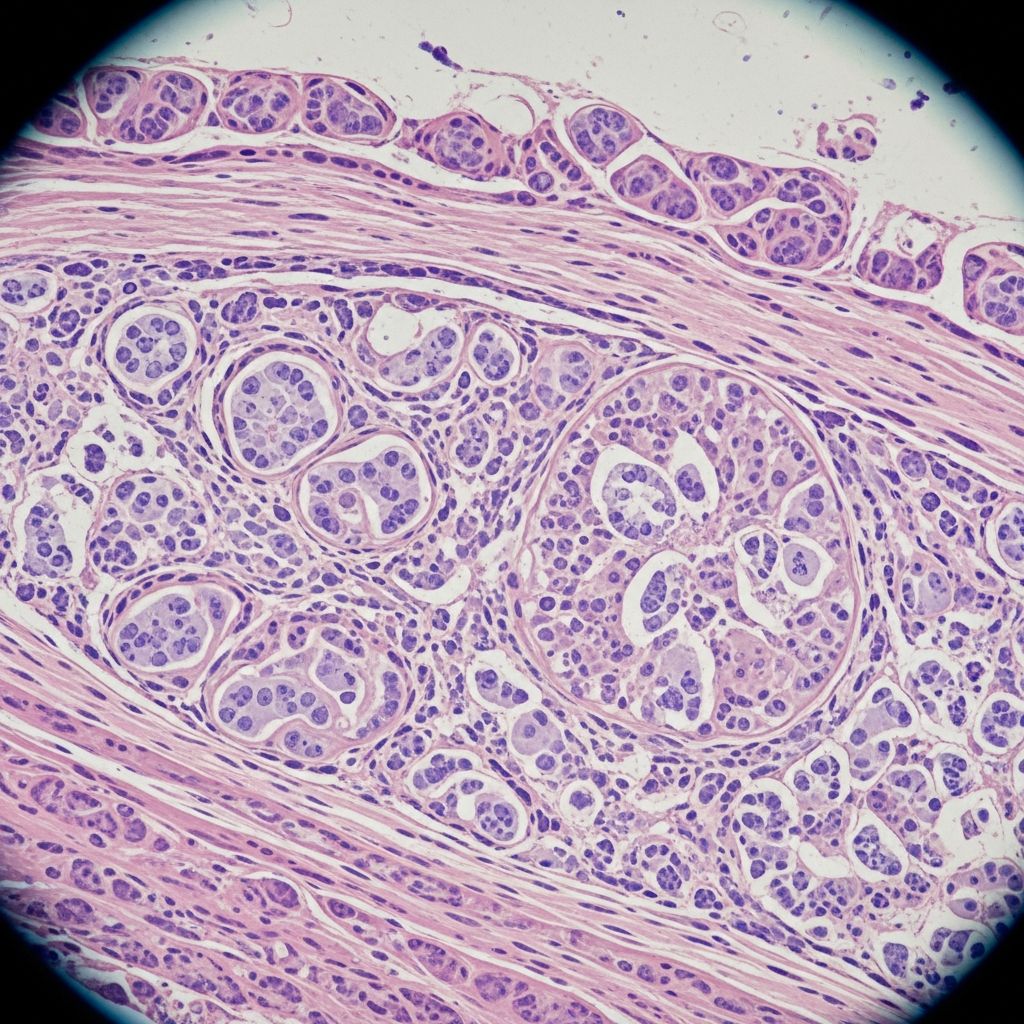
Author: Assoc Prof Patrick Emanuel, Dermatopathologist, Auckland, New Zealand. Updated 2025.
Introduction
**Proliferating epidermoid cyst** represents a rare and poorly defined entity in dermatopathology literature. Unlike standard epidermoid cysts, which are simple keratin-filled sacs lined by stratified squamous epithelium, this variant incorporates regions of epidermal proliferation alongside typical cystic components. The presence of a conventional epidermoid cyst in at least part of the lesion is a defining feature, distinguishing it from pure proliferative processes. These cysts typically arise in the dermis and are characterized by bland squamous proliferation without significant atypia, often linked to prior trauma, rupture, or inflammation that triggers reactive epidermal growth. Clinically, they present as slowly enlarging subcutaneous nodules, commonly on the trunk, extremities, or head and neck, measuring 1-5 cm in diameter. Patients may report a history of a longstanding cyst that suddenly enlarged or became inflamed, reflecting internal rupture and subsequent proliferation. Histogenesis likely involves transepidermal elimination or implantation of epidermal elements following cyst wall disruption, leading to the formation of squamous eddies—concentric whorls of maturing keratinocytes identical to those in irritated seborrhoeic keratosis or inverted follicular keratosis. Recognition is crucial to avoid misdiagnosis as malignancy, as the exuberant proliferation can mimic squamous cell carcinoma, particularly in superficial biopsies. This article delves into the histological hallmarks, ancillary studies, and differential diagnoses to aid precise pathological interpretation.
Histology
Microscopic examination reveals a
dermally based cyst
containing laminated keratin, accompanied by an expansile epidermal proliferative component (see Figures 1-4 equivalents in description). The cyst wall is lined by attenuated stratified squamous epithelium resembling the infundibulum, lacking rete ridges but featuring a prominent granular layer with keratohyalin granules. Adjacent to or arising from the cyst wall are zones ofproliferating squamous epithelium
, composed of bland, maturing keratinocytes arranged in broad sheets or bulbous downgrowths. A hallmark feature is the presence ofsquamous eddies
—tightly coiled whorls of squamous cells undergoing central keratinization, often multiple and striking in appearance (Figures 2-4). These eddies measure 50-200 μm in diameter and represent a reactive phenomenon rather than neoplastic growth. The proliferative areas lack nuclear hyperchromasia, pleomorphism, or increased mitoses (<1 per 10 HPF), with keratinocytes showing orderly maturation from basaloid periphery to orthokeratotic center. Surrounding stroma may exhibit mild chronic inflammation, foreign body giant cell reaction, or fibrosis if prior rupture occurred, with spilled keratin eliciting granulomatous response. The epidermis overlying the lesion is often acanthotic with connected eddies, mimicking an inverted follicular keratosis. No connection to the surface punctum is always evident, but orthokeratosis fills the cyst lumen. In proliferated areas, glycogen-rich clear cells may appear, but viral cytopathic effects are absent. Rare cases show deep invasion, anaplasia, or high mitotic activity, raising concern for malignant transformation, though this is exceptional. Thorough sampling is essential, as partial sections may overestimate atypia.- Cyst component: Laminated keratin-filled sac with thin squamous lining.
- Proliferative component: Bland squamous nests with squamous eddies.
- Stromal changes: Inflammation, fibrosis, granulomas from rupture.
Special Studies
Ancillary tests are
not required
for diagnosis, as the entity is defined by routine histology. Immunohistochemistry (IHC) may confirm epithelial nature but adds little value: proliferating cells express pan-cytokeratins (AE1/AE3++), p63 (basal/myoepithelial marker), and low Ki-67 (<10%). BerEP4 and EMA highlight cyst lining but not eddies. Negative for S100, SOX10 (ruling out adnexal tumors), and p16/HPV markers unless superinfection present. Molecular studies like HPV PCR are unnecessary absent koilocytes or viropathic changes. Ultrastructural analysis historically showed tonofilaments and desmosomes akin to normal epidermis, supporting reactive hyperplasia. In ambiguous cases, conservative excision with margins assesses for infiltration.Differential Diagnoses
Accurate differentiation hinges on recognizing the dual cyst-proliferative pattern and absence of atypia. Key mimics include:
- Standard epidermoid cyst: Lacks proliferation or eddies; purely cystic.
- **HPV-related epidermal cysts:** Hyperplastic lining with koilocytosis, nuclear inclusions, clumped chromatin; HPV-positive IHC/PCR.
- Cystic squamous cell carcinoma (SCC): Critical exclusion; features nuclear atypia (pleomorphism, hyperchromasia), high mitoses (>5/10 HPF), atypical mitoses, deep infiltration, desmoplasia. Challenging post-rupture due to inflammation.
- Inverted follicular keratosis: Surface-connected, eddies prominent but no cyst.
- Proliferating trichilemmal cyst (pilar tumor): Abrupt keratinization, trichilemmal keratin, palisading basal cells, glycogen-rich clear cells; pilar sheath origin.
- Digital papillary adenocarcinoma: Glandular/cystic with atypia, digits; CK7+.
- Dilated pore of Winer: Surface invagination, no deep cyst.
| Feature | Proliferating Epidermoid Cyst | Cystic SCC | HPV Cyst |
|---|---|---|---|
| Cyst present | Yes | May mimic | Yes |
| Squamous eddies | Prominent | Absent | Rare |
| Atypia/Mitoses | Bland, low | High | Viral changes |
| Invasion | Expansile | Destructive | Confined |
Frequently Asked Questions (FAQs)
What is a proliferating epidermoid cyst?
A rare variant of epidermoid cyst with associated bland squamous proliferation and squamous eddies, often post-rupture.
How does it differ from regular epidermoid cysts?
Regular cysts lack the proliferative epidermal component and eddies.
Is it malignant?
Typically benign; rare anaplastic forms reported, but atypia excludes it.
What are the treatment options?
Complete surgical excision; monitor for recurrence if ruptured.
Can it be diagnosed without biopsy?
Related Stories



No, histology is essential to rule out mimics like SCC.
Clinical Relevance and Management
Though benign, excision prevents misdiagnosis and recurrence. Radiologic imaging unnecessary unless deep. Prognosis excellent post-excision.
References
- Proliferating epidermoid cyst pathology — DermNet NZ (Assoc Prof Patrick Emanuel). 2025 (updated). https://dermnetnz.org/topics/proliferating-epidermoid-cyst-pathology
- Epidermoid Cyst — StatPearls, NCBI Bookshelf, NIH. 2023-10-20. https://www.ncbi.nlm.nih.gov/books/NBK499974/
- Proliferating Epidermoid Cysts — Archives of Dermatology (JAMA Network). 1968. https://jamanetwork.com/journals/jamadermatology/articlepdf/529863/archderm_94_1_002.pdf
Similar Articles








Read full bio of medha deb