Proliferating Trichilemmal Cyst Pathology
Detailed pathology of proliferating trichilemmal cysts: from clinical features to histological diagnosis and management strategies.
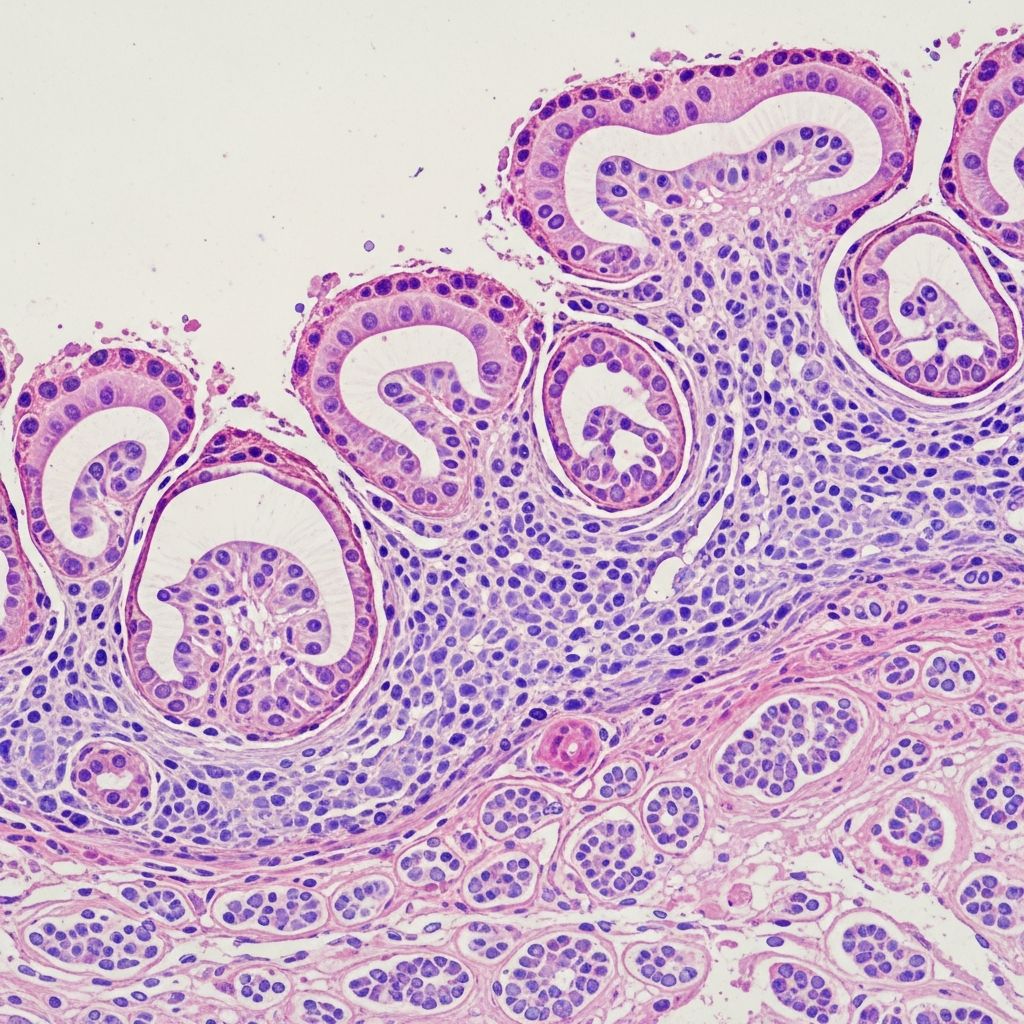
Proliferating trichilemmal cysts, also known as proliferating pilar tumours, are rare, benign but locally aggressive tumours originating from the outer root sheath of hair follicles. These lesions represent an uncommon variant of the more common benign trichilemmal (pilar) cysts, distinguished by their rapid growth and potential for malignant transformation in a small subset of cases. They predominantly affect the scalp in middle-aged to elderly women and exhibit characteristic histopathological features mimicking squamous cell carcinoma.
Introduction
Trichilemmal cysts, affecting approximately 10% of the population, are common benign cutaneous cysts derived from hair follicle epithelium. In rare instances—estimated at less than 3%—these cysts undergo proliferation, forming expanding nodules with solid epithelial components beyond simple cystic dilation. Proliferating trichilemmal cysts (PTCs) are typically slow-growing but can attain large sizes, causing cosmetic concerns, ulceration, or pressure effects. While most remain benign, a malignant form, termed malignant proliferating trichilemmal cyst, has been documented in fewer than 50 cases worldwide, often arising from pre-existing PTCs.
The pathology of PTCs is critical for accurate diagnosis, as clinical features overlap with other adnexal tumours. Histological examination reveals abrupt keratinization and trichilemmal differentiation, key to distinguishing them from mimics like squamous cell carcinoma. This article details the clinical, histopathological, and management aspects based on peer-reviewed dermatopathology literature.
What is a proliferating trichilemmal cyst?
A proliferating trichilemmal cyst is a rare neoplasm arising from the trichilemmal (outer root sheath) cells of hair follicles. Unlike standard pilar cysts, which are simple keratin-filled sacs, PTCs feature epithelial proliferation with endophytic growth, forming lobules of squamous epithelium. They are considered low-grade tumours with rare malignant potential, primarily occurring on the scalp due to the high density of vellus hair follicles.
These cysts evolve from benign trichilemmal cysts through unknown stimuli such as trauma, inflammation, or chronic irritation, leading to hyperplastic changes. PTCs grow slowly over years but can reach diameters exceeding 5 cm, occasionally up to 25 cm in malignant variants, causing overlying skin necrosis or foul-smelling discharge from pressure-induced ulceration.
Who gets proliferating trichilemmal cysts?
Proliferating trichilemmal cysts predominantly affect women, with a female-to-male ratio of approximately 4:1 or higher. The peak incidence is between 50 and 75 years, aligning with postmenopausal demographics. Scalp predilection reflects the anatomical distribution of pilosebaceous units, though rare cases occur on the face, neck, or trunk.
- Most common in Caucasian women aged 50-75 years.
- Rare in children or young adults; familial inheritance reported in benign precursors.
- Association with prior trauma or excision of benign cysts, suggesting reactive proliferation.
Benign trichilemmal cysts show autosomal dominant inheritance in some families, potentially predisposing to PTC development, though specific genetic mutations remain unidentified.
Clinical features of proliferating trichilemmal cysts
Clinically, PTCs present as solitary, firm, subcutaneous nodules on the scalp, often with a smooth, flesh-colored surface. They grow slowly, remaining asymptomatic until large sizes cause pain from pressure or secondary infection. Ulceration occurs in oversized lesions (>5 cm), leading to discharge of malodorous keratinous material.
Malignant transformation manifests as rapid enlargement of a longstanding lesion, with induration, invasion of underlying tissues, or regional lymphadenopathy. Lesions may recur post-excision, with metastasis rates up to 30% in malignant cases.
Related Stories



- Slow-growing, dome-shaped nodule on scalp (90% of cases).
- Firm consistency; mobile early, fixed in advanced growth.
- May ulcerate, bleed, or necrose if >5 cm.
- Rare pain unless inflamed or secondarily infected.
Pathology of a proliferating trichilemmal cyst
Microscopic features: Histopathology is diagnostic, showing a well-circumscribed tumour composed of lobules of squamous epithelium with peripheral palisading and abrupt keratinization without granular layer formation—hallmark of trichilemmal differentiation. Cyst-like spaces contain dense, homogeneous keratin. Proliferative areas exhibit endophytic growth with solid epithelial sheets.
Benign PTCs demonstrate uniform cells, rare mitoses, and no atypia. Malignant variants show pleomorphism, increased mitoses (including abnormal forms), infiltrative borders, necrosis, and desmoplastic stroma. Aneuploidy and high Ki-67 proliferation index support malignancy.
| Feature | Benign PTC | Malignant PTC |
|---|---|---|
| Architecture | Lobulated, expansile | Infiltrative, irregular |
| Keratinization | Abrupt, trichilemmal | Abrupt but with atypia |
| Mitoses | Rare, normal | Frequent, atypical |
| Pleomorphism | Mild/absent | Marked |
| Stroma | Delicate | Desmoplastic |
Immunohistochemistry: Cytokeratin 10 negative, CK15/CK19 positive; CD34 expression in some malignant cases aids differentiation from squamous cell carcinoma. p53 overexpression correlates with malignancy.
Diagnosis
Diagnosis requires excisional biopsy for histopathological confirmation. Incisional biopsy suffices if malignancy suspected. Imaging (CT/MRI) assesses deep extension or bony involvement in large scalp lesions.
Differential diagnosis includes:
- Squamous cell carcinoma (granular layer keratinization).
- Tricholemmoma (clear cells).
- Cylindroma (jigsaw pattern).
- Dermoid cyst (mesenchymal elements).
Treatment of proliferating trichilemmal cysts
Complete surgical excision with 1-2 cm margins is curative for benign PTCs. Mohs micrographic surgery ensures clear margins, ideal for recurrent or scalp lesions.
Malignant cases demand wide excision, lymph node dissection if metastatic, and adjuvant radiotherapy/chemotherapy. Recurrence risk: 10-30%; close follow-up essential.
Frequently asked questions
What causes proliferating trichilemmal cysts?
Exact etiology unknown; likely arises from benign trichilemmal cysts via trauma/inflammation-induced proliferation.
Are proliferating trichilemmal cysts cancerous?
Most benign; <3% progress to malignancy, with rare metastases.
How are they diagnosed?
By histopathology post-biopsy; imaging for large lesions.
What is the treatment?
Surgical excision; Mohs for precision.
Do they recur?
Yes, up to 30% in malignant cases; regular monitoring advised.
References
- Malignant proliferating trichilemmal cyst — DermNet NZ. 2023. https://dermnetnz.org/topics/malignant-proliferating-trichilemmal-cyst
- Pilar Cyst: Causes, Removal & What it Is — Cleveland Clinic. 2023-10-12. https://my.clevelandclinic.org/health/diseases/23092-pilar-trichilemmal-cyst
- Proliferating trichilemmal cyst — Genetic and Rare Diseases Information Center (GARD), NIH. 2023. https://rarediseases.info.nih.gov/diseases/4509/proliferating-trichilemmal-cyst
- Pilar Cyst — MD Searchlight. 2024. https://mdsearchlight.com/skin-problems-and-treatments/pilar-cyst/
- Proliferating Trichilemmal Cyst — MalaCards. 2024. https://www.malacards.org/card/proliferating_trichilemmal_cyst
Similar Articles








Read full bio of medha deb