Proliferating Trichilemmal Cyst: What You Need To Know
Rare benign scalp tumour arising from trichilemmal cysts, requiring surgical excision to prevent recurrence.
A
proliferating trichilemmal cyst
, also known as a proliferating pilar tumour, is a rare type ofbenign hair follicle tumour
that typically develops from a preexistingtrichilemmal cyst
(pilar cyst). While common trichilemmal cysts affect 5-10% of the population, only about 2-3% progress to the proliferating form, which exhibits rapid growth and potential for malignant transformation in rare cases.What is a proliferating trichilemmal cyst?
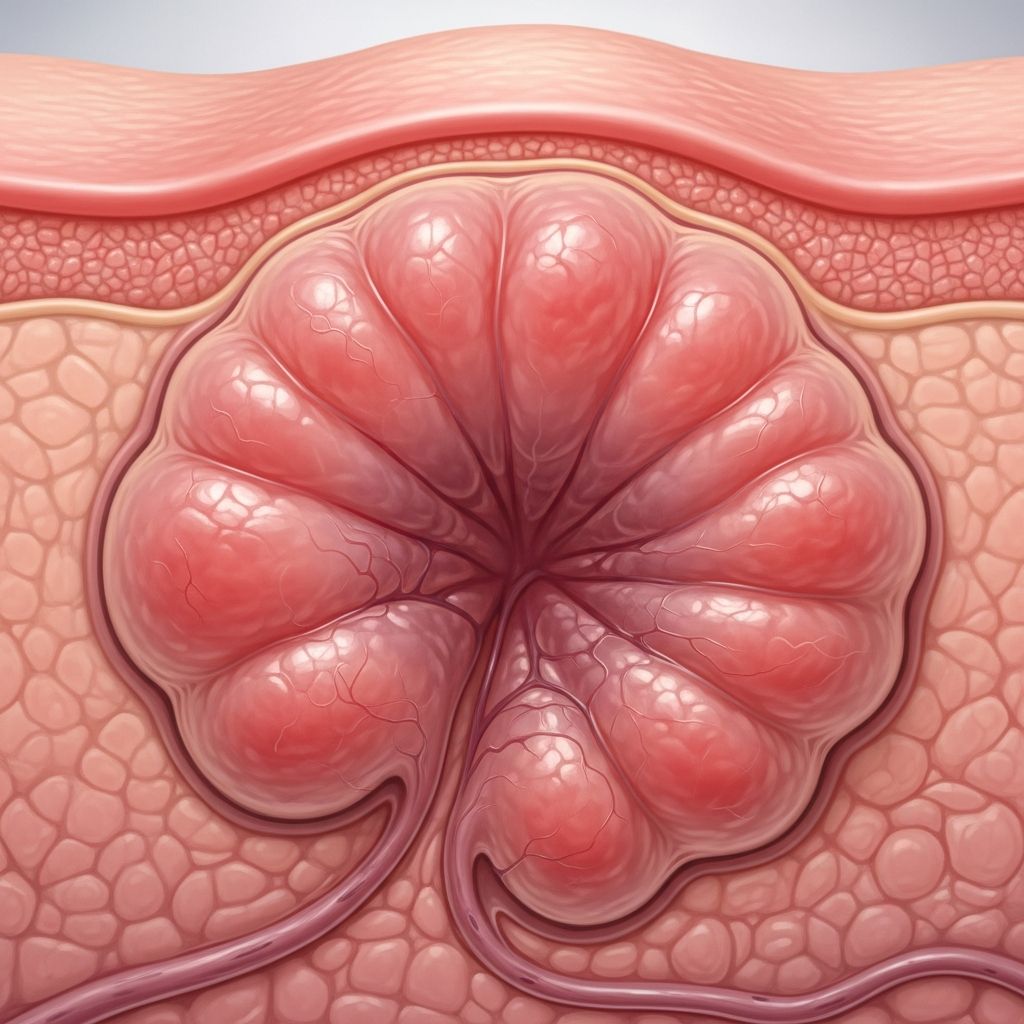
Proliferating trichilemmal cysts represent an uncommon variant of adnexal skin tumours originating from the outer root sheath of the hair follicle, specifically the trichilemmal structure. These cysts arise when a standard trichilemmal cyst, which is a smooth, firm, subcutaneous nodule filled with keratin, undergoes proliferative changes. The proliferation involves excessive growth of squamous epithelial cells with trichilemmal keratinization, leading to larger, more aggressive-appearing lesions despite their usually benign nature.
Histologically, these tumours are distinguished by solid areas of epithelial proliferation with abrupt keratinization, ghost cells, and cholesterol clefts, setting them apart from simple cysts. Although predominantly benign, approximately 5-10% may show malignant features, such as atypia, mitoses, and invasion, termed proliferating trichilemmal carcinoma. This progression underscores the importance of complete excision and histopathological evaluation.
Who gets proliferating trichilemmal cysts?
These cysts predominantly affect
women aged 50-75 years
, with a strong female predominance (about 90% of cases). They occur almost exclusively on thescalp
(90% of reported cases), though rare instances have been documented on the back, chest, groin, thigh, vulva, face, and eyelid. A genetic predisposition exists, as trichilemmal cysts can be inherited in an autosomal dominant pattern, potentially increasing risk for proliferation.- Preexisting trichilemmal cyst (most cases evolve from one).
- Age >50 years, especially postmenopausal women.
- Scalp location with possible history of trauma or irritation.
- Familial tendency in some lineages.
What causes proliferating trichilemmal cysts?
The exact trigger for proliferation remains unclear, but it often develops within a longstanding, asymptomatic trichilemmal cyst. Potential provoking factors include
trauma, irritation, or inflammation
, which may stimulate epithelial hyperplasia. Rapid enlargement is atypical and warrants investigation for superimposed infection or malignant change. Unlike standard pilar cysts, which grow slowly over years, proliferating variants expand more aggressively, sometimes reaching diameters of 25 cm, causing pressure effects.Genetic mutations in genes regulating keratinocyte differentiation, such as those involved in Wnt signaling or p53 pathways, have been implicated in adnexal tumours, though specific drivers for this entity require further research.
What are the clinical features of proliferating trichilemmal cyst?
The typical presentation is a
single, firm-to-soft, painless nodule
ranging from 1-10 cm, though extreme sizes up to 25 cm have been reported. Lesions are often skin-coloured or erythematous, with a smooth or lobulated surface. Overlying skin may thin, ulcerate, or discharge foul-smelling keratinous material if ruptured. Large cysts can causepressure necrosis
of underlying tissues, leading to pain, inflammation, or secondary infection.| Benign Features | Concerning Features (Infection/Malignancy) |
|---|---|
| Firm, mobile nodule on scalp | Rapid growth >1 cm/month |
| Painless, slow enlargement | Ulceration, bleeding |
| Skin-coloured, intact surface | Foul discharge, tenderness |
| <5 cm diameter | >10 cm, fixation to deeper tissues |
Related Stories



Diagnosis
Diagnosis relies on
histopathological examination
of an excisional biopsy, as clinical features overlap with other scalp nodules. Punch or incisional biopsy may suffice initially, but complete excision is preferred for accurate assessment and treatment. Imaging such asCT
orMRI
evaluates large lesions for bony erosion or intracranial extension, particularly if midline.Key histological hallmarks include:
- Proliferating squamous epithelium with trichilemmal keratinization (compact, pale).
- Ghost cells and cholesterol granulomas.
- Absence of granular layer (distinguishes from epidermis).
- Immunohistochemistry: positive for cytokeratins 10/11, negative for involucrin in proliferative areas.
Differential diagnosis
Proliferating trichilemmal cysts must be differentiated from malignant and other benign mimics:
| Condition | Key Distinguishing Features |
|---|---|
| Squamous cell carcinoma | Atypia, mitoses, invasion; granular layer present; HPV association possible. |
| Trichilemmal carcinoma | Malignant counterpart; pleomorphism, necrosis en masse. |
| Dermoid cyst | Midline, contains adnexal elements; no proliferation. |
| Cylindroma | Jigsaw puzzle pattern; ductal differentiation. |
| Standard pilar cyst | No solid proliferation; purely cystic. |
| Metastatic carcinoma | Multiple lesions, known primary. |
Treatment of proliferating trichilemmal cyst
**Complete surgical excision** with a 4-6 mm margin of normal tissue is the gold standard, ensuring low recurrence rates (<5%).
Mohs micrographic surgery
offers superior margin control for recurrent or incompletely excised lesions, preserving scalp tissue. For malignant variants, wide local excision (1-2 cm margins), lymph node dissection if indicated, and adjuvant radiotherapy may be required.Non-surgical options like intralesional steroids or laser ablation are ineffective for proliferating types due to their solid components. Postoperatively, monitor for local recurrence (10-20% risk if incomplete excision) and rare metastases.
Complications
- Recurrence if margins positive (up to 20%).
- Malignant transformation (rare, <5%).
- Infection, ulceration from large size.
- Scarring, alopecia post-surgery.
- Pressure effects: erosion of calvarium, cranial nerve involvement in massive lesions.
Prevention
No proven prevention exists, but early excision of enlarging trichilemmal cysts may halt progression. Avoid trauma to known cysts and monitor familial cases.
Frequently asked questions (FAQs) — proliferating trichilemmal cyst
What is proliferating trichilemmal cyst?
A rare benign tumour arising from trichilemmal cysts, featuring epithelial proliferation, mainly on the scalp.
Who is at risk for proliferating trichilemmal cyst?
Primarily women over 50 with preexisting scalp cysts; genetic factors play a role.
How is proliferating trichilemmal cyst diagnosed?
By excisional biopsy showing trichilemmal keratinization and proliferation; imaging for large lesions.
What does proliferating trichilemmal cyst look like?
Firm scalp nodule 1-25 cm, potentially ulcerated with foul discharge if large.
How is proliferating trichilemmal cyst treated?
Surgical excision with margins; Mohs for conservation.
Can proliferating trichilemmal cyst become cancerous?
Rarely (malignant proliferating trichilemmal tumour); requires histology to confirm.
References
- Proliferating trichilemmal cyst — DermNet NZ. 2023. https://dermnetnz.org/topics/proliferating-trichilemmal-cyst
- Pilar Cyst: Causes, Removal & What it Is — Cleveland Clinic. 2023-10-12. https://my.clevelandclinic.org/health/diseases/23092-pilar-trichilemmal-cyst
- Pilar Cyst — MD Searchlight. 2024. https://mdsearchlight.com/skin-problems-and-treatments/pilar-cyst/
- Proliferating trichilemmal cyst — Genetic and Rare Diseases Information Center (GARD), NIH. 2023. https://rarediseases.info.nih.gov/diseases/4509/proliferating-trichilemmal-cyst
- Proliferating Trichilemmal Cyst — MalaCards (academic resource). 2024. https://www.malacards.org/card/proliferating_trichilemmal_cyst
- What Is a Pilar Cyst (Trichilemmal Cyst) on the Scalp? — WebMD. 2023-05-15. https://www.webmd.com/skin-problems-and-treatments/what-is-a-pilar-cyst-on-scalp
Similar Articles








Read full bio of Sneha Tete