Prurigo
Comprehensive guide to prurigo: causes, symptoms, diagnosis, and effective treatments for this intensely itchy skin condition.
Author: Dermatological Society Review | Last updated: 2025
What is prurigo?
Prurigo refers to a group of skin conditions characterized by intensely itchy (pruritic) papules and nodules. The term encompasses various subtypes, with
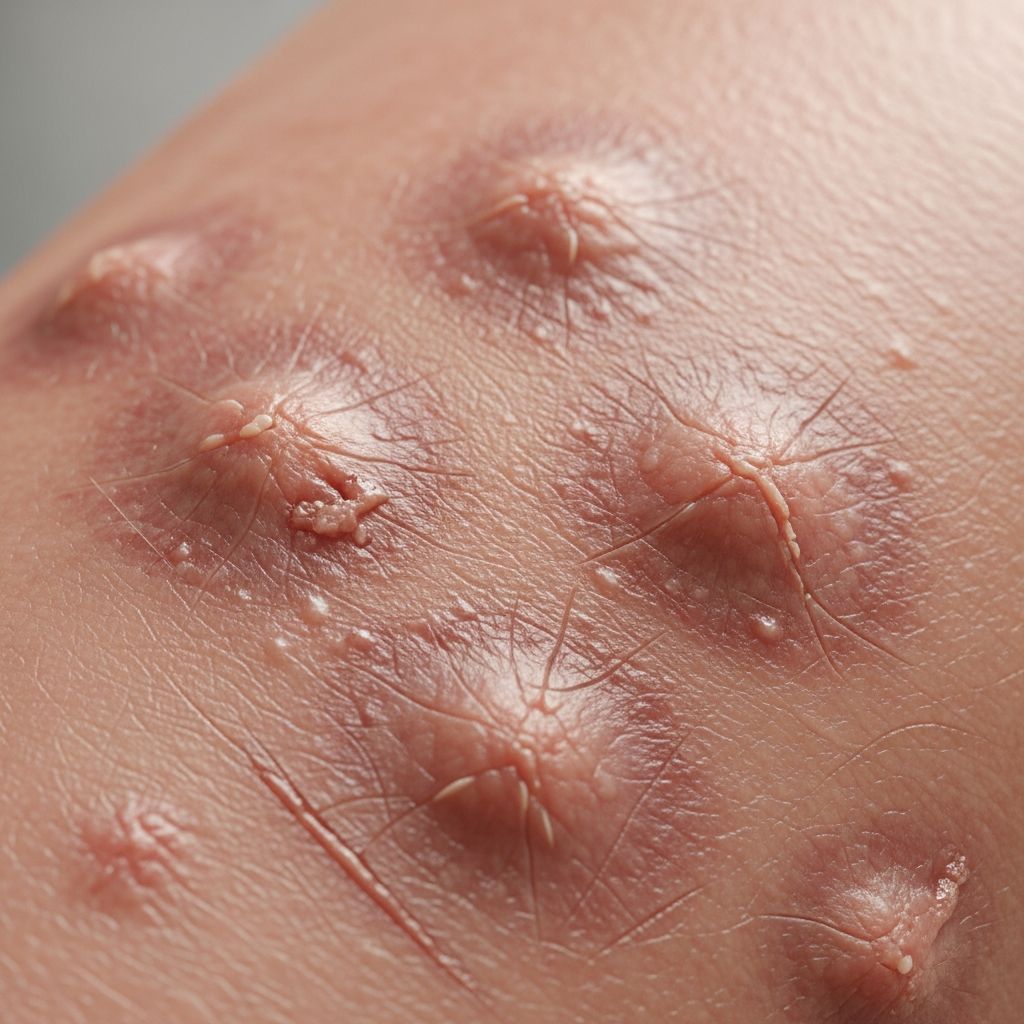
prurigo nodularis (PN)
being the most prominent and debilitating form. PN manifests as multiple, firm, dome-shaped nodules, typically 0.5–2 cm in diameter, often excoriated due to relentless scratching. These lesions predominantly appear on the extensor surfaces of the limbs, such as arms and legs, but can involve the trunk and other areas. Prurigo arises from a vicious itch-scratch cycle, where intense pruritus leads to scratching, causing skin thickening (lichenification) and nodule formation, which in turn perpetuates the itch. This cycle is driven by neurogenic inflammation involving neuropeptides like substance P and calcitonin gene-related peptide (CGRP), as well as elevated interleukin-31 (IL-31) levels.Prurigo can affect individuals across all age groups, though PN is more common in adults aged 20–60 years, with a slight female predominance. It often coexists with atopic dermatitis, chronic pruritus, or systemic conditions like renal failure, diabetes, or malignancies, complicating management. The condition significantly impairs quality of life, leading to sleep disturbance, anxiety, depression, and social isolation due to visible lesions and intractable itch.
Who gets prurigo?
Prurigo affects approximately 40–200 per 100,000 people, with PN prevalence estimated at 50–70 per 100,000. Risk factors include:
- Atopy: Up to 50% of PN patients have a history of atopic dermatitis, asthma, or allergic rhinitis.
- Systemic diseases: Associations with chronic kidney disease (up to 10%), liver disease, thyroid disorders, HIV, hepatitis C, diabetes mellitus, and internal malignancies (e.g., lymphoma).
- Psychological factors: Stress, anxiety, and obsessive-compulsive tendencies exacerbate the itch-scratch cycle.
- Demographics: More common in females (2:1 ratio) and middle-aged adults; prurigo of pregnancy affects women in their third trimester.
In children, subacute prurigo (prurigo strophulus) is triggered by insect bites, presenting as polymorphic papules on exposed skin. PN in the elderly may signal underlying neuropathy or malignancy.
What causes prurigo?
The exact etiology is multifactorial, centered on the itch-scratch-itch cycle. Initial pruritus from various triggers prompts scratching, leading to epidermal hyperplasia, nerve fiber proliferation, and mast cell activation, perpetuating symptoms. Key pathophysiological mechanisms include:
- Neurogenic inflammation: Overexpression of substance P, CGRP, and vanilloid receptor-1 (VR-1) in lesional skin sensitizes itch pathways.
- Cytokine dysregulation: Elevated IL-31, a pruritogen from Th2 cells, correlates with itch intensity.
- Nerve hyperplasia: Increased intraepidermal nerve fibers amplify pruritus signals.
- Triggers: Atopic flares, arthropod bites (in papular prurigo), xerosis, contact irritants, medications (e.g., opioids), and systemic pruritogens (e.g., uremia, cholestasis).
In some cases, prurigo represents a nonspecific reaction pattern rather than a distinct disease, superimposed on underlying pruritic disorders.
What are the clinical features of prurigo?
Clinical presentation varies by subtype but shares intense pruritus as the hallmark.
Prurigo nodularis
- Firm, dome-shaped nodules (0.5–3 cm) with central crust, scale, or hyperpigmentation.
- Grouped symmetrically on extremities (shins, thighs, forearms, shoulders); trunk involvement in severe cases.
- Excoriations, lichenification, and postinflammatory hyperpigmentation common.
- Pruritus described as burning, stinging, or crawling; worse at night.
Papular prurigo (prurigo strophulus)
- Small (2–5 mm), erythematous papules with central vesicle or hemorrhagic crust.
- Asymmetrical on exposed areas (face, arms, legs); resolves with scarring in children.
Prurigo pigmentosa
- Reticulated hyperpigmentation on trunk/neck; linked to ketosis diets.
Dermoscopy reveals comedo-like openings, shiny surfaces, and peripheral vessels in PN.
Diagnosis
Diagnosis is primarily clinical, based on history of chronic pruritus and characteristic nodules. Key steps include:
- History: Duration, itch intensity (e.g., via visual analog scale), triggers, atopy/systemic symptoms, psychological impact.
- Examination: Inspect for nodules, excoriations, lichen simplex chronicus (single plaques vs. multiple nodules).
- Dermoscopy: Differentiates PN (yellowish structures) from hypertrophic lichen planus (pearly white areas, striations).
- Skin biopsy: Confirms acanthohyperkeratosis, epidermal hyperplasia, nerve bundles in papillary dermis; excludes lymphoma/prurigo variants.
- Laboratory tests: CBC, metabolic panel, TSH, HIV, hepatitis serology, IgE, urinalysis, stool ova/parasites to rule out systemic causes.
Differential diagnoses: Lichen simplex chronicus, hypertrophic lichen planus, prurigo pigmentosa, cutaneous T-cell lymphoma, factitial dermatitis.
What is the treatment for prurigo?
Treatment targets breaking the itch-scratch cycle through antipruritics, anti-inflammatories, and behavioral interventions. Multidisciplinary approach is essential.
General measures
- Keep nails short; wear cotton gloves at night.
- Cool baths with emollients; avoid hot showers, irritants.
- Occlusive dressings on nodules to prevent scratching.
- Psychotherapy/cognitive behavioral therapy for psychological components.
Topical therapies
| Agent | Dosage | Efficacy |
|---|---|---|
| Potent corticosteroids (e.g., clobetasol 0.05%) | Occluded nightly x 2–4 weeks | Reduces inflammation; first-line |
| Intralesional triamcinolone (10–40 mg/mL) | Every 4–6 weeks | Flattens nodules rapidly |
| Topical calcineurin inhibitors (tacrolimus 0.1%) | Twice daily | Steroid-sparing |
| Capsaicin 8% patch | Apply 30–60 min, repeat q3 months | Desensitizes nerves via VR-1 |
| Menthol/pramoxine creams | As needed | Symptomatic itch relief |
Systemic therapies
- FDA-approved biologics:
- Dupilumab (Dupixent): IL-4/IL-13 inhibitor; reduces itch by 75% in 75% of patients within 12–24 weeks. Injected subcutaneously q2–4 weeks.
- Nemolizumab: IL-31 receptor antagonist; stops itch-scratch cycle; approved for adults.
- Phototherapy: Narrowband UVB (3–5x/week); effective in 60–80%, especially atopic PN.
- Immunosuppressants: Methotrexate (5–20 mg/week; remission 19 months avg.), cyclosporine, oral tacrolimus.
- Others: Gabapentinoids (pregabalin 150–600 mg/day), antidepressants (doxepin 10–25 mg HS), opioids (naltrexone, nalmefene).
Procedures
- Cryotherapy: Liquid nitrogen q2–4 sessions; flattens nodules.
- Laser therapy: Pulsed dye/CO2 for hypertrophic lesions.
Response rates: 50–70% achieve partial clearance; biologics offer highest efficacy for refractory PN.
Complications
- Secondary bacterial infection (Staph aureus).
- Chronic lichenification, scarring, pigmentation changes.
- Sleep deprivation, depression (30–50% prevalence).
- Reduced work productivity; stigmatization.
Prevention
- Treat underlying atopy/systemic disease promptly.
- Moisturize daily; habit reversal training.
- Avoid triggers (heat, wool, stress).
Prurigo of pregnancy
Benign, pruritic papules/nodules on abdomen/extremities in third trimester; resolves postpartum. Treat symptomatically; no fetal risk.
Frequently asked questions
Q: Is prurigo nodularis curable?
A: Not typically curable but highly manageable. Biologics like dupilumab achieve long-term remission in most patients.
Q: How long does prurigo last?
A: Chronic, often years; early intervention shortens duration.
Q: Can diet affect prurigo?
A: No strong evidence; anti-inflammatory diets may help atopic cases.
Q: When should I see a dermatologist?
A: Immediately for persistent itch with nodules; biopsy may be needed.
Q: Are biologics safe for PN?
A: Yes; common side effects mild (conjunctivitis, injection site reactions).
References
- Prurigo Nodularis – StatPearls — NCBI Bookshelf/NCBI. 2023-07-17. https://www.ncbi.nlm.nih.gov/books/NBK459204/
- Prurigo Nodularis Overview — Yale Medicine. 2024-01-15. https://www.yalemedicine.org/conditions/prurigo-nodularis-overview
- Prurigo nodularis: Diagnosis and treatment — American Academy of Dermatology (AAD). 2025-06-01. https://www.aad.org/public/diseases/a-z/prurigo-nodularis-treatment
Similar Articles


Read full bio of medha deb