Prurigo Pigmentosa: 3-Stage Guide To Causes And Treatment
Rare inflammatory skin condition with itchy net-like rash, often linked to ketosis from ketogenic diets or fasting.
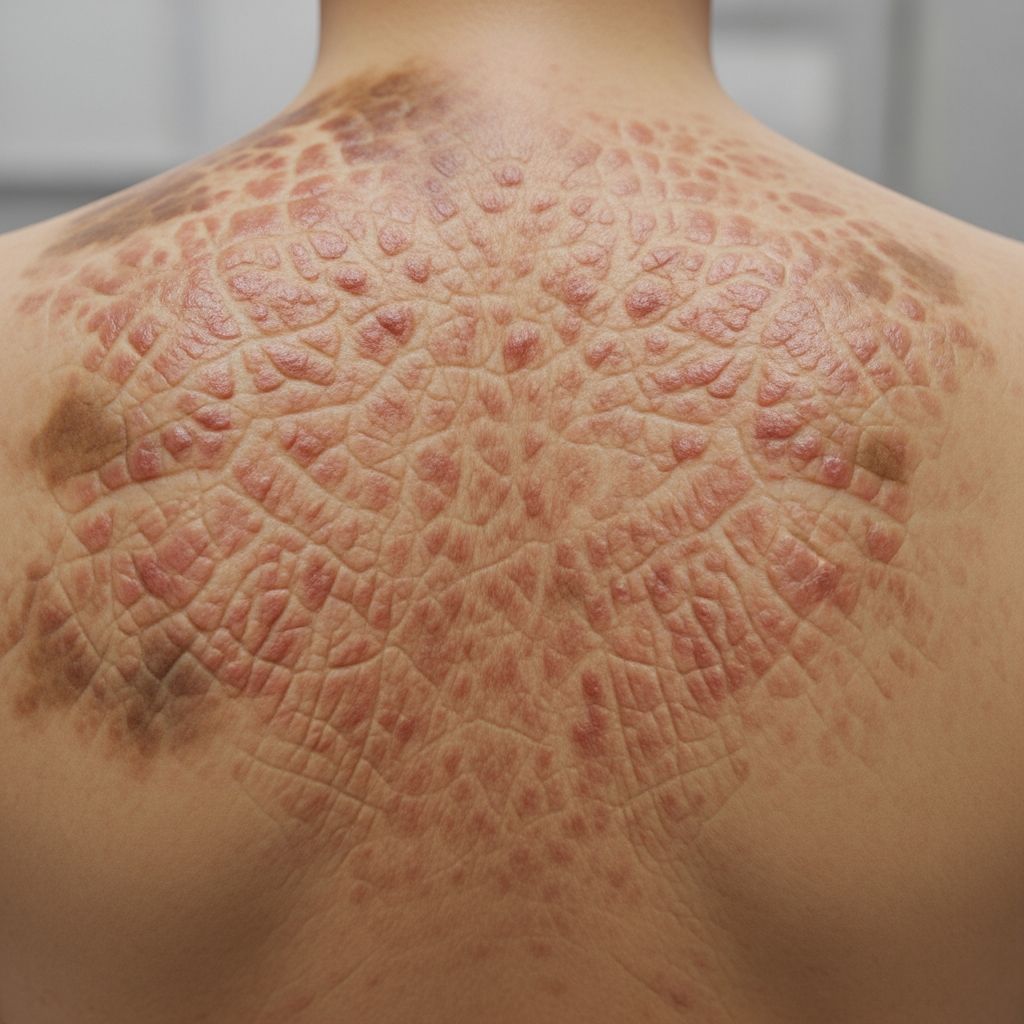
Prurigo pigmentosa is a rare inflammatory dermatosis characterised by intensely itchy (pruritic) papules that form a reticulate (net-like) pattern, predominantly on the trunk and neck. The rash evolves through stages, leaving behind reticulate hyperpigmentation. It is also known as Nagashima disease in Japan, where it was first described.
What is prurigo pigmentosa?
Prurigo pigmentosa (PP) is an uncommon benign inflammatory skin disease featuring recurrent symmetrical pruritic papules arranged in a reticulated pattern on the skin. The condition progresses through distinct inflammatory and postinflammatory stages. Active lesions appear as erythematous (red) papules and plaques coalescing into a net-like configuration, accompanied by severe pruritus that leads to excoriations (scratch marks). Over time, the inflammation subsides, resulting in hyperpigmented (brownish) reticulate patches that may persist for months to years.
The disease name derives from prurigo (itchy papules) and pigmentosa (pigmented), reflecting its hallmark features. PP typically affects young adults, particularly women, though cases occur across ages and ethnicities, increasingly reported worldwide beyond its original Japanese prevalence.
Who gets prurigo pigmentosa?
Prurigo pigmentosa most commonly affects adolescents and young adults, with a female predominance. It was initially described almost exclusively in Japanese patients but is now recognised globally, including in Hispanic, Caucasian, and other populations, often linked to Western adoption of ketogenic diets.
- Peak incidence: 20–30 years old
- Gender: More frequent in females (ratio ~2:1)
- Ethnicity: Originally Japanese (‘Nagashima disease’); rising in diverse groups due to keto diets
- Risk factors: Ketogenic diets, fasting, rapid weight loss, diabetes, eating disorders
What causes prurigo pigmentosa?
The exact aetiology of prurigo pigmentosa remains unknown, but metabolic triggers inducing ketosis are strongly implicated. Ketosis occurs when the body shifts to fat metabolism, producing ketone bodies, often from low-carbohydrate ketogenic (keto) diets, fasting, calorie restriction, or conditions like diabetes and bariatric surgery.
Other proposed triggers include:
- Ketogenic diets (most common modern association, dubbed ‘keto rash’)
- Fasting or anorexia nervosa
- Diabetes mellitus (esp. insulin-dependent)
- Helicobacter pylori infection
- Sweating, friction from clothing, acupuncture
- Rapid weight loss, pregnancy, atopic dermatitis, contact dermatitis
Ketone bodies may provoke perivascular neutrophilic inflammation, though the precise mechanism is unclear.
What are the clinical features of prurigo pigmentosa?
PP manifests in three stages:
- Primary inflammatory stage: Pruritic erythematous papules (1–4 mm) and papulovesicles in reticulate pattern on trunk (chest, back, shoulders), neck, axillae. Severe itch prompts scratching.
- Erythematous stage: Papules coalesce into plaques with white scale in net-like array; central clearing forms annular lesions.
- Hyperpigmented stage: Inflammation resolves to grey-brown reticulated pigmentation; asymptomatic but cosmetically bothersome.
Lesions are symmetrical, non-follicular, and pruritus is disproportionate. No systemic symptoms (fever, malaise).
Differential diagnosis
| Condition | Key Distinguishing Features |
|---|---|
| Confluent and reticulate papillomatosis | Persistent pigmented plaques; less pruritic; no evolution |
| Lichen planus pigmentosus | Asymptomatic; oral involvement possible; purple-brown |
| Erythema dyschromicum perstans | Grey-red macules on limbs; slower progression |
| Keratosis pilaris | Follicular; extensor arms/thighs |
| Follicular eczema | Follicular-based; atopic history |
Related Stories



Pathology of prurigo pigmentosa
Histopathology varies by stage:
- Early: Superficial perivascular neutrophilic infiltrate, papillary dermal oedema, spongiosis.
- Intermediate: Lymphocytic infiltrate with eosinophils, necrotic keratinocytes.
- Late: Interface dermatitis, melanophages (pigment incontinence), fibrosis in papillary dermis.
Biopsy confirms diagnosis, showing non-specific but characteristic reticulate inflammation.
How is prurigo pigmentosa diagnosed?
Diagnosis is clinical, based on characteristic reticulate pruritic papules on trunk/neck with hyperpigmentation history. Key questions: Recent keto diet? Fasting? Weight loss? Biopsy supports if atypical.
Investigations:
- Skin biopsy (gold standard for confirmation)
- Urine/blood ketones to detect ketosis
- Exclude differentials (e.g., fungal scrapings, viral PCR if needed)
What is the treatment for prurigo pigmentosa?
First-line: Address trigger (e.g., cease keto diet, increase carbs). Symptomatic relief with oral tetracyclines (anti-inflammatory).
Active inflammatory lesions
- Oral antibiotics (1st line): Minocycline 100mg BD or doxycycline 100mg BD for 2–8 weeks. Effective via neutrophil inhibition.
- Dapsone (if tetracycline-intolerant)
- Topical: Potent corticosteroids (e.g., clobetasol), tacrolimus for itch/inflammation
- Other: Colchicine, antihistamines, short-course prednisolone
Rash resolves in ~18 days with treatment + diet change; 68% have residual pigmentation.
Hyperpigmentation management
- Topical: Hydroquinone 4%, retinoids, corticosteroids, azelaic acid
- Procedures: Q-switched lasers, chemical peels, microdermabrasion, UVB phototherapy
Prevention and prognosis
Avoid triggers: No extreme low-carb diets, manage diabetes. Educate on recurrence risk with ketosis. Lesions non-contagious. Prognosis excellent with prompt treatment; pigmentation fades over months.
Frequently Asked Questions (FAQs)
Q: Is prurigo pigmentosa the same as keto rash?
A: Yes, ‘keto rash’ is a common name for prurigo pigmentosa triggered by ketogenic diets inducing ketosis.
Q: How long does prurigo pigmentosa last?
A: Active rash resolves in weeks with treatment; hyperpigmentation persists months to years but fades.
Q: Can prurigo pigmentosa be cured permanently?
A: It recurs with triggers like keto diets; avoiding ketosis prevents flares. Not contagious.
Q: Is a skin biopsy always needed?
A: Not always; classic clinical picture suffices, but biopsy confirms atypical cases.
Q: What diet helps prurigo pigmentosa?
A: Increase carbohydrates to end ketosis; avoid fasting/keto. Consult a dietitian.
References
- Prurigo Pigmentosa (Nagashima disease) — MD Searchlight. 2023. https://mdsearchlight.com/skin-problems-and-treatments/prurigo-pigmentosa-nagashima-disease/
- Ketogenic Diet-induced Prurigo Pigmentosa (the “Keto Rash”) — Journal of Clinical and Aesthetic Dermatology. 2020. https://jcadonline.com/ketogenic-keto-rash-diet-prurigo-pigmentosa/
- Keto Rash (Prurigo Pigmentosa) — Cleveland Clinic. 2023-10-27. https://my.clevelandclinic.org/health/diseases/keto-rash
- Treatment of Prurigo Pigmentosa with Diet Modification — Hawaii Journal of Medicine & Public Health. 2022. https://hawaiijournalhealth.org/past_issues/hjmph7705_0114.pdf
- Prurigo Pigmentosa — StatPearls, NCBI Bookshelf. 2023-07-17. https://www.ncbi.nlm.nih.gov/books/NBK599559/
- Prurigo pigmentosa — Primary Care Dermatology Society. 2023. https://www.pcds.org.uk/clinical-guidance/prurigo-pigmentosa
Similar Articles








Read full bio of medha deb