Pseudocarcinomatous Hyperplasia in ALCL Pathology
Exploring pseudocarcinomatous hyperplasia in anaplastic large cell lymphoma: pathology, mimics, and diagnostic challenges.
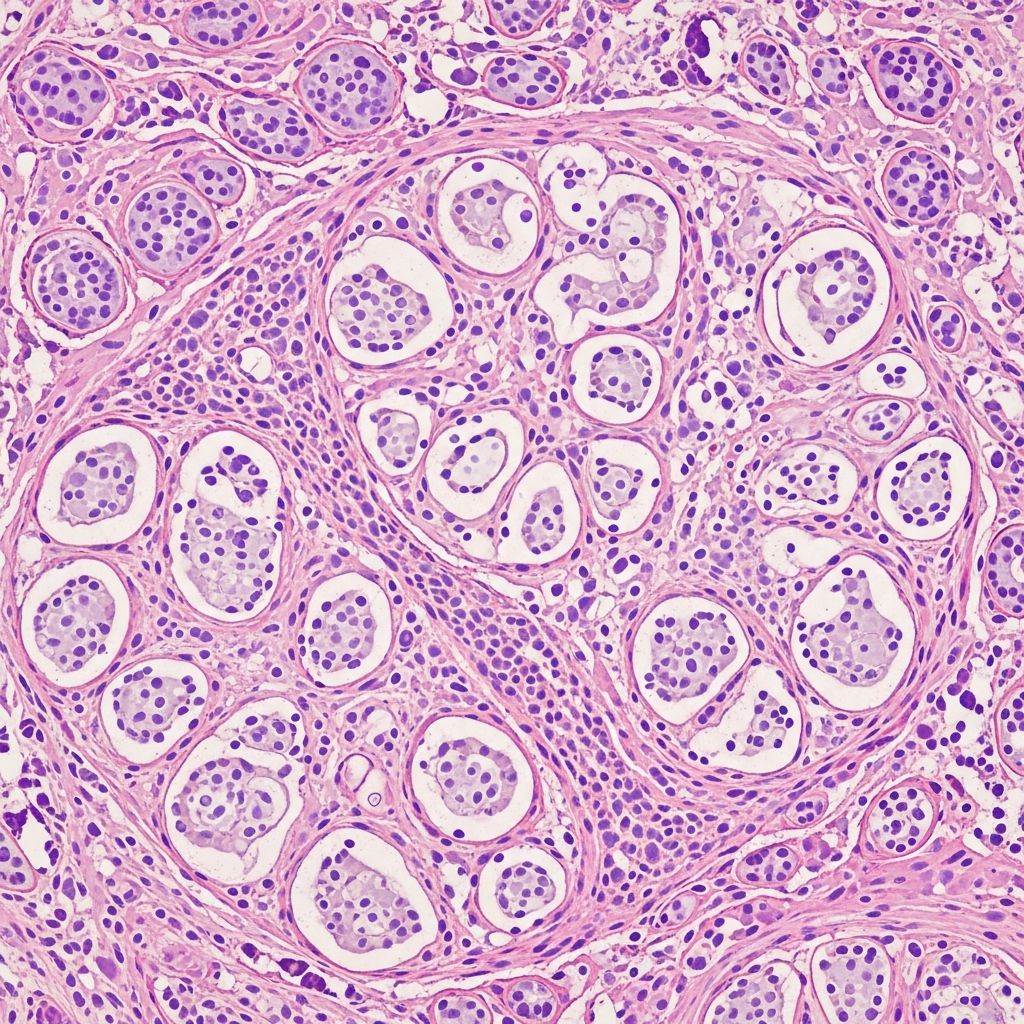
Pseudocarcinomatous hyperplasia (PCH), also known as pseudoepitheliomatous hyperplasia, represents a reactive epidermal proliferation that can closely mimic invasive squamous cell carcinoma (SCC), particularly in the context of underlying CD30-positive lymphoproliferative disorders such as anaplastic large cell lymphoma (ALCL). This phenomenon poses significant diagnostic challenges for dermatopathologists, as the hyperplastic epithelium may overshadow atypical lymphoid infiltrates, leading to misdiagnosis. Understanding this entity is crucial for accurate diagnosis and appropriate patient management.
Introduction
Anaplastic large cell lymphoma (ALCL) is a subtype of CD30-positive T-cell lymphoma characterized by large, atypical lymphoid cells expressing CD30 (Ki-1 antigen). Primary cutaneous ALCL typically presents as solitary or localized nodules or plaques, often on the extremities or trunk, in adults. A key histopathological pitfall in ALCL is the frequent association with overlying pseudocarcinomatous hyperplasia, where the epidermis exhibits irregular downward proliferation resembling poorly differentiated or well-differentiated SCC.
PCH is a benign reactive process triggered by inflammatory stimuli, including infections, trauma, or neoplasms like lymphomas. In CD30+ disorders, cytokines such as interleukin-1 and tumor necrosis factor-alpha from lymphoma cells induce marked epidermal hyperplasia. This article reviews the pathology, clinical features, differential diagnosis, and immunohistochemical aids for recognizing PCH in ALCL, drawing from peer-reviewed case reports and literature.
Clinical Features
Clinically, lesions associated with PCH in ALCL often appear as erythematous plaques, nodules, or ulcerated tumors, mimicking SCC or keratoacanthoma. Patients are typically adults, with cases reported in individuals aged 42 to over 80 years. Common sites include sun-protected areas like the thighs, limbs, or trunk, which are atypical for conventional SCC and should prompt consideration of lymphoproliferative mimics.
- Solitary or few lesions progressing over months to years.
- Erythematous patches evolving to crusted, ulcerated plaques.
- Lack of significant sun exposure history in younger patients.
- Systemic symptoms rare in primary cutaneous ALCL but may occur in systemic forms.
Awareness of atypical presentations is vital, as inflamed SCC-like lesions in non-sun-exposed sites warrant biopsy to exclude lymphoma.
Histopathology
Microscopically, PCH in ALCL features pronounced epidermal hyperplasia with irregular tongues of stratified squamous epithelium extending into the dermis, simulating invasive carcinoma. Key features include:
| Feature | Description |
|---|---|
| Epidermal Changes | Acanthosis, hyperkeratosis, parakeratosis; elongated rete ridges with bulbous downgrowths. |
| Dermal Involvement | Tongues of epithelium infiltrate between collagen bundles without marked atypia or mitoses. |
| Lymphoid Infiltrate | Dense, atypical large cells with horseshoe-shaped nuclei, prominent nucleoli; scattered among epithelial elements. |
| Other | Mixed inflammation (neutrophils, eosinophils); no true desmoplasia or keratin pearls in pure PCH. |
The lymphoid component consists of medium-to-large pleomorphic cells with abundant cytoplasm, often obscured by the epithelial proliferation. In lymphomatoid papulosis (LyP), a related CD30+ disorder, similar PCH overlays wedge-shaped infiltrates of atypical lymphocytes.
Cytology
Cytologically, the hyperplastic keratinocytes show orderly maturation, minimal atypia, and rare mitoses, distinguishing PCH from true SCC. Lymphoma cells exhibit hallmark anaplastic morphology: eccentric nuclei, prominent nucleoli, and frequent mitoses. Multinucleated cells and Reed-Sternberg-like forms may be present, further mimicking carcinoma.
Immunohistochemistry
Immunohistochemistry (IHC) is pivotal for differentiation. PCH keratinocytes express pankeratin and p63, which highlights epithelial tongues but spares interstitial lymphoma cells. CD30 strongly labels atypical lymphoid cells in a membrane/cytoplasmic pattern, often >75% positivity in ALCL.
Related Stories



| Marker | PCH Epithelium | ALCL Lymphocytes | SCC |
|---|---|---|---|
| CD30 (Ki-1) | Negative | Strong positive | Negative |
| p63 | Positive (basal/suprabasal) | Negative | Positive (diffuse) |
| CD3/CD4/CD8 | Negative | Variable T-cell pattern | Negative |
| ALK-1 | Negative | Positive in systemic ALCL | Negative |
| Pankeratin | Positive | Negative | Positive |
Additional stains like CD4 (often positive), CD8 (variable), and loss of CD7/CD5 support T-cell lymphoma. ALK-1 is negative in primary cutaneous ALCL but positive in systemic cases with t(2;5) translocation.
Diagnosis and Differential Diagnosis
Diagnosis requires integrating clinical, histologic, and IHC findings. Pitfalls include overcalling PCH as invasive SCC, especially if lymphoid cells are sparse. Key differentials:
- Squamous Cell Carcinoma: True atypia, keratin pearls, desmoplasia; p63 diffuse, CD30 negative.
- Keratoacanthoma: Symmetric crateriform architecture; rapid growth clinically.
- Lymphomatoid Papulosis: Smaller lesions, self-regressing; similar IHC.
- Inflammatory Conditions: Halogenoderma, deep fungal infections (e.g., chromoblastomycosis).
Clinical correlation is essential: SCC favors sun-exposed elderly skin, while ALCL/PCH occurs in atypical sites.
Pathogenesis
PCH arises from cytokine-driven epidermal repair in response to lymphoma-induced inflammation. CD30+ cells release IL-1, TNF-α, and other growth factors, promoting acanthosis and rete elongation without malignant transformation. This reactive process is well-documented in CD30+ lymphoproliferations, including ALCL and LyP.
Treatment
Primary cutaneous ALCL with PCH is managed as localized disease: surgical excision for solitary lesions, low-dose methotrexate (10-25 mg/week), or radiation for multifocal cases. Prognosis is excellent (>90% 5-year survival), unlike systemic ALCL. Monitoring for extracutaneous spread is recommended.
Frequently Asked Questions (FAQs)
Q: What is pseudocarcinomatous hyperplasia?
A: A benign reactive epidermal overgrowth mimicking carcinoma, often linked to inflammation or neoplasms like ALCL.
Q: How does PCH in ALCL differ from SCC histologically?
A: PCH shows orderly keratinocyte maturation without atypia; IHC reveals CD30+ lymphocytes absent in SCC.
Q: Is IHC always necessary for diagnosis?
A: Yes, especially when epithelium overshadows lymphoma; p63 and CD30 are key discriminators.
Q: Can PCH occur in other lymphomas?
A: Primarily CD30+ disorders like LyP and ALCL; rare in others.
Q: What is the prognosis of cutaneous ALCL with PCH?
A: Favorable with localized therapy; >90% cure rate for primary cutaneous forms.
Conclusion
Recognizing PCH in ALCL prevents misdiagnosis as carcinoma, emphasizing multidisciplinary correlation. Advances in IHC continue to refine diagnostic accuracy in these mimickers.
References
- Pseudocarcinomatous hyperplasia in anaplastic large cell lymphoma, a mimicker of poorly differentiated squamous cell carcinoma: report of a case and review of the literature — Price A, Miller JH, Junkins-Hopkins JM. J Cutan Pathol. 2015-11-01. https://pubmed.ncbi.nlm.nih.gov/26040921/
- Pseudocarcinomatous Hyperplasia Masquerading as a Well-Differentiated Squamous Cell Carcinoma Associated With Primary Cutaneous Anaplastic Large-Cell Lymphoma — LaTour D, Lee MP, Gardner JT, et al. Am J Dermatopathol. 2022-12-01. https://pubmed.ncbi.nlm.nih.gov/36197055/
- Lymphomatoid papulosis with pseudocarcinomatous hyperplasia — Journal of Cutaneous Pathology. 2015. https://www.ovid.com/journals/jcup/fulltext/10.1111/cup.12646
- Pseudocarcinomatous hyperplasia in anaplastic large cell lymphoma — Journal of Cutaneous Pathology (Wiley). 2015-07-03. https://onlinelibrary.wiley.com/doi/10.1111/cup.12543
- Pseudocarcinomatous Hyperplasia Hiding Lymphomatoid Papulosis — International Journal of Surgical Pathology (Sage). 2016-05. https://journals.sagepub.com/doi/abs/10.1177/1066896915623364
Similar Articles








Read full bio of Sneha Tete