Pseudoepitheliomatous Keratotic and Micaceous Balanitis Pathology
Comprehensive pathology guide to pseudoepitheliomatous keratotic and micaceous balanitis, covering histology, diagnosis, and management.
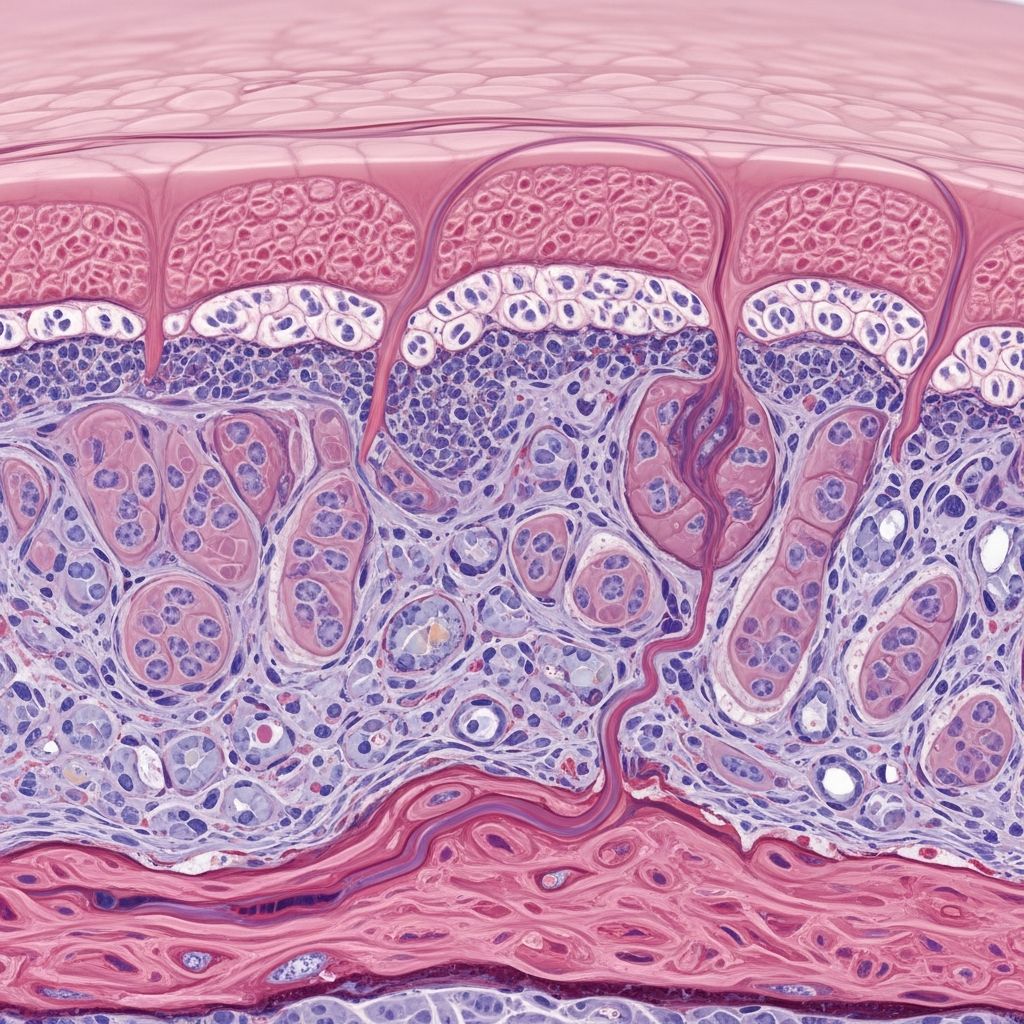
Pseudoepitheliomatous keratotic and micaceous balanitis (PKMB), also known as Civatte’s balanitis, is a rare, chronic dermatological condition primarily affecting the glans penis in uncircumcised men over 60 years of age. It manifests as adherent, silvery-white micaceous scales and keratotic plaques on the coronal sulcus and glans, often progressing slowly over years.
Introduction
PKMB typically presents in older, sexually active men with a history of phimosis or poor genital hygiene. The lesion begins as erythematous plaques that evolve into thick, hyperkeratotic scales resembling mica flakes, which are easily peeled off but recur. Patients may report mild itching, irritation, or fissuring, though many are asymptomatic. The condition’s etiology remains unclear but is hypothesized to involve chronic inflammation, possibly triggered by irritants, bacterial infections, or human papillomavirus (HPV), though HPV DNA is inconsistently detected. Some studies link it to untreated or refractory lichen sclerosus, suggesting it as an unstable variant with pseudoepitheliomatous hyperplasia.
Risk factors include autoimmune diseases, sexually transmitted infections (STIs), genital warts, and lichen sclerosus. Progression occurs in four theorized stages: early plaque, late tumorous, verrucous carcinoma-like, and invasive squamous cell carcinoma (SCC), highlighting its potential premalignant nature. Early intervention is crucial to prevent malignant transformation, reported in up to 20-30% of untreated cases.
Histology
The histopathological hallmark of PKMB is
pseudoepitheliomatous hyperplasia
characterized by marked acanthosis (epidermal thickening), hyperkeratosis (excess keratin), and irregular elongation of rete ridges without true cytological atypia or dysplasia. The epidermis shows papillomatosis, parakeratosis, and a pseudoepitheliomatous pattern mimicking invasive carcinoma but lacking malignant features such as nuclear pleomorphism, mitoses, or stromal invasion.Dermal changes include dilated capillaries, congestion, and a mixed inflammatory infiltrate of lymphocytes, plasma cells, and eosinophils in the superficial dermis. Basal layer atypia may be present but is insufficient for penile intraepithelial neoplasia (PeIN) diagnosis. No viral cytopathic effects (e.g., koilocytes) are typically seen, distinguishing it from HPV-related lesions. Figures from biopsies often reveal compact orthokeratosis overlaying acanthotic epidermis with straight, elongated rete ridges (see illustrative descriptions in sources).
- Key epidermal features: Hyperkeratosis, acanthosis, pseudoepitheliomatous hyperplasia, papillomatosis.
- Dermal features: Non-specific chronic inflammatory infiltrate, vascular dilation.
- Absences: Dysplasia, atypia, koilocytes, fungal elements.
Special Studies
Special stains enhance diagnostic accuracy. Periodic acid-Schiff (PAS) stain excludes fungal infections like candidiasis, which can mimic PKMB clinically. Immunohistochemistry for p16 or HPV typing may be performed if viral etiology is suspected, though often negative. In cases with basal atypia, markers like Ki-67 (proliferation index) or p53 help rule out PeIN or early SCC. Dermoscopy reveals a central keratotic plaque with white scales, peripheral erythema, and dilated vessels, aiding non-invasive assessment.
| Stain/Test | Purpose | Typical Finding in PKMB |
|---|---|---|
| PAS | Exclude fungi | Negative |
| HPV IHC (p16) | Rule out viral cause | Usually negative |
| Ki-67/p53 | Assess atypia | Low proliferation, no overexpression |
Differential Diagnoses
PKMB must be differentiated from premalignant and malignant penile lesions due to overlapping clinical and histological features. Key differentials include:
- Erythroplasia of Queyrat (Bowen’s disease): Velvety erythematous plaque; histology shows full-thickness dysplasia.
- Condyloma acuminatum (genital warts): Cauliflower-like verrucous papules; koilocytes on biopsy, HPV positive.
- Verrucous carcinoma: Exophytic, hyperkeratotic; well-differentiated SCC variant with pushing invasion.
- Squamous cell carcinoma (SCC): Ulcerated nodule/plaque; frank atypia, invasion.
- Lichen sclerosus: White sclerotic plaques; epidermal atrophy, sclerosis.
- Psoriasis or candidiasis: Scaly plaques; specific histology (parakeratosis with neutrophils, fungi).
Related Stories



| Feature | PKMB | Erythroplasia of Queyrat | Condyloma | Verrucous Carcinoma |
|---|---|---|---|---|
| Clinical | Mica-like scales on glans | Shiny red plaque | Cauliflower papules | Exophytic wart-like |
| Dermoscopy | White scales, dilated vessels | Glomerular vessels | Mosaic pattern | Keratotic surface |
| Histology | Pseudoepitheliomatous hyperplasia, no atypia | Dysplasia | Koilocytes | Well-diff SCC, invasion |
Clinical Features
Clinically, PKMB evolves gradually. Initial erythematous patches on the glans corona progress to adherent, silvery micaceous crusts and horny projections. Lesions measure 1-3 cm, may fissure or ulcerate, and rarely involve prepuce or shaft. In a series of eight cases, all Caucasian males (mean age 62) had glans involvement with basal atypia in 75%; one progressed to PeIN. Recurrence post-excision is common without addressing underlying factors like phimosis.
Management
Treatment is challenging due to refractoriness. Conservative options include potent topical steroids, calcineurin inhibitors, or imiquimod, with variable success. Surgical approaches—excision with glans resurfacing and split-skin grafting—achieved remission in 5/8 cases in one series. Circumcision prevents recurrence by improving hygiene. Long-term follow-up with biopsies is mandatory given SCC risk. Glans resurfacing offers high success rates for refractory disease.
- Medical: Topical corticosteroids, 5-FU, imiquimod.
- Surgical: Circumcision, excision + graft, laser ablation.
- Follow-up: Regular dermoscopy/biopsy for progression.
Prognosis
PKMB follows a chronic course with frequent recurrences. While indolent, its premalignant potential necessitates vigilant monitoring. Malignant transformation to verrucous or SCC occurs in advanced stages, but early treatment halts progression. No deaths reported in modern series, but delayed diagnosis worsens outcomes.
Frequently Asked Questions (FAQs)
Is PKMB cancerous?
PKMB is potentially premalignant; it may progress to verrucous carcinoma or SCC if untreated, but lacks inherent malignancy.
Who gets PKMB?
Primarily uncircumcised men over 60 with poor hygiene or lichen sclerosus history.
How is PKMB diagnosed?
By clinical exam, dermoscopy, and biopsy showing pseudoepitheliomatous hyperplasia without atypia.
Can PKMB be cured?
Cure is possible with surgery like glans resurfacing; medical treatments control but rarely eradicate.
Is HPV involved in PKMB?
Suspected but unproven; most cases HPV-negative.
References
- Pseudoepitheliomatous Keratotic and Micaceous Balanitis Pathology — DermNet NZ. 2023. https://dermnetnz.org/topics/pseudoepitheliomatous-keratotic-and-micaceous-balanitis-pathology
- Pseudoepitheliomatous keratotic and micaceous balanitis: a series — Journal of the European Academy of Dermatology and Venereology. 2023-10-01. https://onlinelibrary.wiley.com/doi/abs/10.1111/jdv.18328
- Balanitis pseudoepitheliomatous keratotic and micaceous of Civatte: case report — MedCrave Online. 2022. https://medcraveonline.com/JDC/balanitis-pseudoepitheliomatous-keratotic-and-micaceous-of-civatte-case-report-of-an-atypical-dermatosis.html
- Pseudoepitheliomatous keratotic and micaceous balanitis — PubMed / Dermatol Pract Concept. 2022. https://pubmed.ncbi.nlm.nih.gov/18549127/
- Pseudoepitheliomatous Keratotic and Micaceous Balanitis — DermNet NZ. 2023. https://dermnetnz.org/topics/pseudoepitheliomatous-keratotic-and-micaceous-balanitis
- Pseudoepitheliomatous, keratotic, and micaceous balanitis — PubMed. 2008-06-01. https://pubmed.ncbi.nlm.nih.gov/18549127/
Similar Articles








Read full bio of Sneha Tete