Pseudoepitheliomatous Keratotic and Micaceous Balanitis
Rare penile dermatosis in elderly uncircumcised men featuring hyperkeratotic micaceous plaques on glans with potential premalignant evolution.
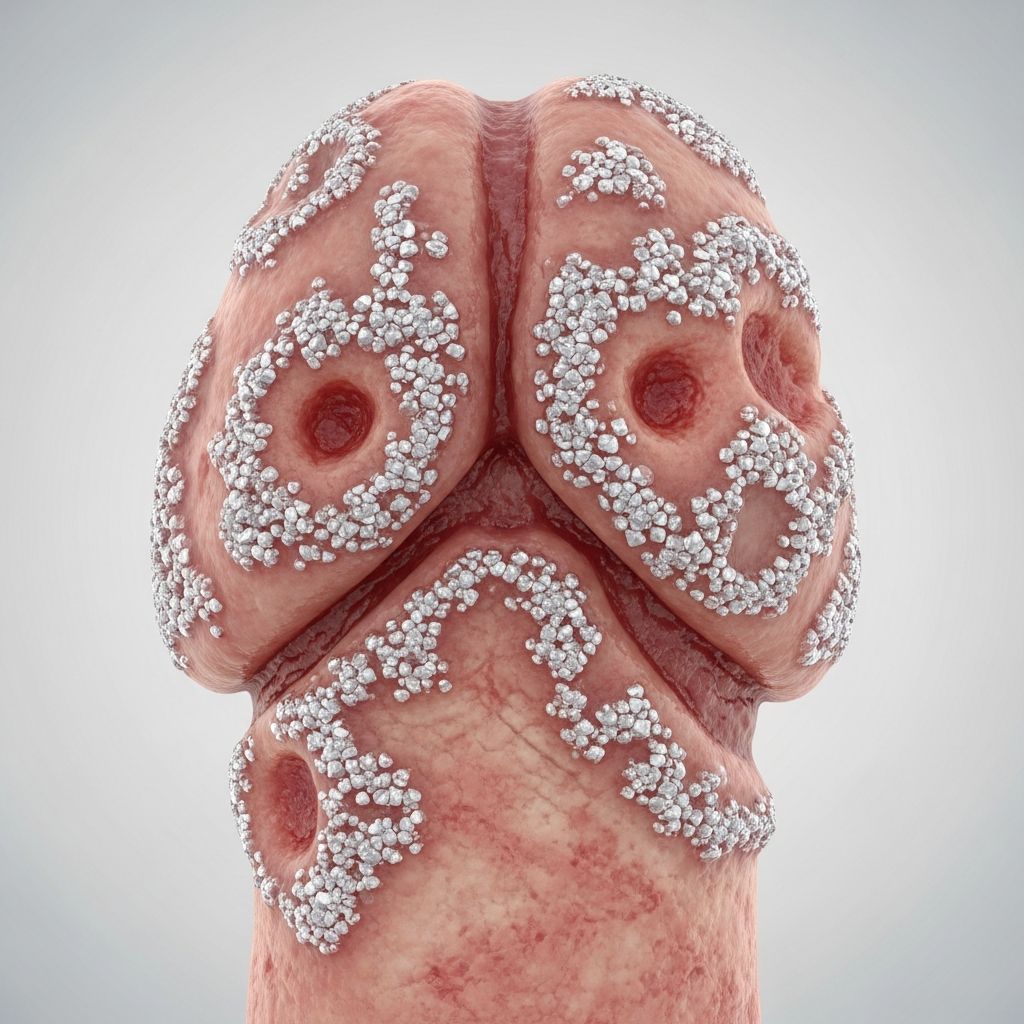
Pseudoepitheliomatous keratotic and micaceous balanitis (PKMB) is a rare dermatological condition primarily affecting the glans penis in elderly uncircumcised men. Characterized by hyperkeratotic plaques covered with thick, adherent micaceous scales, it typically presents asymptomatically but may cause irritation, fissuring, or maceration.
What is PKMB?
PKMB, first described by Civatte in the 1960s, manifests as a well-defined, silvery-white plaque on the glans penis, often resembling a cutaneous horn due to its thickness. The condition is chronic, with a high recurrence rate post-treatment, and raises concerns due to its histological overlap with premalignant lesions like verrucous carcinoma. Unlike common balanitis, which involves inflammation and swelling, PKMB features prominent hyperkeratosis and pseudoepitheliomatous hyperplasia without initial signs of infection.
The name derives from its key features: pseudoepitheliomatous hyperplasia (benign epidermal overgrowth mimicking carcinoma), keratotic scaling, and micaceous flakes resembling mica mineral. It predominantly occurs in men over 60, though cases in younger patients, such as a 40-year-old, have been documented.
Who gets PKMB?
PKMB almost exclusively affects uncircumcised elderly males, with onset typically after age 60. Risk factors include poor genital hygiene under the foreskin, chronic irritation, and possible low-grade infections. Reported cases are scarce, with fewer than 20 documented globally, many from case reports in medical literature.
- Demographics: Elderly (>60 years), uncircumcised men.
- Rare variants: Younger patients (e.g., 40 years) or atypical presentations.
- Associations: Phimosis, urinary stream deviation, sexual dysfunction.
Clinical features
Lesions appear as adherent, micaceous-scaled hyperkeratotic plaques on the glans, often surrounding the urethral meatus. Thickness can create a ‘watering-can penis’ effect during micturition due to multiple urine streams. Symptoms are usually absent but may include itching, burning post-urination, fissuring, or maceration.
In advanced stages, plaques evolve into tumorous growths, potentially ulcerating or causing phimosis and pain, interfering with sexual activity. Surrounding erythema or a halo may be present without lymphadenopathy.
Pathogenesis
The exact cause remains unclear, hypothesized as a pseudoepitheliomatous response to chronic irritation, bacterial infection (pyodermatitis), or HPV. It progresses in four stages:
- Early plaque stage: Flat hyperkeratotic plaque with micaceous scaling.
- Late tumor stage: Thickened, horn-like mass.
- Verrucous carcinoma: Warty, invasive growth.
- Squamous cell carcinoma (SCC): Malignant invasion and metastasis.
Histology shows no viral cytopathic effects or significant dysplasia initially, supporting a reactive rather than neoplastic origin, though atypia may emerge later.
Diagnosis
Diagnosis relies on clinical suspicion and biopsy confirmation. Key histopathological findings include:
- Hyperkeratosis, parakeratosis, acanthosis, papillomatosis.
- Pseudoepitheliomatous hyperplasia with elongated rete ridges.
- Mild lower epidermal dysplasia.
- Perivascular mononuclear infiltrate (lymphocytes, eosinophils) in dermis.
Dermoscopy may reveal a central keratotic plaque with white scales, peripheral erythema, and dilated vessels. Serology rules out HIV, hepatitis, syphilis.
Differential diagnosis
| Condition | Key Features | Distinguishing Histology |
|---|---|---|
| Verrucous carcinoma/SCC | Invasive growth, atypia | Dysplasia, invasion |
| Lichen sclerosus | White sclerotic patches | Hyalinization, fibrosis |
| Erythroplasia of Queyrat | Velvety red plaque | Carcinoma in situ |
| Giant condyloma | Cauliflower-like | Koilocytes, HPV |
| Penile psoriasis | Scaly plaques | Parakeratosis, Munro microabscesses |
| Penile horn | Extreme hyperkeratosis | Similar but no infiltrate |
Management
Treatment is challenging due to recurrences. Options include:
- Topical therapies: Steroids, calcineurin inhibitors, imiquimod for early lesions.
- Circumcision: Essential for uncircumcised men to improve hygiene and access.
- Surgical excision: For thick plaques or suspicion of malignancy, followed by reconstruction.
- Other: Cryotherapy, laser, radiotherapy in select cases.
Related Stories



Long-term follow-up is mandatory due to malignant potential. Multidisciplinary approach involving dermatology and urology is recommended.
Progression and prognosis
PKMB follows an indolent course but can progress to verrucous carcinoma or SCC if untreated. Early intervention halts progression in most cases, though recurrences are common. Prognosis improves with circumcision and vigilant monitoring.
Frequently Asked Questions
What causes PKMB?
Exact etiology unknown; likely reactive hyperplasia from infection or irritation in uncircumcised men.
Is PKMB cancerous?
Benign but premalignant; can evolve into SCC via staged progression.
How is PKMB diagnosed?
By biopsy showing pseudoepitheliomatous hyperplasia, hyperkeratosis without invasion.
Can PKMB be cured?
Manageable with treatment and circumcision, but recurrences occur; requires monitoring.
Does circumcision help?
Yes, improves hygiene and reduces recurrence risk.
Case Examples
A 65-year-old man presented with a 6-month nonhealing penile lesion with itching and burning. Exam showed hyperkeratotic plaque with micaceous scales; biopsy confirmed PKMB. Another 40-year-old had 5-year history with urinary deviation, histology indicating atypia.
This condition underscores the need for prompt penile lesion evaluation in at-risk groups to prevent progression.
References
- Pseudoepitheliomatous keratotic and micaceous balanitis – PMC – NIH — PMC. 2013-10-01. https://pmc.ncbi.nlm.nih.gov/articles/PMC3841663/
- Pseudoepitheliomatous keratotic and micaceous balanitis – Wikipedia — Wikipedia. 2023-01-01. https://en.wikipedia.org/wiki/Pseudoepitheliomatous_keratotic_and_micaceous_balanitis
- Balanitis pseudoepitheliomatous keratotic and micaceous of Civatte: Case report of an atypical dermatosis — MedCrave Online. 2020-01-01. https://medcraveonline.com/JDC/balanitis-pseudoepitheliomatous-keratotic-and-micaceous-of-civatte-case-report-of-an-atypical-dermatosis.html
- Pseudoepitheliomatous keratotic and micaceous balanitis with malignant transformation — PMC – NIH. 2013-07-01. https://pmc.ncbi.nlm.nih.gov/articles/PMC3730473/
- Balanitis: Causes, Symptoms, Treatment & Prevention — Cleveland Clinic. 2024-01-01. https://my.clevelandclinic.org/health/diseases/21186-balanitis
Similar Articles








Read full bio of Sneha Tete