Pseudopelade Of Brocq: Causes, Diagnosis, And Treatment Guide
Rare scarring alopecia mimicking alopecia areata: clinical features, diagnosis, and management strategies.
What is pseudopelade of Brocq?
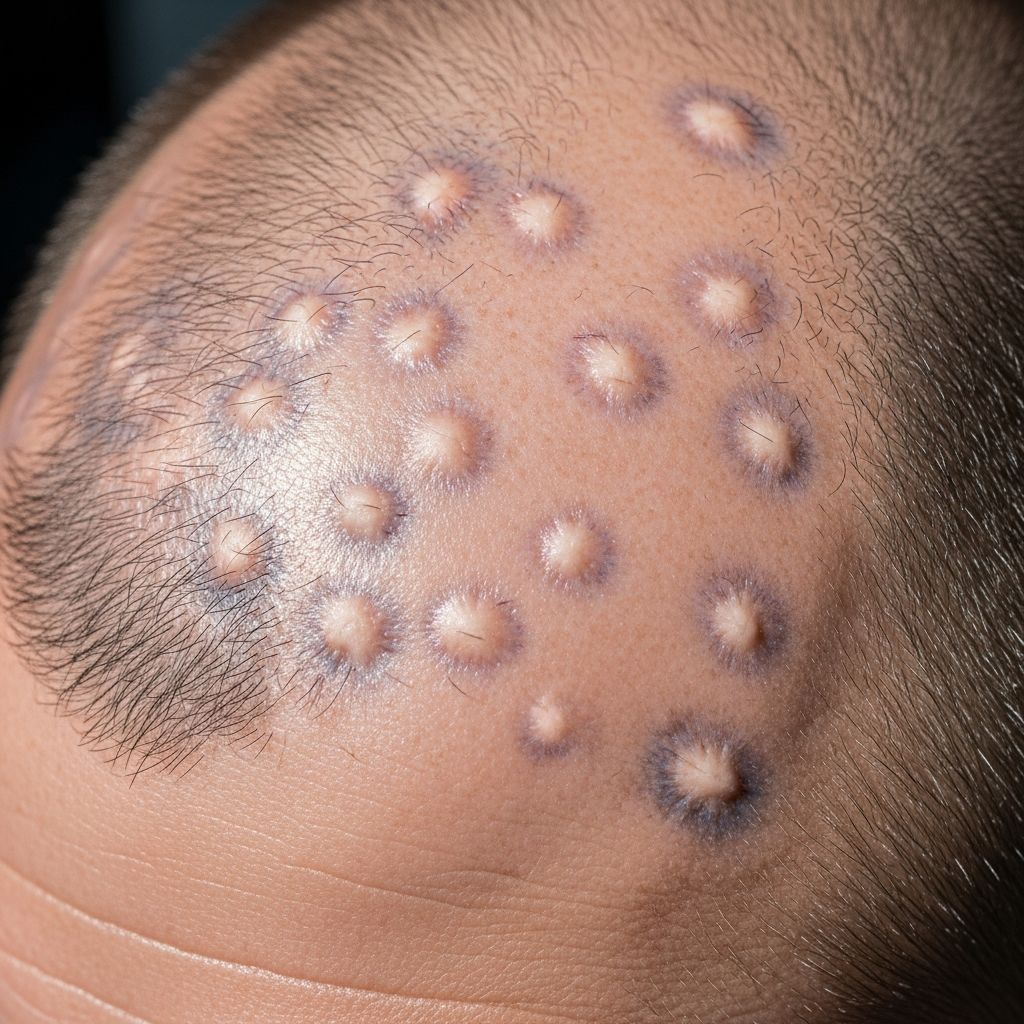
Pseudopelade of Brocq represents a distinctive and uncommon variant of permanent alopecia characterized by scarring hair loss on the scalp, where the underlying etiology remains unidentified despite extensive investigation. This condition manifests as discrete patches of hairless skin that exhibit a smooth, atrophic quality, often evoking the visual metaphor of ‘footprints in the snow’ due to their pale, depressed borders and central smoothness. Unlike more inflammatory alopecias, pseudopelade of Brocq proceeds with minimal overt signs of inflammation, complicating both diagnosis and management.
The term ‘pseudopelade’ originates from French, translating to ‘false baldness,’ reflecting its initial resemblance to non-scarring conditions like alopecia areata. However, histopathological scrutiny reveals irreversible follicular destruction and fibrosis, confirming its cicatricial nature. Contemporary research underscores its separation from other scarring alopecias, with unique gene expression profiles and cellular infiltrates distinguishing it from entities such as lichen planopilaris (LPP) or discoid lupus erythematosus (DLE).
Clinically, it is diagnosed by exclusion after ruling out secondary causes of scarring alopecia. The hair loss stems not primarily from aggressive scarring but from progressive atrophy of hair follicles, leading to permanent denudation without significant dermal replacement fibrosis in early stages. This subtle progression often results in delayed presentation, with patients discovering lesions incidentally during routine scalp examination.
Who gets pseudopelade of Brocq?
Pseudopelade of Brocq predominantly impacts women in middle age and beyond, with a notable female-to-male ratio approaching 3:1. It most frequently emerges between the ages of 30 and 50, though pediatric cases and occurrences in older adults or males are documented. Caucasian individuals appear disproportionately affected, though underreporting in diverse populations may influence this observation.
Familial aggregation is exceptional, with rare reports of multiple affected relatives suggesting a potential genetic susceptibility in isolated instances. No definitive environmental triggers or associations with systemic diseases have been established, reinforcing its idiopathic classification. Risk factors remain elusive, but its insidious onset implies that early subclinical processes may precede visible hair loss by years.
Causes
The pathogenesis of pseudopelade of Brocq eludes precise definition, positioning it as a diagnosis of exclusion within the spectrum of primary cicatricial alopecias. Absent a clear inflammatory cascade, current hypotheses posit a primary follicular atrophy mechanism, where sebaceous glands and hair bulbs undergo premature involution without robust lymphocytic assault. Recent genomic analyses reveal distinct inflammatory cell profiles and upregulated genes compared to LPP or DLE, supporting its status as a unique entity rather than a ‘burnt-out’ phase of another alopecia.
Two conceptual frameworks dominate: (1) primary idiopathic pseudopelade, an autonomous process; and (2) end-stage manifestations of prior inflammatory alopecias where active inflammation has subsided, leaving fibrotic remnants. Biopsies from active margins occasionally disclose sparse perifollicular lymphocytes, hinting at a smoldering lymphocytic microinflammation. Autoimmune mediation is speculated but unproven, with no consistent serological markers identified. Viral or genetic etiologies lack substantiation, perpetuating the etiological enigma.
Clinical features
The inaugural presentation typically involves an asymptomatic patch of alopecia at the vertex or parietal scalp, the crown and sides respectively. Lesions commence as ‘moth-eaten’ irregularities, evolving into confluent, porcelain-white plaques with well-demarcated, slightly elevated borders and central atrophy. Single vellus hairs may persist within patches, a feature evoking alopecia areata but distinguished by scarring on closer inspection.
Related Stories



Characteristic descriptors include:
- Footprint-in-the-snow appearance: Smooth, hypopigmented centers with pale, depressed surfaces and subtle perifollicular erythema at edges.
- Irregular shaping: Non-round, haphazard contours contrasting alopecia areata’s ovoid patches.
- Minimal symptoms: Rare pruritus or tenderness; progression is indolent over years.
- Distribution: Predominantly vertex/parietal; occasional facial extension to beard or brows.
Advanced disease coalesces into larger ivory plaques with induration and loss of follicular orifices. Progression varies: some stabilize post-initial patch, while others inexorably expand, culminating in extensive scalp denudation. Trichoscopy reveals absent follicular openings, perifollicular scaling (subtle), and ‘white dots’ signifying fibrosis.
Diagnosis
Diagnosis hinges on clinical morphology, dermoscopy, and confirmatory scalp biopsy, as pseudopelade of Brocq masquerades as other alopecias. Exclusion of LPP, frontal fibrosing alopecia (FFA), DLE, and central centrifugal cicatricial alopecia (CCCA) is paramount. Early biopsies from lesion peripheries may capture transitional features.
Histopathology: Thin epidermis, sclerotic superficial dermis, fibrosis streamers to subcutis, absent inflammation or minimal upper-follicular lymphocytes. Sebaceous gland loss precedes follicular obliteration. No interface dermatitis or mucin distinguishes from lupus.
Dermoscopy: Featureless smooth areas, absent follicles, white structureless zones.
| Feature | Pseudopelade of Brocq | Alopecia Areata | Lichen Planopilaris |
|---|---|---|---|
| Scarring | Yes (subtle) | No | Yes |
| Inflammation | Minimal | Peribulbar lymphocytes | Perifollicular lichenoid |
| Patch shape | Irregular, atrophic | Ovoid | Perifollicular scaling |
| Progression | Slow, permanent | Reversible | Active then burnt-out |
Treatment
No standardized therapy exists owing to etiological obscurity and variable progression. Management aims to arrest extension and camouflage defects, with mixed efficacy. Observation suffices for stable, small patches.
- Topical/intralesional corticosteroids: Clobetasol or triamcinolone injections to active margins; modest stabilization reported.
- Antimalarials: Hydroxychloroquine (200-400mg daily) for suspected autoimmune overlap; anecdotal benefits.
- Systemic immunosuppressants: Hydroxychloroquine, doxycycline, or low-dose cyclosporine for progressive cases.
- 5-alpha reductase inhibitors: Dutasteride (0.5mg daily) to mitigate follicular miniaturization.
- Camouflage: Wigs, micropigmentation, hair fibers for cosmesis.
Response is unpredictable; early intervention may preserve islands of hair. Multidisciplinary oversight by dermatologists/trichologists optimizes outcomes. Patient education on permanence and monitoring is crucial.
Frequently Asked Questions (FAQs)
Q: Is pseudopelade of Brocq reversible?
A: No, it causes permanent scarring alopecia; treatments aim to halt progression rather than restore hair.
Q: How is pseudopelade of Brocq diagnosed?
A: Through clinical exam, dermoscopy, and scalp biopsy excluding other cicatricial alopecias.
Q: Does pseudopelade of Brocq affect only women?
A: Primarily middle-aged women, but men and children can be affected.
Q: Can pseudopelade of Brocq be cured?
A: No cure exists; management focuses on stabilization and cosmetic solutions.
Q: Is a biopsy always necessary?
A: Yes, to confirm scarring and rule out mimics like LPP or DLE.
References
- Classic Pseudopelade — Scarring Alopecia Foundation. Accessed 2026. https://scarringalopecia.org/classic-pseudopelade
- Pseudopelade of Brocq — Wikipedia. Accessed 2026. https://en.wikipedia.org/wiki/Pseudopelade_of_Brocq
- Pseudopelade of Brocq: A Caricature of Alopecia Areata — IOMCWorld. 2021. https://www.iomcworld.org/open-access/pseudopelade-of-brocq-a-caricature-of-alopecia-areata-88415.html
- Pseudopelade of Brocq — DermNet NZ. 2011 (updated). https://dermnetnz.org/topics/pseudopelade-of-brocq
- Pseudopelade — VisualDx. Accessed 2026. https://www.visualdx.com/visualdx/diagnosis/?diagnosisId=52223&moduleId=46
Similar Articles








Read full bio of medha deb