Psoas Muscle: Anatomy, Function, and Health
Discover the anatomy, function, and importance of the psoas muscle for movement and posture.
What Is the Psoas Muscle?
The psoas muscle is a deep, powerful muscle located in the lower abdomen and pelvis. It is one of the most important muscles for movement and posture, connecting the spine to the legs. The psoas muscle is often referred to as the “fight or flight” muscle due to its role in stress responses and survival mechanisms.
Anatomy of the Psoas Muscle
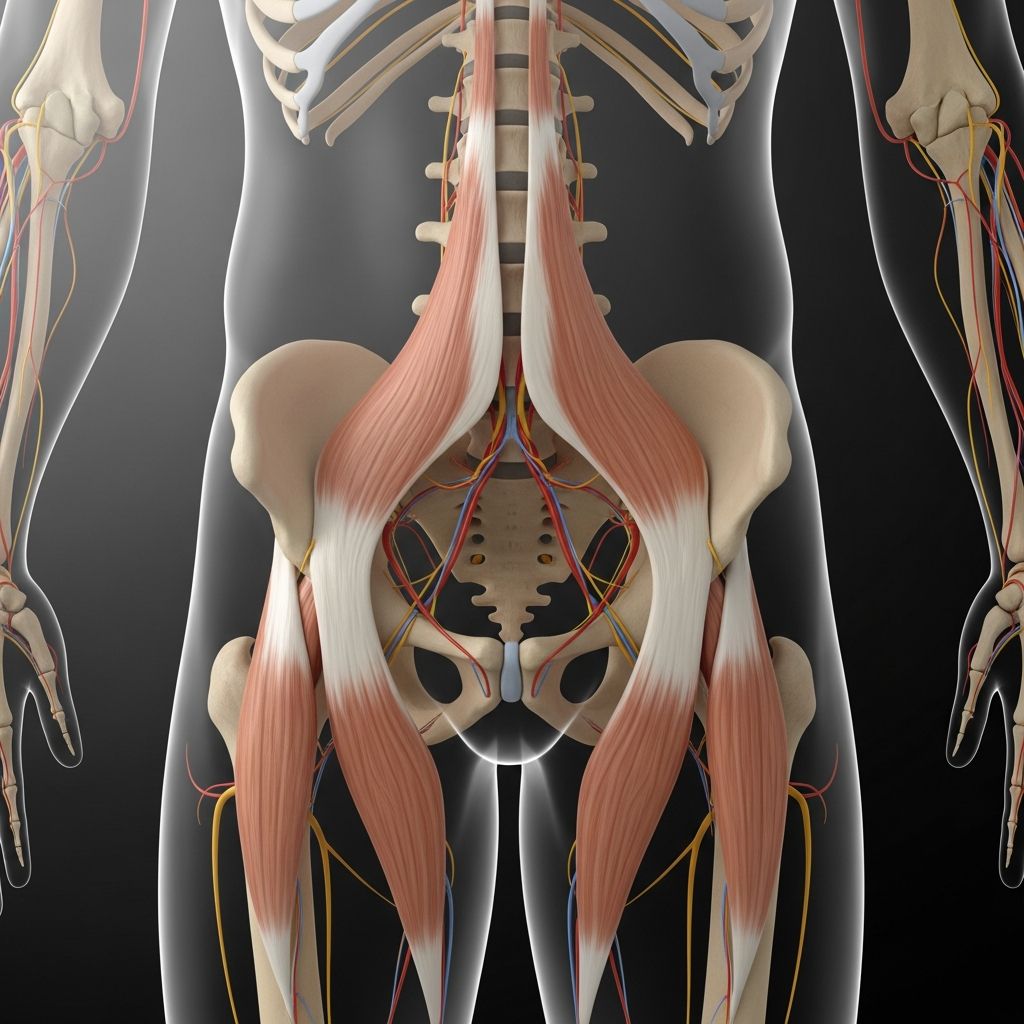
The psoas muscle is a long, thick, fusiform muscle located in the lumbar region of the trunk, lateral to the lumbar vertebrae and medial to the quadratus lumborum muscle. It belongs to the inner muscles of the hip group. The name ‘psoas’ is of Greek origin, meaning ‘muscle of the loin.’
Origin and Insertion
The psoas major muscle has an extensive origin from:
- Vertebral bodies of T12-L4
- Intervertebral discs between T12-L4
- Transverse processes of L1-L5 vertebrae
The fibers of the psoas major extend inferolaterally through the lesser pelvis towards the thigh. They pass along the pelvic brim and inferior to the inguinal ligament towards their merged insertion in the anterior thigh. Along its course, the lateral-most fibers of the psoas major fuse with the fibers of the iliacus muscle to form the iliopsoas muscle. The iliopsoas passes deep to the inguinal ligament and anterior to the joint capsule of the hip to insert onto the lesser trochanter of the femur.
Relations
Superiorly, the psoas major lies posterior to the diaphragm. The quadratus lumborum is located lateral to the muscle. In the abdomen, the psoas major is closely related to a number of retroperitoneal structures. The inferior vena cava is located medial to the right psoas major muscle. On the left, the abdominal aorta lies medial to the psoas major. The sympathetic trunk and aortic lymph nodes are also located medially. Other retroperitoneal structures related to the muscle are the kidneys and ureters, the gonadal vessels, and the genitofemoral nerve.
Blood Supply
The psoas major muscle is supplied mainly by the iliolumbar branch of the internal iliac artery. The lumbar branches of the aorta, the obturator branch of the internal iliac artery, as well as branches of the external iliac and femoral arteries also contribute to the blood supply. Venous drainage of the psoas major muscle mirrors the arterial supply. It drains back into the femoral, external iliac, and internal iliac veins as well as directly into the inferior vena cava.
Function of the Psoas Muscle
The actions of the psoas major are flexion and lateral rotation of the thigh at the hip. It also flexes the trunk at the hip and flexes the trunk laterally. The psoas major is also a postural muscle. During standing, it stabilizes the vertebral column by maintaining normal lumbar lordosis and indirect thoracic kyphosis.
Role in Movement
The psoas muscle is a primary hip flexor, helping to lift the leg and support movements like walking, running, and climbing. It also stabilizes the spine and acts as a bridge between lower body strength and upper body control. Its connection to the diaphragm through connective tissue means it can play a role in how you breathe, especially under stress.
Related Stories



Role in Posture
The psoas muscle helps maintain proper posture by stabilizing the spine and pelvis. It is crucial for maintaining balance and preventing lower back pain. Chronic tension in the psoas can lead to a forward-leaning posture and increased risk of back pain.
Role in Stress Responses
The psoas muscle is often called the “fight or flight” muscle because of its strong link to the autonomic nervous system, which manages our stress responses. When we encounter a stressful situation, muscle tension increases throughout the body, creating a kind of body armor to protect vital organs. The psoas muscle plays a central role by pulling the legs towards the abdomen and curling the spine forward, creating a compact protective posture. This response not only protects the body physically but also conserves energy and reduces detection by potential threats. However, if the freeze response persists, especially in people with a history of trauma, the psoas can remain tight as if still guarding against the threat. This chronic tension can lead to a forward-leaning posture and increased risk of back pain.
Clinical Implications
Disability due to iliopsoas (IP) pain and dysfunction is underdiagnosed in the athletic population. The IP unit consists of the psoas major and iliacus muscles converging to form the IP tendon and is responsible primarily for hip flexion strength but has a number of secondary contributions such as femoral movement, trunk rotation, core stabilization, and dynamic anterior stability to the hip joint.
Psoas Syndrome
Psoas syndrome is a rare form of muscle irritation that causes pain in the lower back, groin, or buttocks. Treatment is typically physical therapy, including stretches and exercises to lengthen and strengthen the psoas muscle. Tightness and pain in the psoas typically stem from muscles that are weak or that need to be stretched out, or a combination of both. If we spend long times in one position, like sitting at your desk, your psoas muscles get stiff because they’ve been shortened for long periods. When you don’t use it, you lose it. So weakness sets in.
Common Conditions
- Lower back pain
- Groin pain
- Buttock pain
- Difficulty with hip flexion
- Forward-leaning posture
Exercises and Stretches
Counteracting psoas muscle stiffness and soreness with stretches that lengthen and strengthen the muscle is essential. Here are some effective stretches and exercises:
Psoas Stretch
- Standing lunge stretch
- Kneeling hip flexor stretch
- Seated forward bend
Strengthening Exercises
- Lying leg raises
- Standing leg lifts
- Plank variations
Frequently Asked Questions (FAQs)
Q: What is the psoas muscle?
A: The psoas muscle is a deep, powerful muscle located in the lower abdomen and pelvis, connecting the spine to the legs. It is crucial for movement and posture.
Q: What are the functions of the psoas muscle?
A: The psoas muscle is a primary hip flexor, helps stabilize the spine, and plays a role in stress responses and breathing.
Q: What are common conditions related to the psoas muscle?
A: Common conditions include lower back pain, groin pain, buttock pain, difficulty with hip flexion, and forward-leaning posture.
Q: How can I stretch and strengthen the psoas muscle?
A: Effective stretches include standing lunge stretch, kneeling hip flexor stretch, and seated forward bend. Strengthening exercises include lying leg raises, standing leg lifts, and plank variations.
Q: What is psoas syndrome?
A: Psoas syndrome is a rare form of muscle irritation that causes pain in the lower back, groin, or buttocks. Treatment is typically physical therapy, including stretches and exercises to lengthen and strengthen the psoas muscle.
References
- Psoas major: Origins, insertions, actions, innervation — Kenhub. 2023. https://www.kenhub.com/en/library/anatomy/psoas-major-muscle
- Fight, Flight, or Freeze: The Psoas Muscle’s Role in Stress — Anatomy Lab. 2025. https://www.youtube.com/watch?v=W7gutbhW-pY
- The Iliopsoas: Anatomy, Clinical Evaluation, and Its Role in Hip Pain — PubMed. 2023. https://pubmed.ncbi.nlm.nih.gov/38502896/
- 5 Psoas Stretches and Exercises — Cleveland Clinic. 2023. https://health.clevelandclinic.org/psoas-stretch-guide-for-psoas-release
- Psoas Syndrome: Symptoms, Causes & Treatment — Cleveland Clinic. 2023. https://my.clevelandclinic.org/health/diseases/15721-psoas-syndrome
Similar Articles








Read full bio of Sneha Tete