PASI Score: Complete Guide To Calculating Psoriasis Severity
Master the PASI score: Essential guide to assessing psoriasis severity, calculating scores, and tracking treatment progress effectively.
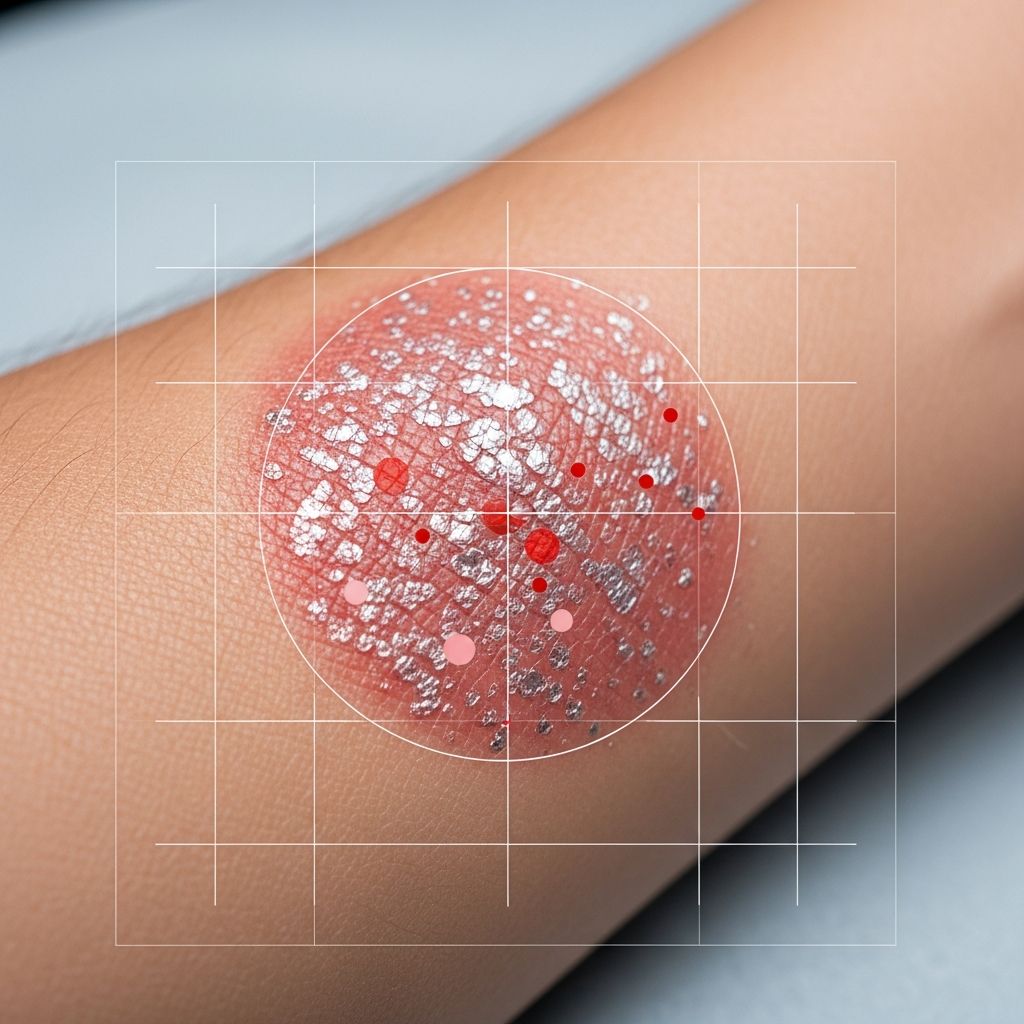
The
Psoriasis Area and Severity Index (PASI)
is a standardized tool widely used in dermatology to quantify the severity and extent of psoriasis lesions. Developed in 1989, it provides an objective measure combining lesion characteristics—erythema (redness), induration (thickness), and scaling—with the percentage of body surface area affected. PASI scores range from 0 (no disease) to 72 (maximum severity), aiding clinicians in treatment decisions and researchers in evaluating therapeutic efficacy.What is the PASI Score?
The PASI score assesses psoriasis by dividing the body into four regions and scoring both the
intensity
of clinical signs and thearea
involved in each. It is the gold standard for psoriasis trials due to its comprehensive nature, despite some subjectivity in area estimation.- Key components: Erythema, induration, scaling (each scored 0-4), and area affected (0-6).
- Body regions: Head and neck (10%), upper limbs (20%), trunk (30%), lower limbs (40%).
- Applications: Baseline severity assessment, treatment monitoring (e.g., PASI 75 response: 75% improvement), clinical trials.
Body Regions in PASI
The body is segmented into four areas weighted by their surface area relative to total body surface area (BSA):
| Region | Abbreviation | Area Weight |
|---|---|---|
| Head and neck | h | 0.1 (10%) |
| Upper extremities (arms, hands) | u | 0.2 (20%) |
| Trunk (chest, abdomen, back) | t | 0.3 (30%) |
| Lower extremities (legs, feet) | l | 0.4 (40%) |
These weights reflect the palm method approximation, where one hand (palm + fingers) equals ~1% BSA.
Assessing Lesion Severity (Intensity Scores)
For each region, select a
representative lesion
and score three parameters on a 0-4 scale:- Erythema (E): Redness.
- 0 = None
- 1 = Mild (pink)
- 2 = Moderate (red)
- 3 = Severe (very red)
- 4 = Very severe (fiery red)
- Induration/Thickness (I): Plaque elevation.
- 0 = None
- 1 = Mild
- 2 = Moderate
- 3 = Severe
- 4 = Very severe
- Scaling (S): Flaking.
- 0 = None
- 1 = Mild (fine)
- 2 = Moderate (dusty)
- 3 = Severe (thick)
- 4 = Very severe (hard)
Average intensity per region: (E + I + S)/3, but in formula, summed directly.
Assessing Area of Involvement
Estimate psoriasis coverage in each region, scored 0-6:
| Score | Percentage Affected |
|---|---|
| 0 | 0% (none) |
| 1 | 1-9% |
| 2 | 10-29% |
| 3 | 30-49% |
| 4 | 50-69% |
| 5 | 70-89% |
| 6 | 90-100% |
Area estimation uses the hand rule: patient’s palm ≈1% BSA. Include all lesions per region.
PASI Calculation Formula
The composite score is:
PASI = 0.1(Eh + Ih + Sh)Ah + 0.2(Eu + Iu + Su)Au + 0.3(Et + It + St)At + 0.4(El + Il + Sl)Al
Where subscripts denote regions (h=head, u=upper, t=trunk, l=lower). Maximum: 4×3×6×1=72 per region adjusted by weights.
Example Calculation
Patient data:
– Head: E=2, I=1, S=2 (sum=5), A=1
– Upper: E=3, I=3, S=3 (sum=9), A=3
– Trunk: E=1, I=1, S=1 (sum=3), A=2
– Lower: E=4, I=4, S=4 (sum=12), A=4
PASI = 0.1(5)(1) + 0.2(9)(3) + 0.3(3)(2) + 0.4(12)(4) = 0.5 + 5.4 + 1.8 + 19.2 = 27 (severe).
PASI Severity Categories
| PASI Score | Severity |
|---|---|
| 0-5 | Mild/None |
| 6-10 | Moderate |
| >10-11 | Severe |
| >20 | Very severe (often) |
Scores guide therapy: mild may use topicals; severe, systemic biologics.
Applications of PASI in Clinical Practice
PASI monitors response: PASI 50 (50% reduction), PASI 75 (75%—standard endpoint), PASI 90/100 for clearance.
- Trials: Primary outcome measure.
- Treatment selection: High PASI prompts escalation.
- Patient education: PO-PASI self-assessment tools exist.
Related Stories



Advantages and Limitations of PASI
Advantages
- Comprehensive: Integrates area + severity.
- Validated: Correlates with quality of life, BSA.
- Responsive: Detects changes post-therapy.
Limitations
- Subjective: Area estimation inter-observer variability.
- Complex: Time-consuming for routine use.
- Insensitive: Misses mild cases, non-plaque psoriasis.
- Palmoplantar overweighted due to leg dominance.
Alternatives: BSA, DLQI (quality of life), PGA.
PASI in Research and Trials
Regulatory bodies like FDA/EMA endorse PASI 75 for approval. Recent biologics achieve PASI 90+ in >50% patients.
Practical Tips for PASI Assessment
- Use natural light, patient standing.
- Average multiple lesions per region.
- Document with photos for consistency.
- Train observers for reproducibility.
Frequently Asked Questions (FAQs)
What is a good PASI score?
A PASI of 0 indicates clearance; PASI 75 (75% improvement from baseline) is a standard treatment success benchmark.
How accurate is PASI?
Reasonably reliable but subjective in area scoring; inter-rater variability ~20%.
Can patients calculate PASI?
Yes, via PO-PASI apps/tools, though clinician assessment preferred.
Does PASI consider itch or pain?
No, focuses on visible signs; pair with DLQI for symptoms.
How often to reassess PASI?
Baseline, 4-12 weeks post-treatment initiation.
Conclusion
PASI remains pivotal for psoriasis management, balancing detail with practicality. Ongoing refinements enhance its utility.
References
- PASI score: Definition and how to calculate — Medical News Today. 2023-05-15. https://www.medicalnewstoday.com/articles/pasi-score
- Psoriasis Area and Severity Index (PASI) — Physiopedia. 2024-01-10. https://www.physio-pedia.com/Psoriasis_Area_and_Severity_Index_(PASI)
- Understanding Your PASI Score For Psoriasis — Healthline. 2023-08-20. https://www.healthline.com/health/pasi-psoriasis
- PASI (psoriasis area and severity index) — DermNet NZ. 2024-02-05. https://dermnetnz.org/topics/pasi-score
- Plaque Psoriasis (PASI, PGA) — MedOne Rx (PDF). 2022-11-12. https://medone-rx.com/uploads/pr-resources/Plaque_Psoriasis_(PASI,_PGA).pdf
- The Benefits and Limitations of the PASI Score — AJMC. 2023-06-18. https://www.ajmc.com/view/pasi-score-benefits-and-limitations
- Estimation of Psoriasis Area and Severity Index score — NCBI Bookshelf. 2023-09-01. https://www.ncbi.nlm.nih.gov/books/NBK109508/
Similar Articles








Read full bio of medha deb