Psoriatic Arthritis vs. Rheumatoid Arthritis
Understand the key differences between psoriatic arthritis and rheumatoid arthritis to ensure accurate diagnosis and effective treatment.
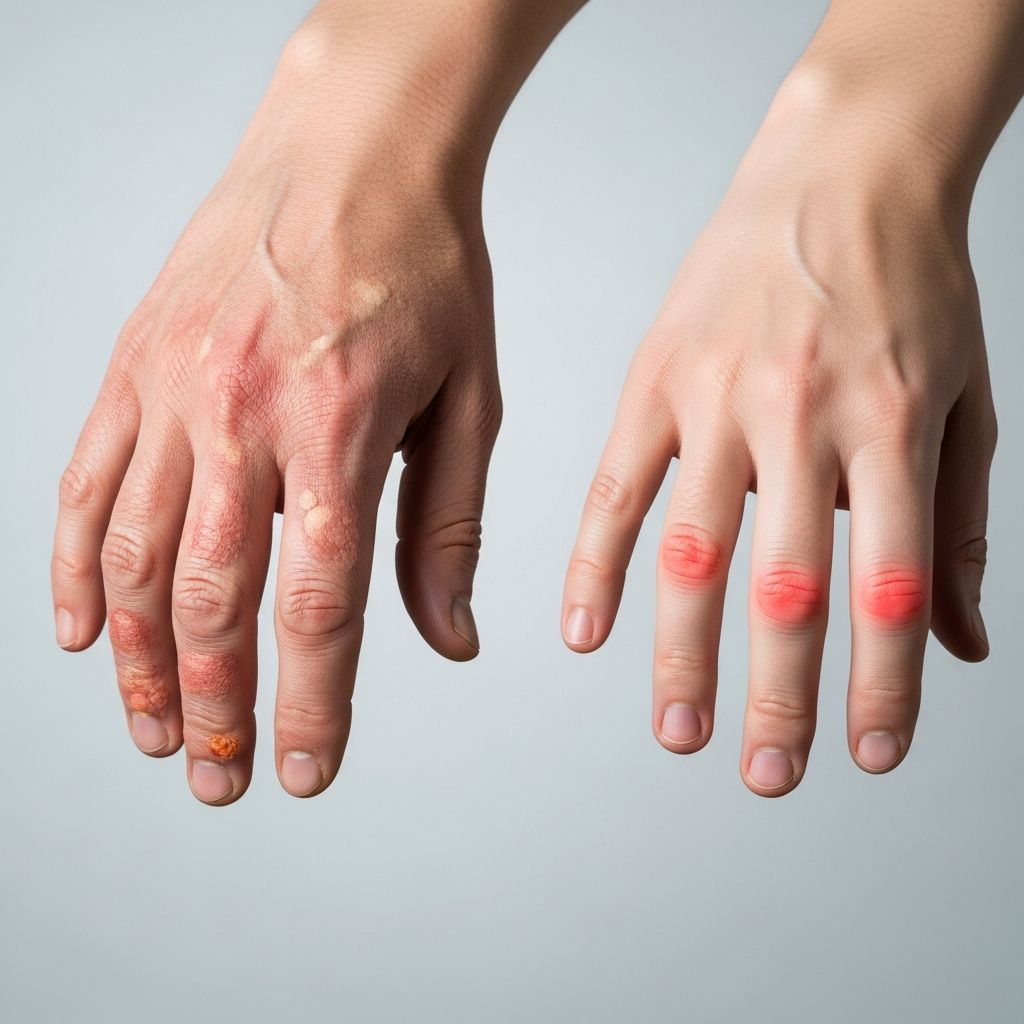
Psoriatic arthritis (PsA) and rheumatoid arthritis (RA) are both chronic inflammatory joint diseases, but they differ in causes, symptoms, joint involvement, and treatment approaches. PsA often links to psoriasis, featuring skin plaques and nail changes, while RA is characterized by symmetric small joint polyarthritis and high autoantibody positivity.
What Is Psoriatic Arthritis?
Psoriatic arthritis is a seronegative spondyloarthropathy affecting 20-30% of people with psoriasis, involving peripheral joints, axial skeleton, entheses, skin, nails, and eyes. It presents with heterogeneous patterns: oligoarthritis (most common), polyarthritis, distal interphalangeal (DIP) predominant, spondylitis, or arthritis mutilans. Enthesitis (inflammation at tendon insertions) occurs in 35-50% of cases, dactylitis (sausage digits) in 30-50%, and uveitis in 7-25%.
PsA pathogenesis involves genetic factors (HLA-B27), environmental triggers, and IL-23/IL-17 axis dysregulation, leading to entheseal inflammation and new bone formation like periostitis. Unlike RA, PsA shows lower acute-phase reactants but correlates with swollen joints and ultrasound abnormalities.
What Is Rheumatoid Arthritis?
Rheumatoid arthritis is a systemic autoimmune disease driven by autoantibodies (RF, anti-CCP) targeting synovial joints, causing erosive synovitis, cartilage loss, and bone damage. It affects 0.5-1% globally, predominantly women, with symmetric polyarthritis of metacarpophalangeal (MCP), proximal interphalangeal (PIP), wrists, and larger joints.
RA features morning stiffness >1 hour, fatigue, and extra-articular manifestations like rheumatoid nodules (20-30%), interstitial lung disease, and vasculitis. Pathogenesis centers on citrullinated protein autoantibodies activating osteoclasts via TNF-α and IL-6. ESR/CRP are markedly elevated, predicting progression.
Similarities Between Psoriatic Arthritis and Rheumatoid Arthritis
Both are autoimmune, causing synovial inflammation, pain, swelling, and functional impairment. They increase cardiovascular risk (10-12% prevalence), metabolic syndrome, and require DMARDs for treat-to-target strategies. Polyarticular forms mimic each other, with morning stiffness and elevated inflammatory markers. Prognosis worsens with joint count; both benefit from early intervention to prevent erosions.
Differences Between Psoriatic Arthritis and Rheumatoid Arthritis
Key distinctions aid differential diagnosis:
- Skin/Nails: PsA has psoriasis (85% precede arthritis), nail dystrophy (pitting, onycholysis); RA lacks these.
- Joints: PsA asymmetric/oligoarticular, DIP/axial involvement, no cervical spine beyond RA’s.
- Extra-articular: PsA enthesitis, dactylitis, uveitis; RA nodules, lung disease.
- Serology: PsA seronegative (RF/CCP negative); RA positive in 70-80%.
- Imaging: PsA pencil-in-cup, new bone growth; RA marginal erosions without periostitis.
| Feature | Psoriatic Arthritis (PsA) | Rheumatoid Arthritis (RA) |
|---|---|---|
| Symmetry | Asymmetric (often) | Symmetric |
| DIP Joints | Frequent + nail disease | Rare |
| Axial Involvement | Sacroiliitis/spondylitis (up to 50%) | Cervical only |
| RF/CCP | Negative | Positive (70-80%) |
| ESR/CRP | Mildly elevated | Markedly elevated |
| Bone Changes | Erosions + new bone | Erosions only |
Symptoms of Psoriatic Arthritis vs. Rheumatoid Arthritis
PsA symptoms: asymmetric pain/swelling (hands/feet), sausage digits, back pain, heel enthesitis, scaly plaques, nail pitting. Stiffness worsens with inactivity. RA: symmetric small joint swelling, prolonged morning stiffness, fatigue, low-grade fever. PsA may flare with psoriasis; RA has constant progression without treatment.
Related Stories



Causes and Risk Factors
PsA: psoriasis (family history), HLA-B27, trauma, infections; 50% heritability. RA: HLA-DR4, smoking, female sex, parity; anti-CCP predicts erosions. Both share obesity/CVD risks.
Diagnosis
No single test; CASPAR criteria for PsA (psoriasis/nails + inflammatory arthritis). RA uses 2010 ACR/EULAR (joint count, serology, duration). Labs: PsA normal/low RF/CCP, mild ESR/CRP; RA high titers. Imaging differentiates: US/MRI shows PsA enthesitis/tenosynovitis vs RA synovitis.
Treatment
- Both: NSAIDs, csDMARDs (MTX), bDMARDs (TNF-i), tsDMARDs (JAKi); glucocorticoids short-term.
- PsA-specific: IL-17/IL-23i (secukinumab, guselkumab); Apremilast.
- RA-specific: Triple therapy, rituximab for seropositive.
Treat-to-target: remission/low disease activity.
Prognosis and Complications
Untreated, both cause erosions/deformities; early DMARDs halt progression. PsA: mutilans (5%); RA: functional disability (50% by 10 years). CVD risk equivalent to diabetes.
When to See a Doctor
Seek rheumatology for persistent joint pain (>6 weeks), swelling, skin changes, family psoriasis/RA history. Early diagnosis prevents damage.
Frequently Asked Questions (FAQs)
Can you have psoriatic arthritis without psoriasis?
Yes, 15% present with arthritis first or have family history; CASPAR criteria apply.
Is psoriatic arthritis worse than rheumatoid arthritis?
No direct comparison; both chronic but PsA axial/entheseal adds unique burden.
How do doctors tell PsA from RA?
History (psoriasis), exam (dactylitis), serology (negative in PsA), imaging.
Do PsA and RA treatments overlap?
Yes, MTX/TNF-i effective; PsA favors IL-17i.
Can you have both PsA and RA?
Rare; usually one diagnosis prevails.
References
- Differentiating Psoriatic Arthritis from Osteoarthritis and Rheumatoid Arthritis — Mease P, et al. Rheumatology and Therapy. 2021-10-19. https://pmc.ncbi.nlm.nih.gov/articles/PMC8572231/
- Distinguishing rheumatoid arthritis from psoriatic arthritis — CME Outfitters. 2018-11. https://www.cmeoutfitters.com/wp-content/uploads/2018/11/RAvsPsA.pdf
- Psoriatic Arthritis: Symptoms and Treatments — Cleveland Clinic. 2024. https://my.clevelandclinic.org/health/diseases/13286-psoriatic-arthritis
Similar Articles








Read full bio of medha deb