Pyoderma Faciale: Diagnosis, Causes, And Treatment Guide
Rare severe rosacea variant causing sudden facial nodules, pustules, and scarring in young women.
Pyoderma faciale, also known as
rosacea fulminans
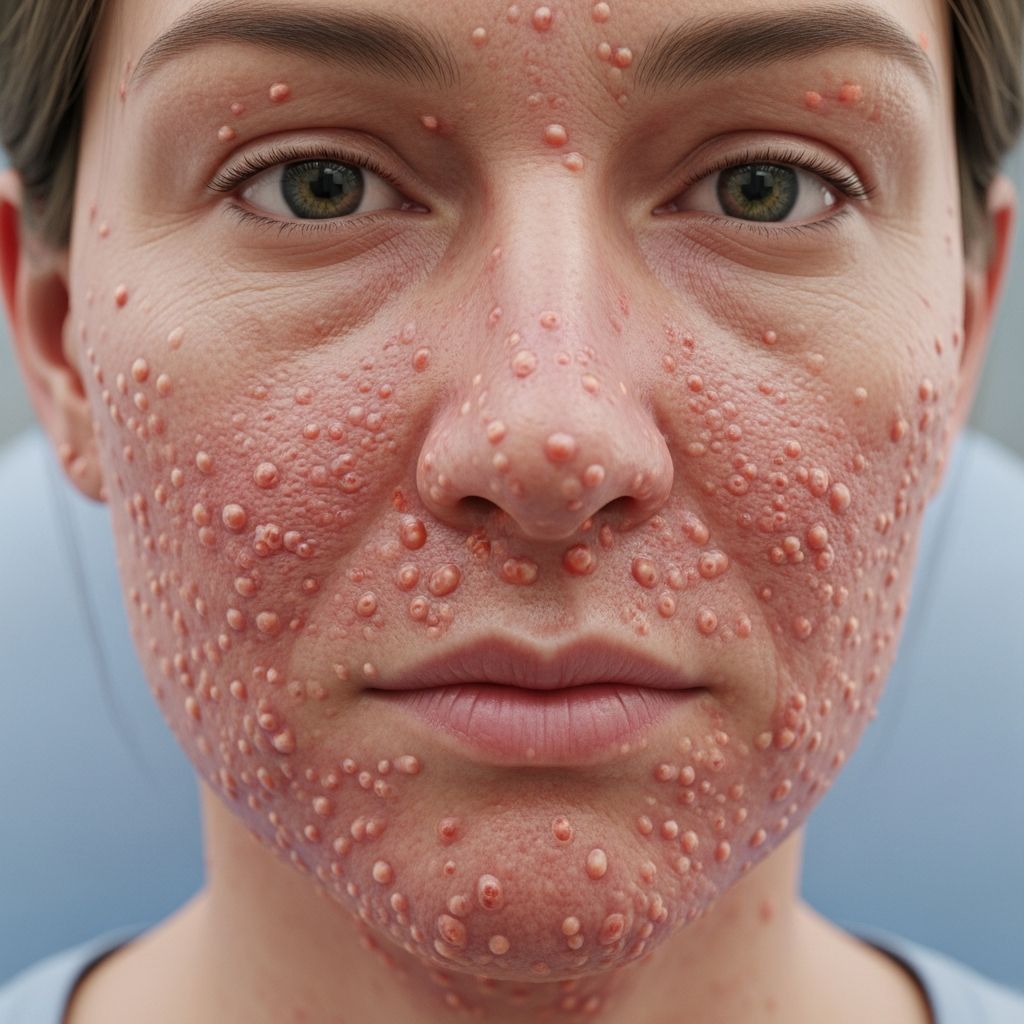
, is a rare and severe inflammatory dermatosis characterized by the sudden onset of coalescing papules, pustules, nodules, and cysts confined to the face. It primarily affects young women and can lead to significant scarring if not treated promptly.What is pyoderma faciale?
Pyoderma faciale is an extreme and acute form of rosacea that manifests abruptly with intense facial inflammation. Previously termed rosacea fulminans, it features a rapid eruption of inflammatory lesions without comedones, distinguishing it from acne vulgaris. The condition is almost exclusively reported in females aged 15–46 years, often those with a prior history of mild rosacea or acne.
The disease involves suppurative folliculitis and perifolliculitis, leading to draining sinuses and firm facial oedema. Lesions are typically asymptomatic but can cause psychological distress due to disfiguring scars. Histology reveals a mixed inflammatory infiltrate around hair follicles and sebaceous glands, with neutrophils and lymphocytes in the papillary dermis.
Who gets pyoderma faciale?
Pyoderma faciale predominantly affects
young women
in their 20s and 30s. It is rare in men and children. Risk factors include:- History of rosacea, seborrhoea, or flushing/blushing.
- Possible associations with oral contraceptives, pregnancy, or inflammatory bowel disease (IBD).
- Recent discontinuation of systemic corticosteroids or stress.
In patients with IBD, such as Crohn’s disease or ulcerative colitis, pyoderma faciale may present as an extraintestinal manifestation. One case reported successful treatment in a patient with ulcerative colitis using isotretinoin despite IBD concerns.
What causes pyoderma faciale?
The exact aetiology remains unclear, but it is considered an acute, severe variant of rosacea. Potential triggers include:
- Hormonal factors: Links to high-dose oestrogen contraceptives or pregnancy.
- Immune dysregulation: Exaggerated inflammatory response involving neutrophils.
- Associations: IBD, anti-TNF therapy side effects (though distinguishable).
- Other: Withdrawal of steroids, stress, or bacterial superinfection (cultures usually show normal flora).
No pathogenic bacteria are consistently isolated, supporting an inflammatory rather than infectious cause.
What are the clinical features of pyoderma faciale?
The condition erupts suddenly over days to weeks, without prodrome. Key features include:
- Sudden onset of
intense reddish or cyanotic erythema
on the face. - Coalescing
papules, pustules, nodules, and cysts
on cheeks, chin, forehead; rarely neck/chest. - Firm oedema**,
draining sinuses
, andfluctuant nodules
. - Absence of comedones; lesions may merge into plaques.
- Pain, burning, stinging**; no fever or systemic symptoms typically.
Scarring is common, leading to pitted atrophic scars and psychological impact. Ocular involvement is rare but possible.
Differential diagnosis
| Condition | Key Distinguishing Features |
|---|---|
| Acne vulgaris | Presence of comedones, slower onset, trunk/back involvement. |
| Pyoderma gangrenosum | Ulcerative lesions, pathergy, systemic disease association. |
| Anti-TNF psoriasis | Pustular, different distribution (not centrofacial). |
| Perioral dermatitis | Periorificial, milder, scale. |
Biopsy if uncertain: shows perifollicular inflammation without granulomas.
How is pyoderma faciale diagnosed?
Diagnosis is clinical based on characteristic explosive facial eruption in young women without comedones. Supportive findings:
- No pathogenic organisms on culture.
- Histology: suppurative folliculitis, mixed infiltrate.
- Rule out acne/IBD-related conditions.
Skin biopsy is rarely needed if history and exam are typical.
Related Stories



How is pyoderma faciale treated?
Treatment requires systemic therapy to prevent scarring; early intervention is critical. Standard approach:
- Prednisone 0.5–1 mg/kg/day orally for 2–4 weeks to control acute inflammation.
- Then
isotretinoin
starting low (10–20 mg/day), titrate to 0.5–1 mg/kg/day; total cumulative dose 120–150 mg/kg. - Adjuncts: Topical corticosteroids/antibiotics initially; tetracyclines (doxycycline 100–200 mg/day).
Alternatives for isotretinoin intolerance: dapsone, prolonged tetracyclines. In IBD patients, isotretinoin succeeded without exacerbating colitis. Taper steroids once isotretinoin controls disease to avoid flare.
Response: Rapid improvement in 4–8 weeks; full resolution in months, though scarring may persist. Relapse rare with complete isotretinoin course.
Complications of pyoderma faciale
Untreated, it causes severe scarring: ice-pick, hypertrophic, or keloidal. Psychological effects include anxiety/depression from disfigurement. Rarely, secondary infection or permanent telangiectasia.
Prevention of pyoderma faciale
No proven prevention, but avoid triggers: discontinue high-oestrogen contraceptives if susceptible. Early rosacea treatment may mitigate risk.
Frequently asked questions about pyoderma faciale
Q: Is pyoderma faciale the same as acne?
A: No. Pyoderma faciale lacks comedones, has rapid fulminant onset, and is face-only, unlike acne.
Q: Can pyoderma faciale occur in men?
A: Extremely rare; almost exclusively in young women.
Q: Is isotretinoin safe for pyoderma faciale with IBD?
A: Yes, at least one case showed success without IBD flare.
Q: How long does treatment take?
A: Acute control in weeks; full course 4–6 months with isotretinoin.
Q: Does it scar permanently?
A: Prompt treatment minimizes scarring, but atrophic scars may need lasers.
Q: What triggers it suddenly?
A: Hormonal changes, stress, steroid withdrawal.
This comprehensive overview draws from peer-reviewed cases and expert guidelines to educate on pyoderma faciale management. Consult a dermatologist for personalized care.
References
- Young Adult with 1-Year History of Erythema, Papules, and Pustules on Her Cheeks and Skin — The Hospitalist. 2023. https://blogs.the-hospitalist.org/content/young-adult-1-year-history-erythema-papules-and-pustules-her-cheeks-and-skin
- Successful Treatment of Localized Pyoderma Faciale in a Patient — PMC (NCBI). 2014-03-27. https://pmc.ncbi.nlm.nih.gov/articles/PMC3981002/
- Rosacea Fulminans (Pyoderma Faciale) — Dermatology Advisor. 2023. https://www.dermatologyadvisor.com/home/decision-support-in-medicine/dermatology/rosacea-fulminans-pyoderma-faciale/
- Rosacea fulminans: unusual clinical presentation of rosacea — PMC (NCBI). 2017-02-23. https://pmc.ncbi.nlm.nih.gov/articles/PMC5325025/
- Rosacea fulminans: Causes, symptoms, and treatments — Medical News Today. 2023. https://www.medicalnewstoday.com/articles/rosacea-fulminans
- Rosacea fulminans — Indian Journal of Dermatology, Venereology and Leprology. 2023. https://ijdvl.com/rosacea-fulminans/
Similar Articles








Read full bio of medha deb