Pyodermatitis-Pyostomatitis Vegetans: Diagnosis And Treatment
Rare mucocutaneous marker of inflammatory bowel disease with pustular oral and skin lesions.
What is pyodermatitis-pyostomatitis vegetans?
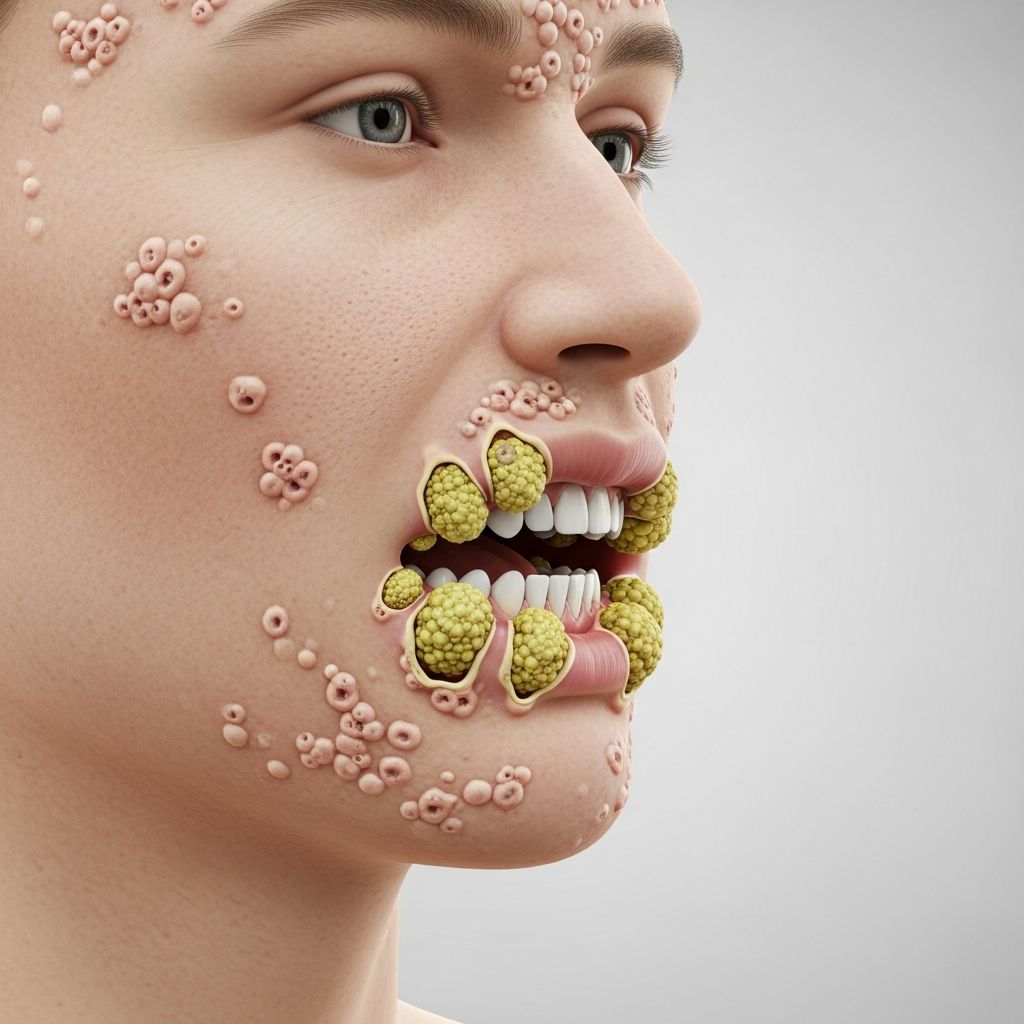
Pyodermatitis-pyostomatitis vegetans (PPV) is a rare, benign inflammatory disorder affecting both the skin and mucous membranes, particularly the mouth. It manifests as recurrent crops of small sterile pustules that evolve into erosions and vegetating plaques. First described by Hallopeau in 1898, PPV serves as a critical cutaneous and oral marker for underlying inflammatory bowel disease (IBD), most commonly ulcerative colitis (UC), though it can also associate with Crohn’s disease. The condition splits into pyodermatitis vegetans (skin involvement) and pyostomatitis vegetans (oral involvement), with full PPV encompassing both.
Prevalence is extremely low, with fewer than 100 cases documented in literature up to 2022. It predominantly affects adults aged 20-60, with a slight male predominance. Eosinophilia in peripheral blood is common, reflecting the neutrophilic and eosinophilic infiltrate seen histologically. While not life-threatening, PPV significantly impacts quality of life due to painful lesions and its association with systemic IBD.
Who gets pyodermatitis-pyostomatitis vegetans?
PPV typically occurs in individuals with undiagnosed or active IBD. Over 70% of cases link to UC, 20-25% to Crohn’s disease, and rarely to other gastrointestinal issues. It arises in patients without prior IBD symptoms, prompting gastroenterological evaluation. Demographic data from systematic reviews show:
- Age: Mean onset around 40-50 years, ranging 18-80.
- Sex: Slight male bias (55-60% of cases).
- Ethnicity: Reported across Caucasians, Asians, and others, no strong predisposition.
- Risk factors: IBD history, peripheral eosinophilia (>5% in 60% of cases), no clear genetic or environmental triggers identified.
In one review of 77 cases, oral lesions appeared before IBD diagnosis in 40%, emphasizing PPV’s diagnostic value even without gastrointestinal symptoms.
What causes pyodermatitis-pyostomatitis vegetans?
The exact etiology remains unknown, but PPV is widely regarded as a neutrophilic dermatosis triggered by immune dysregulation in IBD. Proposed mechanisms include:
- Reactive process to bowel inflammation, with shared cytokines (TNF-α, IL-17).
- Autoimmune phenomena, evidenced by acantholysis and intraepithelial clefts mimicking pemphigus.
- Bacterial superantigens or altered gut microbiota exacerbating pustule formation.
- Association with eosinophilia suggests hypersensitivity.
Histopathology reveals pseudoepitheliomatous hyperplasia, intraepithelial pustules with neutrophils/eosinophils, and microabscesses—key for diagnosis. No infectious agents are cultured from lesions.
What are the clinical features of pyodermatitis-pyostomatitis vegetans?
Lesions are polymorphous, starting as vesicles/pustules that rupture into erosions and vegetate.
Skin lesions (pyodermatitis vegetans)
- Erythematous plaques in intertriginous areas (axillae, groin, inframammary—80% of cases).
- Pustules on yellow base, erode to oozing vegetations; may crust or erode deeply.
- Other sites: scalp, face, eyelids, extremities (less common).
- Symptomatic: pruritus, pain, secondary infection risk.
Oral lesions (pyostomatitis vegetans)
The hallmark is snail track ulcers—linear, yellowish erosions with undermined edges (95% of cases). Sites include:
| Site | Frequency |
|---|---|
| Buccal mucosa, labial mucosa, gingiva | 70-80% |
| Palate, lips vermilion, tongue | 30-50% |
| Floor of mouth | 10-20% |
Symptoms: pain on eating (60%), bleeding; lesions bleed easily.
Related Stories



Diagnosis of pyodermatitis-pyostomatitis vegetans
Diagnosis combines clinical, histological, and IBD association:
- Clinical: Snail tracks orally + vegetating intertriginous plaques.
- Histology: Intraepithelial clefts, eosinophilic spongiosis, pustules (gold standard).
- Labs: Eosinophilia, elevated IBD markers (CRP, calprotectin).
- GI workup: Colonoscopy/biopsy for IBD (mandatory).
Differential: pemphigus vegetans, halogenoderma, blastomycosis—ruled out by histology and IBD link.
Treatment of pyodermatitis-pyostomatitis vegetans
No gold standard; treat underlying IBD primarily. Systemic therapies dominate.
| Treatment | Efficacy | Role |
|---|---|---|
| Oral corticosteroids (e.g., prednisone 40mg/day) | High (90% response) | Induction |
| 5-ASA (mesalamine) | Moderate-high | Maintenance |
| Azathioprine/6-MP | High | Steroid-sparing |
| Biologics (infliximab) | High | Refractory/maintenance |
| Oral calcineurin inhibitors (cyclosporine) | High | Alternative |
| Topicals, dapsone, antibiotics | Low | Adjunct/ineffective alone |
Remission in 7 days with infliximab + steroids reported; relapses common without IBD control.
Complications and prognosis
Complications: secondary bacterial infection, scarring, nutritional issues from oral pain. Prognosis ties to IBD control—excellent with treatment, chronic relapsing otherwise.
Prevention
No primary prevention; early IBD screening in at-risk patients. Maintain IBD remission to prevent flares.
Pyodermatitis-pyostomatitis vegetans in adults vs children
Almost exclusively adults; pediatric cases exceptionally rare (<5%), often with familial IBD.
Related conditions
- Pemphigus vegetans
- Pyoderma gangrenosum
- Erythema nodosum (IBD markers)
Frequently asked questions (FAQs) on pyodermatitis-pyostomatitis vegetans
Q: Is PPV contagious?
A: No, lesions are sterile; non-infectious reactive process.
Q: Can PPV occur without IBD?
A: Rare (<10%); screen GI tract regardless.
Q: How long until treatment works?
A: 1-2 weeks for systemic steroids/biologics.
Q: Is surgery needed?
A: No; medical management suffices.
Q: Does diet help?
A: IBD-friendly diet (low-residue) may aid indirectly.
References
- Pyodermatitis-pyostomatitis vegetans: a case report and systematic review — Head Neck Pathol. 2024. https://pmc.ncbi.nlm.nih.gov/articles/PMC11330387/
- Pyodermatitis-pyostomatitis vegetans: a clinical course of two decades — Acta Derm Venereol. 2001-05-01. https://pubmed.ncbi.nlm.nih.gov/11501652/
- Treatment of Pyodermatitis-Pyostomatitis Vegetans: A Systematic Review — J Drugs Dermatol. 2021. https://skin.dermsquared.com/skin/article/view/1134
- Pyodermatitis-Pyostomatitis Vegetans: A Cutaneous Clue for IBD — J Clin Invest Dermatol. 2019. https://www.avensonline.org/wp-content/uploads/JCID-2373-1044-09-0073.pdf
- Pyodermatitis-Pyostomatitis Vegetans with Eyelid Involvement — Dermatology. 2024. https://karger.com/article/doi/10.1159/000547653
Similar Articles








Read full bio of Sneha Tete